

“You Could Be Left Alone?” — Israel Is Never Alone
On the evening of June 8, 2026, as the exchange of fire between Israel and Iran flared once more into open war, the President of the United States gave an interview to Israel’s Channel 12 and delivered what can only be described as a warning to the Prime Minister of the Jewish state. Be careful what you do, he said; press the fight too far, and “you could be left alone against Iran very soon.” He went on to say that he had reduced the scale of Israel’s strike, and that when Tehran asked him to halt the fighting, “I called Bibi and made him stop.” In the same season he had told the Financial Times, of Mr. Netanyahu and a prospective American arrangement with Iran, that he calls all the shots and the Prime Minister does not. Taken together, the statements form a single posture: that the fate of Israel rests in Washington’s hands, and that the favor on which her safety depends may be extended or withdrawn at the pleasure of her great patron.
We have answered elsewhere the first half of that posture — the claim to “call the shots” over Israel, and the scriptural answer that no man, however powerful, decides the fate of the nation God Himself has chosen. The present essay takes up the second half: the threat of abandonment. For the words “you could be left alone” carry a particular sting, and they are meant to. The threat of isolation is the oldest lever of fear there is, older than missiles and older than empires. And it deserves a particular answer, because the Scripture speaks to it directly, and its answer is the very heart of why Christians stand with Israel: she is never, and can never be, alone.
Let it be said again, as we said of the first remark, that this is not an attack upon the man. President Trump has in many ways been a friend to Israel, and friends may speak bluntly without becoming enemies. But friendship does not confer custody, and a warning framed as the withdrawal of protection must be measured against a higher word than any spoken in Washington or Tehran. The believer who knows his Bible hears in “you could be left alone” an echo of a fear God has been answering for four thousand years — and answering always with the same promise.
What Was Said, and When It Was Said
The setting matters, because it sharpens the meaning of the words. The remarks came in the midst of a renewed and dangerous escalation: Iranian ballistic missiles falling on Israeli cities, Israeli aircraft already in the air toward Iran, and a flurry of diplomacy among Washington, Jerusalem, and several regional capitals seeking to halt the spiral before it became a wider war. According to the reporting, Mr. Netanyahu had informed the American administration of his decision to strike only at a very late stage, when the operation was already under way. The President, displeased at being presented with a decision rather than consulted upon it, framed his response in the language of leverage: comply, moderate, defer — or risk standing without your indispensable ally.
It is worth pausing to grant what is true in the President’s concern. No small nation can be indifferent to the posture of the most powerful country on earth, and an Israel that needlessly squanders American goodwill would be acting foolishly. Prudence in the management of alliances is not faithlessness; Scripture nowhere commends recklessness, and the wise steward counts the cost. But there is a vast and decisive difference between valuing an alliance and resting one’s very survival upon it. The first is wisdom. The second is the precise error the prophets rebuked again and again, when they watched Judah run to Egypt or to Assyria for the security that belonged to God alone. The threat “you could be left alone” is potent only against a people who believe that their aloneness among men would be the same thing as being alone.
The Oldest Threat in the World
Isolation has been the standing condition of Israel for most of her history, not the exception to it. She came into being as a single family in a world of empires. She entered her land as a small people surrounded by larger and hostile nations. In the long centuries of exile she was a scattered and friendless minority, tolerated in good seasons and hunted in bad ones, with no army, no state, and few defenders. The modern era has not changed the fundamental arithmetic so much as dressed it in new clothes: a single small democracy, the only Jewish state on earth, regularly outvoted, lectured, embargoed, and condemned by blocs of nations many times her size. To threaten Israel with being “left alone” is, in a sense, to threaten her with her own normal weather.
And here is the fact that ought to arrest us. Through all of it — the empires, the exiles, the coalitions, the condemnations — she has not ceased to be. Nations vastly greater than she, nations that counted her as nothing and expected to bury her, have themselves passed into the museum of history while Israel remains. Egypt of the Pharaohs, Assyria, Babylon, the classical empires, the persecuting kingdoms of the long dispersion: each in its turn imagined that it held Israel’s fate in its hand, and each in its turn discovered otherwise. The survival of this one small people across the wreck of every power that ever sought to end her is not an accident of politics. It is the visible signature of a promise.
I Will Not Leave Thee, Nor Forsake Thee
That promise is stated, in almost so many words, at the very thresholds where Israel faced her hardest battles. On the plains of Moab, with the Jordan before them and the fortified cities of Canaan beyond, Moses said to the whole assembly: “Be strong and of a good courage, fear not, nor be afraid of them: for the LORD thy God, he it is that doth go with thee; he will not fail thee, nor forsake thee.” And to Joshua, who would lead them into the fight, the LORD Himself said: “I will not fail thee, nor forsake thee.” The promise was not that Israel would have powerful allies, nor that the surrounding nations would look kindly upon her. It was that God would go with her — that whatever else she lacked, she would not lack Him.
This is the answer Scripture returns to the threat of abandonment, and it is worth seeing how exactly it meets the threat. A man says: you could be left alone. God says: I will never leave thee. The two sentences address the identical fear and give opposite verdicts, and only one of the two speakers has ever had the power to keep His word. Presidents and patrons may mean well and still fail; their tenure is short, their attention divided, their interests their own. The covenant-keeping God of Israel has no term limit, no rival claim upon His loyalty, and no possibility of changing His mind. “The eternal God is thy refuge, and underneath are the everlasting arms.” That is the floor beneath Israel that no withdrawal of human favor can remove.
He Shall Neither Slumber Nor Sleep
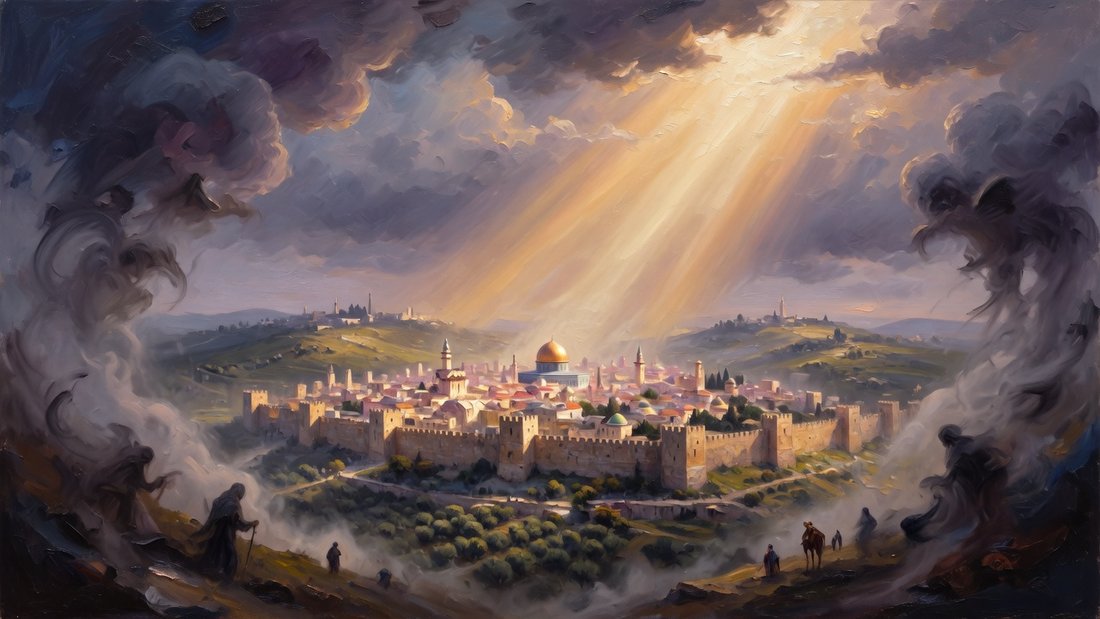
The one hundred and twenty-first Psalm was sung by pilgrims going up to Jerusalem, and it reads like a deliberate rebuke to the fear of being left unguarded. It begins with the lifting of the eyes to the hills and the question of where help comes from, and it answers at once: help comes from the LORD, who made heaven and earth. Then it makes the promise specific and tireless: “He that keepeth Israel shall neither slumber nor sleep. The LORD is thy keeper: the LORD is thy shade upon thy right hand.” The picture is of a watchman who never once nods at his post, never goes off duty, never leaves the wall untended through the long hours of the night when the city is most afraid.
Set that picture beside the warning of June 2026. The fear in “you could be left alone” is precisely the fear of the unguarded night — of the moment when the protector turns away and the enemy finds the gate unwatched. The Psalm declares that for Israel that moment will never come, because her ultimate Keeper does not keep office hours. Human guardians sleep; they tire; they are recalled; they recalculate. The Keeper of Israel does none of these things. The missiles fall in the night, and the night has a Watchman who has not closed His eyes since the world began.
Zechariah carried the same assurance a step further, into an image of active defense. To a Jerusalem that lay open and unwalled, exposed to every raider, the LORD said: “I… will be unto her a wall of fire round about, and will be the glory in the midst of her.” A city without walls is the very picture of a people left exposed and alone — and to that people God promised to be the wall Himself, a barrier of fire that no army crosses and no patron need supply. The same prophet gave the reason such a defense is so jealously kept: “he that toucheth you toucheth the apple of his eye.” The nations weigh Israel as one small interest among many; God regards her as a man regards the pupil of his own eye — the thing he shields by instinct, the thing he will not suffer to be touched. A people so regarded is not a people who can be casually left alone.
Fear Thou Not; For I Am With Thee
When Isaiah spoke to a people terrified of the gathering nations, he did not promise them a coalition of their own. He gave them the presence of God, and he gave it against the exact emotion the modern threat is designed to produce. “Fear thou not; for I am with thee: be not dismayed; for I am thy God: I will strengthen thee; yea, I will help thee; yea, I will uphold thee with the right hand of my righteousness.” And a few verses on, lest the point be missed, the LORD adds of His people: “I the LORD will hear them, I the God of Israel will not forsake them.” The remedy Scripture offers for the fear of standing alone is never a stronger alliance. It is the nearness of the One who cannot be driven from the field.
Notice, too, what Isaiah says will become of the nations that menace her. “They that strive with thee shall perish… they that war against thee shall be as nothing, and as a thing of nought.” The very powers that present themselves as the arbiters of Israel’s survival are, in the prophet’s sight, the transient ones. They rise, they threaten, they make their demands — and they pass. The believer is not asked to despise them or to pretend they wield no earthly power. He is asked to see them in proportion: real for a season, formidable in their hour, and finally weightless against the purpose of God.
An Arm of Flesh, and the Arm of the LORD
The prophets reserved some of their sternest words not for Israel’s enemies but for her habit, in seasons of fear, of running to the great powers for the security that belonged to God alone. “Woe to them that go down to Egypt for help,” cried Isaiah, “and stay on horses, and trust in chariots, because they are many… but they look not unto the Holy One of Israel, neither seek the LORD.” The sin he named was not the making of alliances as such, but the transfer of trust — the quiet movement of the heart that fixes its hope on Pharaoh’s cavalry and forgets the One who once drowned Pharaoh’s cavalry in the sea. Jeremiah stated the principle as a flat antithesis: “Cursed be the man that trusteth in man, and maketh flesh his arm, and whose heart departeth from the LORD… Blessed is the man that trusteth in the LORD, and whose hope the LORD is.”
The contrast was made unforgettable by Hezekiah, when the Assyrian army stood before the walls of Jerusalem and every human calculation counseled surrender. He gathered the people and told them not to be afraid of the king of Assyria nor of all the multitude with him: “for there be more with us than with him: with him is an arm of flesh; but with us is the LORD our God to help us, and to fight our battles.” There is the whole matter in a sentence. The arm of flesh is real; it is simply not decisive. A patron’s protection is an arm of flesh — genuinely useful, but flesh, and therefore subject to weariness, distraction, and withdrawal. The arm of the LORD is of another order entirely. To be warned that one might lose the arm of flesh is no cause for terror in a people whose battles are finally fought by the arm of the LORD. Such a warning could unmake a nation that trusted in chariots. It cannot unmake a nation that trusts in God.
This is why the believer can hear a warning like the one issued in June 2026 without the disquiet it was designed to produce. The President spoke as men have always spoken who hold an arm of flesh and know its worth: comply, or risk losing it. The counsel is not foolish on its own terms, for an arm of flesh is worth keeping, and Israel would be unwise to throw away a friendship lightly. But the people of God were never told to keep that arm at the price of their trust, and they were never promised it would always be there. They were promised something better and surer — that whether the arm of flesh remained or was withdrawn, the arm of the LORD would not be shortened, and the battle, in the end, was His.
When the Allies Withdraw
Let us be candid about the strategic reality, because faith is not a substitute for sense. Alliances are genuine goods, and the friendship of the United States has been a great good to Israel. It would be a foolish counsel that told her to treat that friendship lightly, and nothing in Scripture commends such folly. But every earthly alliance shares the same fatal property: it is contingent. Administrations change; majorities turn; the calculations of national interest shift with the season. The patron who is indispensable today may be distracted tomorrow and absent the day after, not from malice but from the simple mutability of human affairs. To build the foundation of one’s survival upon so shifting a ground is to build upon sand, however solid the sand may feel on a clear morning.
And so the threat “you could be left alone” is, in the end, an accidental confession of the truth. Yes — every human ally can withdraw. That is exactly why the people of God have never been permitted to rest their hope in human allies. If the whole world withdrew its hand from Israel tomorrow; if every embassy closed and every treaty lapsed and every friendly capital fell silent; if she stood, to all human appearance, utterly alone against the gathered nations — she would still not be alone. For her covenant is not with Washington, and it was not Washington that made it. “Lo, I am with you alway,” said the Lord, and the promise to keep Israel is older and surer than any nation now standing.
If God Be for Us
The apostle Paul, reasoning about the security of those whom God has purposed to keep, arrived at the question that ends every argument: “If God be for us, who can be against us?” It is not a denial that anyone is against us; the chapter is full of tribulation and peril and sword. It is the insistence that no force arrayed against the purpose of God can finally prevail over it. The same logic governs the covenant nation. The God who said to Abraham, “I will bless them that bless thee, and curse him that curseth thee,” staked His own name on the welfare of Abraham’s seed, and that name has never been dishonored. Every power that has presumed to dispose of Israel has discovered, sooner or later, that there was a prior claim upon her it had failed to reckon with.
That prior claim is the quiet center of the whole matter. The nations imagine that Israel’s fate is a thing to be negotiated among themselves — granted here, withheld there, traded for advantage at the conference table. Scripture reveals that her fate was settled long before any of the present powers existed, settled by an oath that God swore by Himself because He could swear by no greater. The men who threaten to leave her alone are, without knowing it, threatening to do a thing that is not theirs to do. They did not grant her existence, and they cannot revoke it. They are guests, however grand, in a story whose Author is not among them.
Israel Is Never Alone
Return, then, to the warning of June 8, 2026, and weigh it on the scale the Scripture provides. “You could be left alone against Iran very soon.” As a statement about the shifting favor of nations, it may even be true; alliances are fragile things, and the friendship of the powerful is never to be presumed upon. But as a statement about the actual condition of Israel, it is empty, for it leaves out the only Ally who has never once withdrawn. The sun still rises over Jerusalem. The Watchman on her wall has not slept. The everlasting arms are still underneath her. And the covenant that was sworn to Abraham is not up for renegotiation in any capital on earth.
This is the confidence in which Christians stand with Israel: not in the steadiness of presidents, which wavers, nor in the goodwill of nations, which turns, but in the faithfulness of the God who said He would never leave nor forsake His people, and who has kept that word through every empire that ever rose to test it. Let the powers extend their hand or withdraw it as they will. Israel is not theirs to abandon, because she was never theirs to keep. She has one Keeper, and He does not sleep, and He will not leave, and He will not forsake. Whatever else may be said of her in the councils of men, this much is settled in heaven: Israel is never alone.