
 The Iranian Threat
The Iran-backed Houthis of Yemen — The Paper Tigers of the Arabian Peninsula
On the night of June 8, 2026, as Iranian ballistic missiles rained down on the cities of Israel and the wider war flared once more into the open, a familiar second voice rose from the southern tip of the Arabian Peninsula. From the mountains of northern Yemen, more than a thousand miles from Jerusalem, the Houthi movement announced that it too had launched missiles at the Jewish state, and that it would once again move to disrupt shipping in the Red Sea. The announcement was delivered, as it always is, in the grand and apocalyptic language of “the Axis of Resistance.” And as it almost always is, the practical result was negligible: projectiles intercepted, a siren or two, and a great deal of triumphant broadcasting on a satellite channel. The Houthis had piled on once again.
There is a pattern here worth naming plainly, because it tells us something both about the nature of this particular actor and about the deeper truth that governs every assault upon Israel. The Iran-backed Houthis of Yemen are, in the strategic sense, paper tigers — a small player on a very crowded block, forever seeking relevance by attaching themselves to the conflicts of larger powers, all bluster and proclamation and very little real weight. This is not to say they are harmless; a paper tiger can still start a fire. But it is to say that they are not what they claim to be, and that the Christian who reads his Bible has the clearest possible lens for seeing them as they truly are.
This article is written in that spirit: not to mock a poor and war-ravaged people, for the ordinary men, women, and children of Yemen are themselves among the chief victims of the movement that rules them, but to measure the Houthi phenomenon honestly against two standards — the standard of cold strategic reality, and the higher standard of Scripture. By both measures the conclusion is the same. The little voice on the block does not decide the fate of Israel. It never has, and it never will.
Who Are the Houthis?
The movement known to the world as the Houthis calls itself Ansar Allah — “Supporters of God.” It emerged in the 1990s among the Zaydi Shia community of the northern Yemeni highlands, taking its popular name from the family of its founder. Through the long Yemeni civil war it seized the capital, Sanaa, in 2014, and it has since governed a large portion of the country’s northwest by force. Its official slogan, displayed on its banners and shouted at its rallies, is a compact summary of its worldview: “God is the Greatest, Death to America, Death to Israel, Curse upon the Jews, Victory to Islam.”
That slogan is the key to understanding everything that follows. The Houthi movement did not adopt hostility to Israel as a calculated response to any Israeli action against Yemen, for Israel has done nothing to Yemen. It adopted that hostility as a matter of ideological identity, imported wholesale from its patron in Tehran. The Houthis are, in the most precise sense, a franchise. Their weapons, their training, their missile technology, and their guiding theology of “resistance” flow from the Islamic Republic of Iran. When they fire on Israel, they are not acting as an independent Yemeni interest. They are performing a role written for them in a script composed elsewhere.
This is why any honest account of the Houthis must place them within the larger structure that Iran built across the region over four decades — the network of proxies that Tehran assembled to wage its war against Israel without exposing itself directly. Hezbollah in Lebanon was the crown jewel of that network. Hamas in Gaza was its forward outpost. The Shia militias of Iraq and Syria were its corridor. The Houthis were the distant southern flank, the most peripheral of the proxies, valued precisely because they sat astride one of the world’s great shipping lanes and could threaten global commerce at little cost to Iran.
The Strategy of the Pile-On
Observe the timing of Houthi action, and a revealing rhythm appears. The Houthis do not initiate; they join. They rarely lead a confrontation; they attach themselves to one already underway. When the Gaza war erupted in October 2023, the Houthis announced their entry into the fray. When the broader Iran war opened in 2026, the Houthis announced again. When Iran fired missiles, the Houthis fired missiles. The movement times its dramatic gestures to coincide with the larger storms generated by its patron, because it understands that on its own it commands almost no attention at all.
This is the strategy of the pile-on, and it is the behavior of a small actor seeking to borrow significance from a large one. Yemen is the poorest country in the Arab world, broken by years of civil war, famine, and disease. The Houthis preside over hunger and ruin. They have nothing remotely approaching the industrial, financial, or military weight of a serious state power. What they have is geography — a perch above the Bab el-Mandeb strait — and a willingness to be loud. And so they make themselves useful to Tehran by generating headlines, disrupting a shipping lane, and providing the “Axis of Resistance” with the appearance of a multi-front war, while the actual damage they inflict on Israel remains, in military terms, marginal.
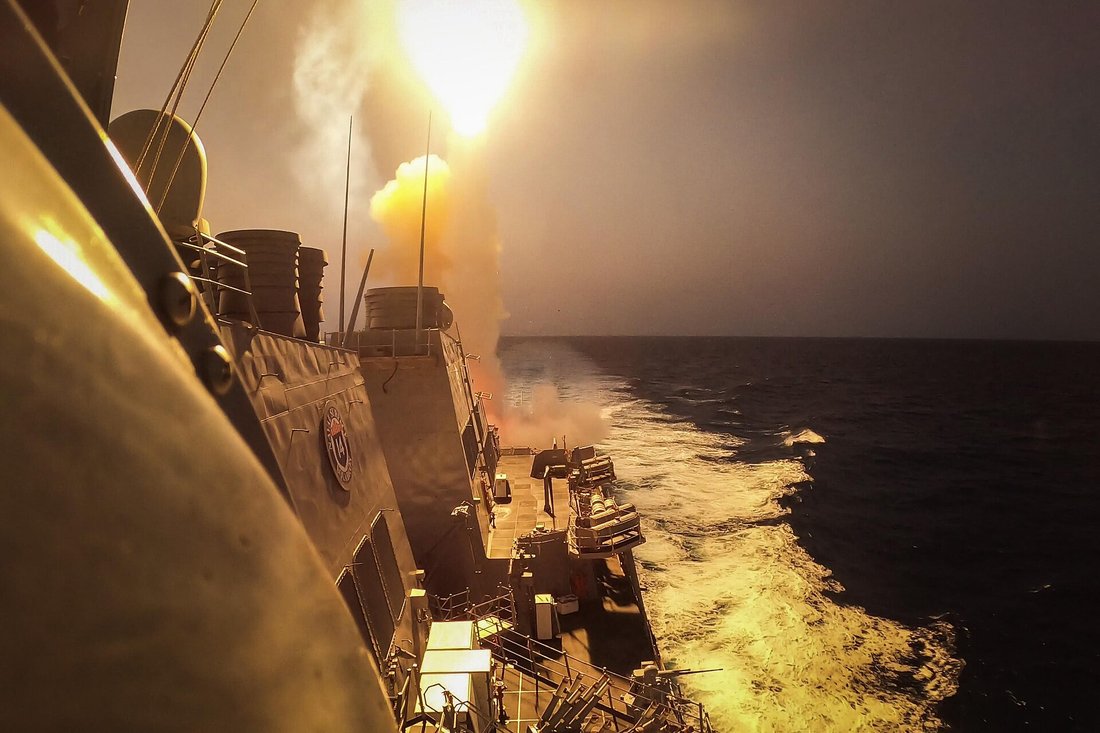
Consider the record honestly. The overwhelming majority of Houthi missiles and drones launched toward Israel across these conflicts have been intercepted — by Israel’s Arrow system, by American and allied warships in the Red Sea, by a coalition of air and naval defenses arrayed against them. The photograph that accompanies this article is itself an emblem of the entire phenomenon: an American destroyer calmly swatting Houthi projectiles out of the night sky. The Houthis fire; the missiles are knocked down; the satellite channel proclaims a great victory; the cycle repeats. This is not the profile of a decisive military power. It is the profile of a movement whose chief product is its own publicity.
Real Costs, Real Limits
It would be dishonest to pretend the Houthis are merely theatrical, with no capacity to do harm. They are not. Their attacks on commercial shipping in the Red Sea genuinely disrupted one of the arteries of global trade, forcing vessels onto the long route around Africa and raising costs worldwide. Occasionally their weapons have gotten through. Sailors have been endangered; ships have been struck; lives have been lost. A weapon need not be sophisticated to kill, and the Houthis possess an arsenal of Iranian-supplied ballistic and cruise missiles and drones that no responsible nation can simply ignore.
But there is a vital distinction between the capacity to cause disruption and the capacity to decide an outcome. The Houthis can impose costs. They cannot impose results. They can make the Red Sea dangerous for a season; they cannot close it permanently against the navies of the world. They can launch missiles at Israel; they cannot meaningfully degrade Israel’s ability to defend itself or to prosecute its wider war. The disruption is real. The decisiveness is illusory. And it is precisely this gap — between the noise a small actor can generate and the result it can actually achieve — that the term “paper tiger” was coined to describe.
Their dependence is total. Strip away Iranian missiles, Iranian funding, Iranian technical advisers, and Iranian strategic direction, and the Houthis revert to what they were: a regional faction in a civil war over the governance of Yemen, with no quarrel with Israel and no means of reaching it. Everything that makes them a threat to the Jewish state was given to them by someone else. They are not a fire; they are a match struck by another hand. And when the hand that strikes them is itself weakened — as Iran has been weakened, its leadership decimated, its proxies battered — the match has less and less to ignite.
How Scripture Measures the Nations
Here the Christian Zionist must lift his eyes from the strategic map to the far older and far surer map of Scripture, for the Bible has a great deal to say about small nations that rage against the people of God, and its verdict is consistent from Genesis to Revelation. The second Psalm frames the entire matter with a sublime calm that should steady every believing heart in a season of sirens and proclamations:
Notice the posture of God in the face of the raging nations. He is not anxious. He is not scrambling for a defense. He laughs — not in cruelty, but in the serene certainty of One whose purposes cannot be overturned by the bluster of men. If the great empires of the earth provoke only the divine laughter when they imagine they can thwart the purpose of God for Israel, how much more a barefoot militia firing borrowed missiles from the mountains of Yemen? The Houthis rage; they imagine a vain thing; and the One who sits in the heavens is not moved from His throne.
The prophet Isaiah is even more pointed about the ultimate fate of those who make war on Israel. He does not merely say they will fail. He says they will cease to exist as adversaries altogether, fading into nothing:
“As nothing, and as a thing of nought.” There is no more precise theological description of a paper tiger in all of literature. The enemies of Israel, however fierce in the moment, are assigned by the prophetic word to the category of the weightless — the thing that strives and rages and then is sought and cannot be found. Pharaoh believed himself a god and lies entombed; Babylon was the wonder of the world and is a ruin; the empires that decreed Israel’s end are studied now only by archaeologists. The Houthi movement, a faction of a fractured state, sets itself against the same people and imagines itself a force of history. Scripture has already filed it under “a thing of nought.”
The Burdensome Stone
There is a particular prophecy that bears directly on every nation, great or small, friendly or hostile, that presumes to lay hands upon Jerusalem. Through Zechariah, the LORD declares a principle that has held across the whole sweep of history:
A burdensome stone is a weight too heavy to lift — a stone that men gather around, confident they can heave it from its place, and who succeed only in rupturing themselves in the straining. The image perfectly captures the Houthi predicament. They have burdened themselves with the affairs of Jerusalem, a city they have never seen and a people who have never wronged them, purely to please a patron and purchase relevance. And the prophecy is indifferent to their size. It does not say that only great nations who lift the stone will be cut; it says all who burden themselves with it. The smallest hand laid upon Jerusalem in enmity is laid upon the same immovable weight that crushed the giants.
This is the deep reason the Houthi project is doomed, beneath all the strategic analysis. It is not merely that they are militarily outmatched, though they are. It is that they have set themselves against a city and a people that God Himself has fortified by decree. To make war on Israel is to grasp the burdensome stone, and the stone does not yield. It has not yielded to Pharaoh or Sennacherib or Titus or Hitler, and it will not yield to a movement whose entire arsenal is on loan.
The Keeper Who Does Not Sleep
If the prophecies of judgment describe the fate of Israel’s enemies, the Psalms describe the security of Israel herself — and they ground that security not in her armies, formidable as they are, but in the unsleeping vigilance of her God. The hundred and twenty-first Psalm is the believer’s answer to every night of sirens:
The Keeper of Israel does not nod at His post while missiles fly from Yemen. He does not depend upon the Arrow battery or the American destroyer, though He is pleased to work through such means. The interception of a Houthi missile over the Negev is, to the eye of faith, simply one more instance of the keeping that never ceases. The Houthis launch under cover of darkness; the One who keeps Israel does not require the light to see, and is not subject to the night. Their strategy assumes that they can wound a people whose Keeper is awake. It is a miscalculation of the most fundamental kind.
The wise man of Proverbs reduces the entire question to a single sentence that the Houthi war planners would do well to ponder: “The horse is prepared against the day of battle: but safety is of the LORD” (Proverbs 21:31). Let the proxies prepare their horses, their missiles, their drones, their grand announcements. The disposing of the outcome belongs to Another. Preparation is the duty of men; the verdict is the prerogative of God.
What This Means for the Christian Zionist
It would be a mistake to draw from all this the conclusion that the believer may be careless or contemptuous, as though the suffering caused by these conflicts were of no account. The Houthi assault on shipping has imperiled innocent sailors. The Houthi rule over Yemen has deepened the misery of a desperate population. The missiles fired at Israel, even when intercepted, terrorize families and disrupt lives. None of this is to be waved away. To call an enemy a paper tiger is not to deny that he can do damage; it is to deny that he can do what he claims — namely, alter the destiny of the people of God.
The right posture, then, is neither panic nor mockery, but a settled and watchful confidence. The Christian Zionist watches the proxies of Iran flare up and subside, one after another, and he is neither surprised nor shaken, because he has read the script in advance. He prays for the peace of Jerusalem. He prays, too, for the deceived peoples conscripted into these doomed campaigns — for the ordinary Yemeni who has been handed a banner of hatred against a people he will never meet, in service of a war that brings his own nation nothing but further ruin. And he holds fast to the assurance that the God who keeps Israel keeps her still.
There is, finally, a sober warning embedded in the Houthi example for every nation and movement that contemplates joining the chorus against Israel. The covenant given to Abraham still stands: “I will bless them that bless thee, and curse him that curseth thee” (Genesis 12:3). The smallness of an actor does not exempt it from that covenant. A great empire that curses Israel falls; a small faction that curses Israel falls more quickly and is mourned by fewer. The Houthis have chosen, for the sake of a patron and a slogan, to stand on the cursing side of the oldest promise in the world. That is the truly decisive fact about them — not the range of their missiles, but the side of the covenant on which they have planted their flag.
A Strait Is Not a Destiny
Much has been made, and rightly, of the Houthi position astride the Bab el-Mandeb, the narrow strait at the mouth of the Red Sea through which a substantial share of the world’s seaborne trade must pass. It is the one genuine asset the movement possesses, and it accounts for nearly all of the attention the world pays them. By menacing this chokepoint, the Houthis can impose real costs on global commerce and compel the navies of powerful nations to expend treasure and attention upon them. This is the lever that converts an otherwise marginal faction into a name in the headlines.
Yet a chokepoint is a position, not a power. Holding a strait allows one to harass; it does not allow one to prevail. The world’s commercial and naval powers possess the means to escort, to intercept, to reroute, and ultimately to suppress, and history offers no example of a small faction permanently closing a great waterway against the combined will of the nations that depend upon it. The Houthis can raise insurance rates and lengthen voyages; they cannot bend the world to their will from a stretch of Yemeni coastline. Their leverage is real but bounded, the leverage of a nuisance rather than a sovereign. And every interceptor fired to knock down their missiles, costly as it is, is also a demonstration of the very asymmetry that defines them: they throw cheap weapons and call it war, while the actual decisions of the region are made far above their station.
The Graveyard of Israel’s Enemies
To see the Houthis clearly, set them in the long line of those who have set themselves against the covenant people and consider how that line has fared. The pattern is not subtle, and it is not recent. Pharaoh, who enslaved the Hebrews and drowned their infants, was himself drowned with his army. Sennacherib of Assyria boasted that he had shut up Hezekiah “like a bird in a cage” before his army was annihilated in a night and he himself was murdered in the house of his god. Haman built a gallows for the Jews and hanged upon it. Antiochus desecrated the Temple and died in agony and disgrace. Rome razed Jerusalem and is itself a memory; the Jewish people pray still in the tongue of their fathers.
In every generation a new power has arisen to declare the end of Israel, and in every generation that power has supplied only a fresh chapter for the historians while Israel has endured. This is not the special pleading of the faithful; it is a matter of plain historical record, and it is the kind of record that no run of mere coincidence can explain. The believer sees in it the steady hand described by Jeremiah, who staked the permanence of Israel on the permanence of the sun and moon themselves: only if those fixed ordinances should depart, said the LORD, would the seed of Israel cease from being a nation before Him. The sun has not gone out. Neither has Israel. And a movement firing borrowed missiles from Yemen has added precisely nothing to the long catalogue of those who thought themselves the exception and proved themselves the rule.
A Thing of Nought
Return, then, to the night of June 8, 2026, and to the small voice that rose from the Arabian Peninsula to join the larger storm. Strip away the apocalyptic language, the satellite broadcasts, the slogans painted on the banners, and what remains is a familiar and unimpressive thing: a dependent faction, firing borrowed weapons at a people it cannot reach, on behalf of a patron it cannot save, for a cause that Scripture long ago consigned to futility. The pile-on is not strength. The noise is not weight. The proclamation of victory over a missile that was knocked from the sky is not victory.
The Houthis of Yemen are the paper tigers of the Arabian Peninsula — loud, dependent, and ultimately weightless against the One who keeps Israel and neither slumbers nor sleeps. They rage; they imagine a vain thing; and the One who sits in the heavens laughs. They strive with Israel, and the prophetic word has already pronounced their end: they shall be as nothing, and as a thing of nought. The sun still rises over Jerusalem. The missiles are knocked from the sky. And Israel still stands — not by the favor of the great, nor in spite of the malice of the small, but because her Keeper does not sleep, and her fate was sealed, in blessing, before the Houthis or their patrons or any empire that ever raged was born.