
The Garden of Eden
Historical & Biblical Background
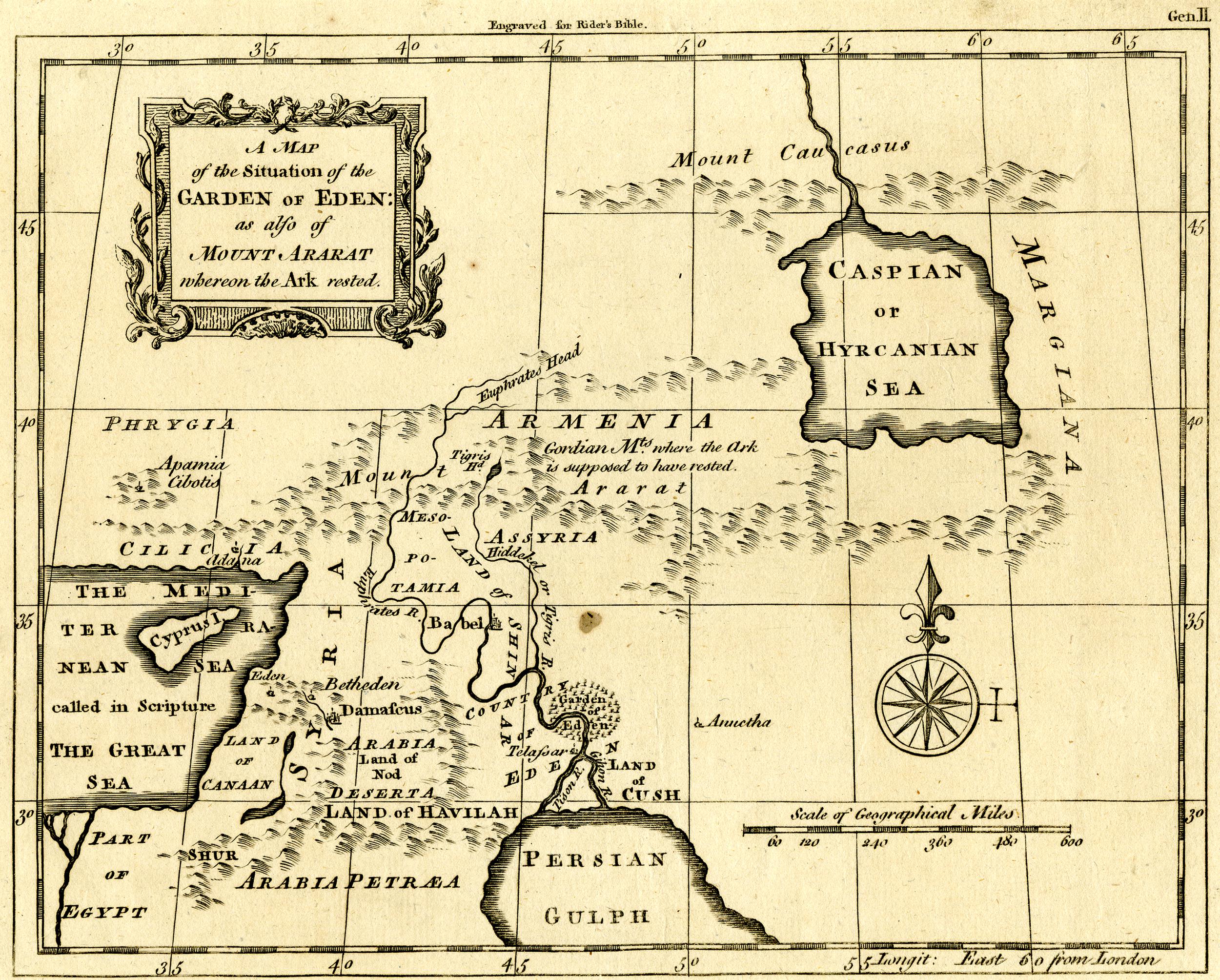
The Garden of Eden stands at the very beginning of human history — the first place named in Scripture, the birthplace of mankind, and the original dwelling place of God with His creation. Genesis 2 places the garden "eastward in Eden," a phrase that has fascinated scholars, theologians, and explorers for millennia. This 18th century map, engraved for Rider's Bible, represents one of the most serious early attempts to place Eden in its precise geographical setting using the biblical text of Genesis 2.
The cartographer places Eden near the confluence of the great rivers of Mesopotamia — the region we know today as southern Iraq — with the Land of Cush to the southeast and the Land of Havilah to the south. This placement reflects the dominant scholarly view of the 18th century, and remains one of the most defensible positions today.
The Four Rivers of Genesis 2
The most significant geographical clue Scripture provides is the four rivers flowing from a single source within Eden. Two — the Euphrates and the Tigris (Hiddekel in Hebrew) — are unmistakable and still flow today through Turkey, Syria, and Iraq. The Pishon "encompassed the whole land of Havilah, where there is gold," and the Gihon "encompassed the whole land of Cush." On this map, the cartographer traces these rivers carefully, placing their headwaters in the Armenian highlands and their mouths near the Persian Gulf.
Mount Ararat & the Ark
Notably, this map also shows Mount Ararat — labeled "Gordian Mts. where the Ark is supposed to have rested" — placing both Eden and the Ark's resting place within the same geographical frame. This reflects the biblical understanding that the post-flood world was repopulated from the same region where Eden had been located, with Noah's descendants spreading outward from the mountains of Ararat down into the Mesopotamian plain.
Where Was Eden?
No physical location for the Garden of Eden can be confirmed today, and Scripture does not intend for us to find it — after the Fall, God placed cherubim and a flaming sword at the entrance to prevent return (Genesis 3:24). The most widely accepted scholarly view places it in the Persian Gulf region, possibly on land now submerged. What matters most about Eden is not its geography but its theology: here God walked with man in the cool of the day, and here began the long story of redemption that ends in the New Jerusalem of Revelation 22.
"And a river went out of Eden to water the garden; and from thence it was parted, and became into four heads."— Genesis 2:10 (KJV)
Key Scripture References
Genesis 2:10–14 — The four rivers described
Genesis 3:23–24 — The expulsion from Eden; the cherubim guard the way
Ezekiel 28:13 — "Thou hast been in Eden the garden of God"
Isaiah 51:3 — God will make Zion's wilderness "like Eden"
Revelation 22:1–5 — The Garden restored in the New Jerusalem