
The Empire of Assyria
Historical & Biblical Background
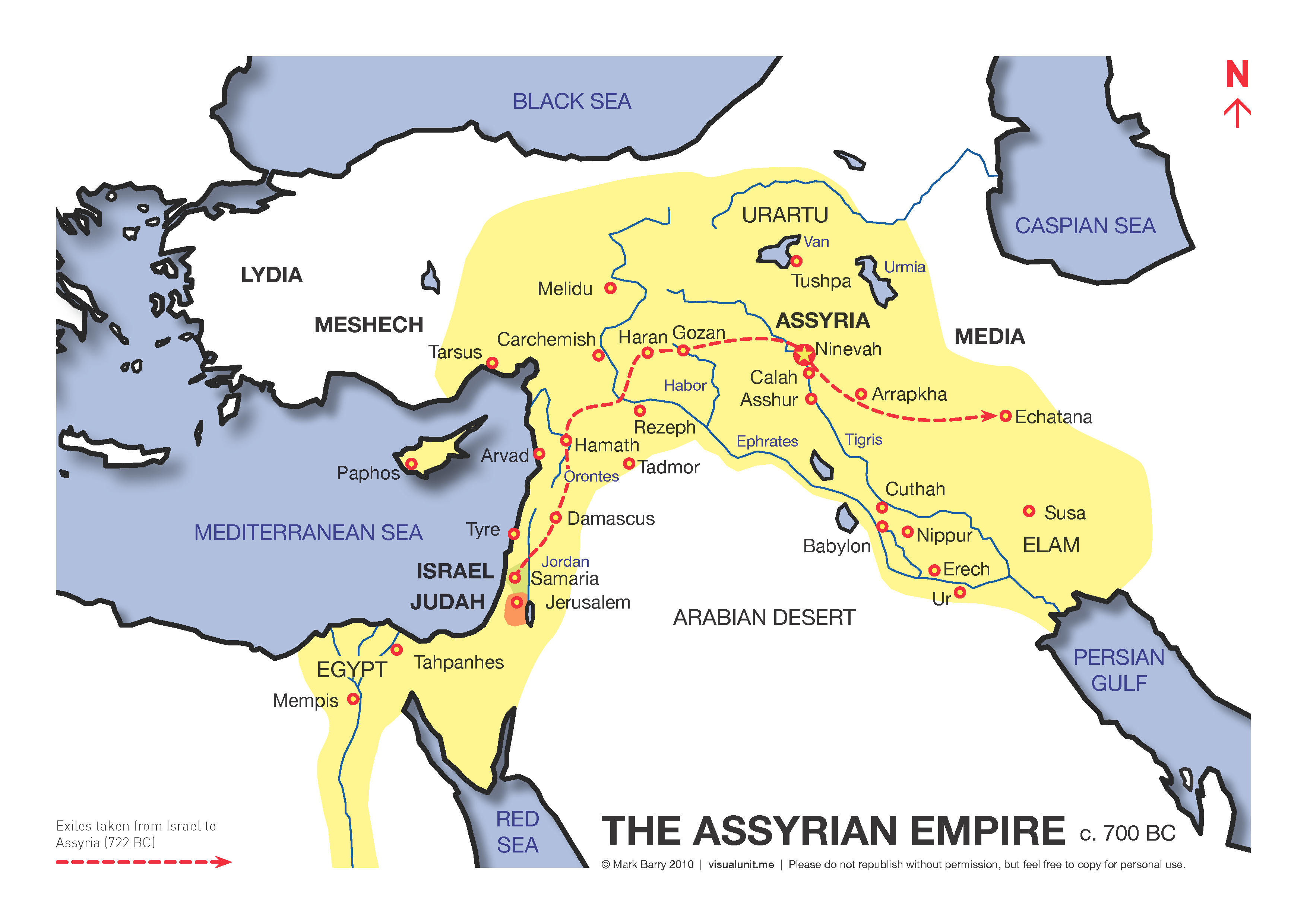
No empire in the ancient world inspired more terror than Assyria. From their capital at Nineveh on the Tigris River, the Assyrian kings built an empire through systematic brutality — mass deportations, public impaling, cities razed to the ground, populations resettled across the empire to prevent rebellion. Their own royal inscriptions boast of these atrocities in clinical detail. It was this empire — the yellow mass on this map stretching from Egypt to the borders of Persia — that God used as "the rod of mine anger" (Isaiah 10:5) to judge the northern kingdom of Israel.
The Fall of Samaria — 722 BC
The red dashed line on this map tells one of the most tragic stories in all of Scripture. In 722 BC, after a three-year siege, the Assyrian king Shalmaneser V (completed by Sargon II) took Samaria — the capital of the northern kingdom of Israel — and deported its population to Halah, Habor, the river Gozan, and the cities of the Medes (2 Kings 17:6). Over 27,000 Israelites were taken, according to Sargon's own annals. In their place, Sargon resettled peoples from Babylon, Cuthah, Avva, Hamath, and Sepharvaim — creating the mixed population that became known as the Samaritans.
Why Did God Allow It?
The Bible is explicit about the reason: "For so it was, that the children of Israel had sinned against the LORD their God... and had feared other gods... Therefore the LORD was very angry with Israel, and removed them out of his sight" (2 Kings 17:7–18). The northern kingdom had been warned for over 200 years — by Elijah, Elisha, Amos, Hosea, and others. They refused to repent. God's judgment, when it finally came through Assyria, was the fulfillment of Moses's warnings in Deuteronomy 28: "The LORD shall bring a nation against thee from far... And he shall besiege thee in all thy gates."
Sennacherib and Jerusalem — 701 BC
Twenty years after Samaria fell, the Assyrian king Sennacherib turned south against Judah. He swept through forty-six fortified cities, deported over 200,000 people, and besieged Jerusalem itself. His own annals boast of shutting up King Hezekiah "like a bird in a cage." But Jerusalem did not fall. The angel of the LORD struck down 185,000 Assyrian soldiers in a single night, and Sennacherib withdrew to Nineveh where he was later murdered by his own sons (2 Kings 19:35–37). Jerusalem's miraculous deliverance became the defining proof that God had not abandoned His people.
The Fall of Assyria — God's Judgment on the Rod
God had called Assyria the "rod of my anger" — but He also promised to punish Assyria for its arrogance: "Wherefore it shall come to pass, that when the Lord hath performed his whole work upon mount Zion and on Jerusalem, I will punish the fruit of the stout heart of the king of Assyria" (Isaiah 10:12). In 612 BC, just ninety years after Samaria's fall, Nineveh itself was destroyed by a coalition of Babylonians and Medes — so completely that for centuries its very location was forgotten. The prophet Nahum had predicted it in vivid detail decades before it happened.
"O Assyrian, the rod of mine anger, and the staff in their hand is mine indignation. I will send him against an hypocritical nation, and against the people of my wrath will I give him a charge, to take the spoil, and to take the prey... Howbeit he meaneth not so, neither doth his heart think so."— Isaiah 10:5–7 (KJV)
Key Scripture References
2 Kings 15:19–20 — Tiglath-Pileser first extracts tribute from Israel
2 Kings 15:29 — Tiglath-Pileser deports the northern Israelites
2 Kings 17:1–6 — Shalmaneser besieges and takes Samaria; ten tribes exiled
2 Kings 17:7–23 — Why God allowed the exile — Israel's persistent idolatry
2 Kings 18–19 — Sennacherib besieges Jerusalem; the angel destroys his army
Isaiah 10:5–19 — Assyria as God's rod; and God's judgment on Assyria
Jonah 1:1–2 — God sends Jonah to preach repentance in Nineveh
Nahum 1–3 — The full prophecy of Nineveh's destruction