
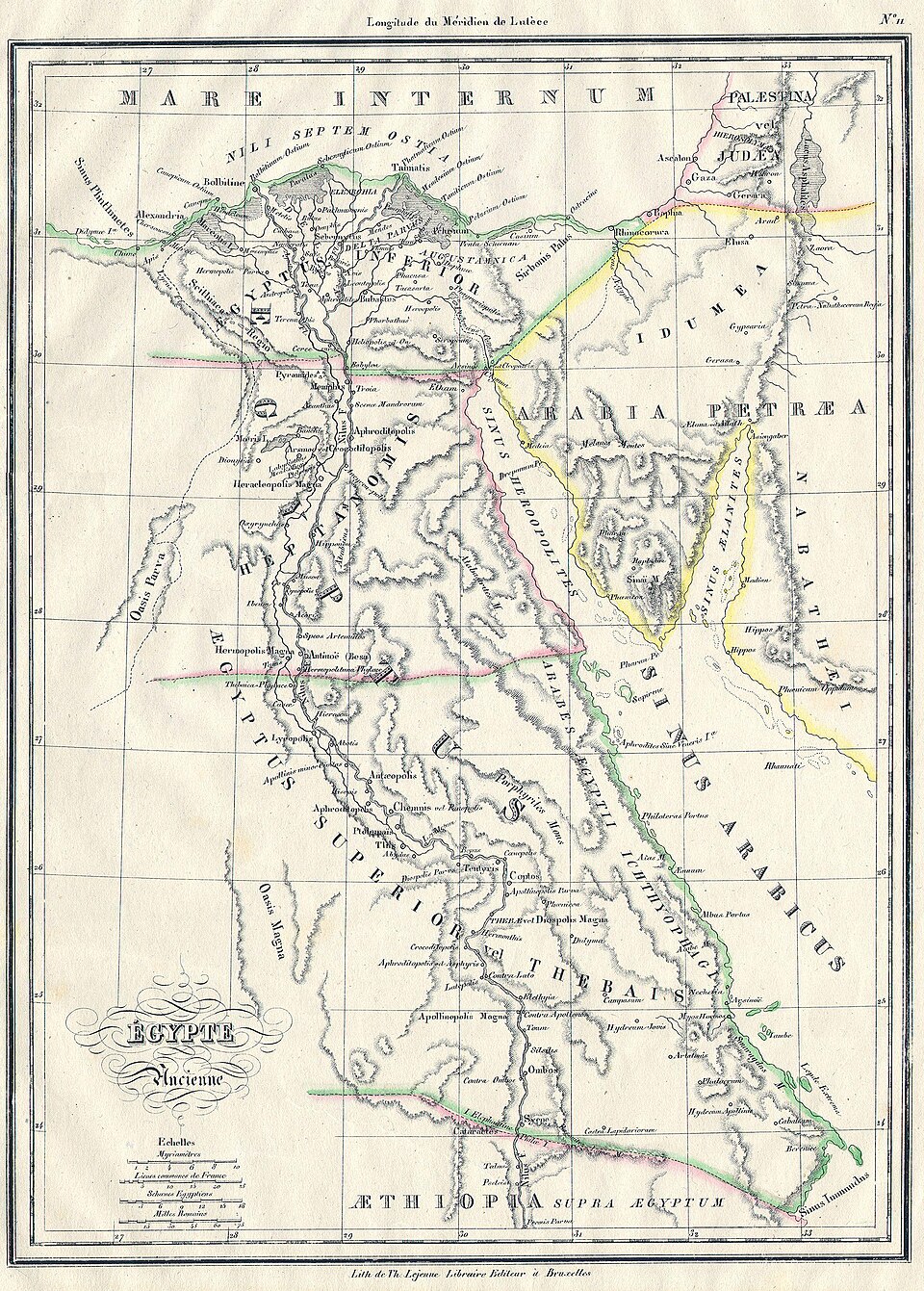
No nation outside of Israel itself plays a larger role in the Old Testament than Egypt. From Abraham's first journey there during a famine in Canaan (Genesis 12:10), through Joseph's rise to power under Pharaoh, through four centuries of Israelite slavery, through the ten plagues and the Exodus, through the wilderness wanderings in its shadow, through the divided kingdom's repeated temptation to seek Egyptian alliances instead of trusting God — Egypt is woven into the fabric of biblical history from beginning to end.
Ancient Egypt was built entirely around the Nile. The ancient Greek historian Herodotus famously called it "the gift of the Nile," and the description is exact. Egypt is essentially a narrow strip of fertile land — the Nile Valley — carved through an otherwise absolute desert. The annual inundation of the Nile deposited rich black silt along its banks, enabling an agricultural abundance that made Egypt the breadbasket of the ancient world. Beyond the narrow green strip on either side of the river, nothing grew. The Two Lands — Upper Egypt (the river valley) and Lower Egypt (the Delta) — were distinct geographical and cultural regions unified by the Pharaoh, who wore the double crown of both.
The Land of Goshen, where Israel settled during Joseph's time and where the Israelite population grew to several million over four centuries, occupied the eastern edge of the Nile Delta — the most fertile part of Egypt and the closest to Canaan. The city of Rameses (also called Avaris or Pi-Ramesses), one of the store-cities the enslaved Israelites built with forced labor (Exodus 1:11), was located in this region. The Exodus route led eastward from the Delta through the Sinai Peninsula toward the Promised Land.
The theological significance of Egypt in the Bible cannot be overstated. God's deliverance of Israel from Egypt became the defining event of Israelite identity — the event to which the prophets, psalmists, and apostles return again and again as the supreme demonstration of divine power and covenant faithfulness. "I am the LORD thy God, which have brought thee out of the land of Egypt, out of the house of bondage" (Exodus 20:2) — this is how God identifies Himself at the giving of the Law. Not as the Creator of the universe, but as the Deliverer from Egypt. The Exodus was the lens through which Israel understood everything else God did.
Remarkably, Egypt also serves in Scripture as a foreshadowing of the ultimate redemption. Matthew 2:15 quotes Hosea 11:1 — "Out of Egypt have I called my son" — and applies it to Jesus's return from Egypt after the flight of the holy family. The pattern of descent into Egypt and deliverance from Egypt, played out in Joseph's story and in the Exodus, finds its final fulfillment in the life of the Son of God. Egypt in the Bible is not merely a geographical setting. It is a theological type — the house of bondage from which God delivers His people into freedom.