
 The Iranian Threat
Iran After Khamenei — The Theology Did Not Die With the Man
On the morning of February 28, 2026, joint United States and Israeli strikes destroyed the residential and office compound of Ayatollah Ali Khamenei in Tehran. The Supreme Leader of the Islamic Republic of Iran, the man who had ruled the country for nearly thirty-seven years, was killed in the opening hours of what would become the largest direct confrontation between Iran and the Western powers in the regime’s history. Within a week, the Assembly of Experts had named his son, Mojtaba Khamenei, as the third Supreme Leader of the Islamic Republic. The change of name at the top did not change the theology underneath. For the Christian Zionist seeking to understand what has happened, the central observation must be this: the hostility of Iran toward the State of Israel was never personal to one man. It was, and is, the formal theological commitment of the regime itself. Replacing the architect did not dismantle the architecture.
A Death Long Threatened, Long Promised
Ali Khamenei was eighty-six years old at the time of his death. He had occupied the position of Supreme Leader since the death of his predecessor, Ayatollah Ruhollah Khomeini, in June 1989. For nearly four decades he had directed the foreign policy, the strategic doctrine, and the theological pronouncements of the Iranian state. The destruction of Israel was, throughout that entire period, the defining and non-negotiable feature of his public utterances. He referred to Israel as a “cancerous tumor” on more occasions than can reasonably be tallied. He predicted, repeatedly, the elimination of the Jewish state within definite timeframes. He blessed and funded the proxy networks — Hezbollah, Hamas, the Houthis, the Iraqi militias — that for forty years rained rockets, suicide bombings, and ideological warfare on Israeli civilians.
The strike that killed him was preceded by more than a year of escalating regional conflict. Israeli operations against Hezbollah in Lebanon during the autumn of 2024 had eliminated most of that organization’s senior leadership. Operations against Hamas in Gaza, beginning after the October 7, 2023 massacre, had decimated that organization’s military capacity. The collapse of the Assad regime in Syria in December 2024 had severed Iran’s land bridge to its proxies in the Levant. By early 2026, Iran itself was the only remaining intact pillar of what its own propagandists called the “Axis of Resistance.” The strike on the Khamenei compound was the natural conclusion of a strategic logic that Iran had imposed on the region for forty years: a regime committed to the destruction of its neighbor will eventually invite its own.
The Succession: Eight Days From Strike to Selection
Under the Iranian constitution, the Assembly of Experts — an eighty-eight member panel of senior Shia clerics — is the body legally responsible for selecting a new Supreme Leader upon the death of the incumbent. The Assembly is required to act “as soon as possible.” In practice, the political reality after February 28 was that the Islamic Revolutionary Guard Corps held the gun, the cash, and the information networks, and the Assembly held the rubber stamp. In the chaos of an active war, with Iranian air defenses degraded and the leadership compound destroyed, the Revolutionary Guard moved with extraordinary speed.
On March 8, 2026 — just eight days after the strike — the Assembly named Mojtaba Khamenei, the fifty-six-year-old son of the slain leader, as the third Supreme Leader of the Islamic Republic. The selection was reported by every major regional news source as having been driven by the IRGC and its allied principalist faction, led by hardliner Saeed Jalili. Reformist clerics opposed the choice. The Assembly approved it under pressure. The signal could not have been clearer. Iran was choosing, in the moment of its greatest weakness, not de-escalation but defiance. Not a moderate technocrat positioned to negotiate, but the bloodline of the man whose policies had brought the regime to ruin.
“Iran was choosing, in the moment of its greatest weakness, not de-escalation but defiance — not a moderate technocrat, but the bloodline of the man whose policies had brought the regime to ruin.”
Mojtaba Khamenei: Worse Than His Father
Mojtaba Hosseini Khamenei was born on September 8, 1969, in Mashhad, the second of his father’s six children. For more than two decades he had served as the de facto chief of staff to the Supreme Leader’s office, controlling access to his father, managing the family’s vast financial holdings, and operating as the principal liaison between the leadership and the Islamic Revolutionary Guard Corps. He briefly served in the IRGC ground forces during the Iran-Iraq War as a young man, and his ties to the Guard’s senior commanders are described by every credible source as the closest of any clerical figure in the country. He has trained at the Qom seminary, holds clerical credentials, and is identified across the Iranian political spectrum as one of the most uncompromising hardliners in the system.
The judgment of Western observers in the days after his selection was unanimous and grim. Alan Eyre, the former United States diplomat and longtime Iran specialist, told the press that “Mojtaba is even worse and more hardline than his father.” A regional official close to Tehran told Reuters that “the world will miss the era of his father… Mojtaba will have no choice but to show an iron fist.” The Times of Israel ran a headline characterizing his appointment as a signal of “defiance and revenge.” The Foreign Affairs analysis of the transition described him as “the embodiment of continued hardline policies at home and abroad, incapable of forging national consensus and unwilling to agitate for meaningful change.”
This is, in the cold language of policy analysis, an escalation. The man who has succeeded Ali Khamenei is not a moderating influence. He is the embodiment of the same theology, now operating in a state of declared war with the United States and Israel, and personally bereaved by the strike that killed his father, his wife, and several of his children. The notion that the Iranian regime, under such leadership, will moderate its commitments to the destruction of Israel is not a serious proposition.
A Dynasty, Not Merely a Succession
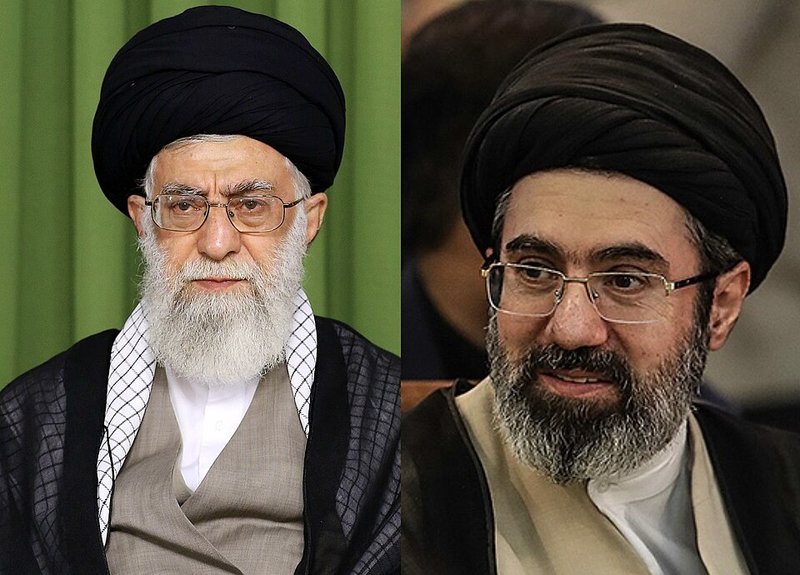
When the Assembly of Experts elevated Mojtaba Khamenei, it did something the Islamic Republic had never done before and had, in its founding rhetoric, explicitly condemned. It passed supreme power from father to son. The revolution of 1979 was waged, in significant part, against the hereditary monarchy of the Pahlavi shahs; Khomeini denounced dynastic rule as a corruption alien to Islamic governance, a usurpation in which men inherited authority they had not earned. Nearly half a century later, the republic that abolished one throne has produced another — a clerical dynasty in which the highest office in the land has now descended by bloodline. The photograph of the two men, father and son, is therefore not a family keepsake. It is a portrait of an ideology arranging for its own survival by the oldest and most monarchical of means.
Mojtaba’s qualification for the role was never primarily scholarly. He is not numbered among the grand ayatollahs whose religious eminence might command the deference of the seminary by its own weight. His authority rests on two foundations that have nothing to do with learning: he is his father’s son, and he is the trusted man of the Revolutionary Guard. The clerical establishment in Qom is reported to have harbored real reservations about handing the guardianship to a figure of modest scholarly standing. Those reservations were overruled, as nearly everything in wartime Tehran is now overruled, by the institution that holds the guns and the money. Lineage opened the door; the Guard pushed him through it.
Consider what it means that the man now bearing the title was born in 1969 — a decade before the revolution, but raised entirely within its apparatus. He has no adult memory of an Iran that was not the Islamic Republic. He was formed from boyhood inside the institutions his father built, schooled in their doctrine, married into their networks, entrusted with their secrets. The enmity toward Israel was not, for Mojtaba, a conviction adopted in maturity after weighing the alternatives. It was the atmosphere of his childhood, as natural and unexamined as the language he spoke. This is precisely the point the Christian observer must grasp. The ideology has become self-reproducing. It no longer depends upon the charisma or the personal certainty of a founding generation that remembered the Shah. It has bred heirs who have known nothing else, and who could not conceive of the regime apart from the hatreds that define it.
A dynasty, then, and not merely a succession. The distinction matters because it reveals the regime’s deepest commitment and its deepest fear in a single act. The commitment is that the theology must continue without interruption. The fear is that any genuine break — any moderate, any technocrat, any leader prepared to revise the founding enmities — might unravel the whole. Faced with that risk in the hour of its greatest weakness, the regime reached not for renewal but for blood. It chose the son because the son guarantees the sameness. That is the meaning of the picture.
The First Statements: Continuity, Not Change
Mojtaba Khamenei issued his first public statement as Supreme Leader on March 12, 2026, four days after his selection. It was not delivered on camera. According to multiple intelligence sources, the new leader was severely wounded in the February 28 strike, possibly losing a limb, possibly having sustained injuries from which he has yet to fully recover. The statement was read on Iranian state television by a news anchor while a still photograph of Mojtaba was displayed on screen — a striking departure from the practice of his father, who delivered his pronouncements in person well into his eighties. The content of that first statement removed any ambiguity about the new regime’s posture.
He called for the closure of the Strait of Hormuz to international shipping as a strategic instrument against Iran’s enemies. He pledged that the Iranian-backed armed groups in Yemen, Iraq, and elsewhere would “do the job” against American bases and Israeli targets. He emphasized that “cooperation between the members of the Resistance Front will shorten the path to eliminating the Zionist sedition.” The vocabulary was identical to his father’s. The threat was identical. The theological framework — that the destruction of Israel is a religious duty, not a policy preference — was identical. Only the speaker had changed.
On May 26, 2026, Mojtaba issued his Hajj statement — the annual communication that the Supreme Leader directs to the Muslim world during the pilgrimage to Mecca. The statement, published in English by the semi-official ISNA news agency, declared that “‘Death to America’ and ‘Death to Israel’ shall become the common chants of the Islamic ummah, especially its youth.” It described Israel as “the shaken Zionist regime and the cancerous tumor” — recycling his father’s exact vocabulary of forty years — and predicted that the Jewish state was “approaching the final stages of their wretched existence.” This is not the language of de-escalation. This is the language of continuity, expressed in the moment of greatest possible weakness, by a regime determined to demonstrate that its theological commitments are not negotiable even in the face of military defeat.
The IRGC: The Real Power in Tehran
A consensus has emerged among Israeli, American, and Iranian-exile analysts that Mojtaba Khamenei is, in practice, a symbolic figurehead rather than an operational leader. The New York Times has cited Iranian sources describing the country as being run “like a board of directors, together with IRGC commanders.” The Jerusalem Post and other Israeli sources have reported that Mojtaba has not been seen in public, has not delivered a single statement in his own voice on camera, and may be physically incapable of fulfilling the public functions of the position. Power, in the practical sense, has shifted to the Islamic Revolutionary Guard Corps and to the Supreme National Security Council that operates as the regime’s wartime executive.
This matters more than it may first appear. The IRGC is the most ideologically committed institution in the Iranian state. Its officers were screened, vetted, and promoted on the basis of their commitment to the revolutionary doctrine — including, centrally, the destruction of Israel. The IRGC controls Iran’s missile program, its proxy network across the region, its nuclear infrastructure, and a sprawling commercial empire that has made many of its senior commanders extraordinarily wealthy. These men have no incentive whatsoever to negotiate. The economic concessions any genuine peace agreement would require would directly threaten their personal fortunes. The strategic concessions required would directly undo the work to which they have devoted their adult lives.
The structural conclusion is this. The Supreme Leader of Iran is now, at best, a wounded symbolic figure with limited operational role. The actual decisions of the Iranian state are being made by a small circle of IRGC commanders, the Supreme National Security Council, and a handful of senior clerics whose interests align with continued confrontation. The regime that emerged from the death of Ali Khamenei is not a softer regime. It is, by every available measure, a more dangerous one — smaller in its decision-making circle, more ideologically committed in its membership, and possessing less moderating influence at its center than at any point since 1989.
“The regime that emerged from the death of Ali Khamenei is not a softer regime. It is a more dangerous one.”
The Architecture: Velayat-e Faqih
To understand why the death of Ali Khamenei changed so little, one must understand the doctrine upon which his office was built. The Islamic Republic is not a theocracy in the loose sense in which that word is often thrown about. It rests upon a specific and historically recent theological innovation: velayat-e faqih, the Guardianship of the Islamic Jurist, formulated by Ruhollah Khomeini in a series of lectures delivered in exile around 1970. The doctrine holds that during the concealment of the awaited Twelfth Imam, supreme political authority over the Muslim community rightly belongs to the most qualified Islamic jurist, who governs as the Imam’s deputy until the appointed return. The Supreme Leader of Iran is therefore not, in the regime’s self-understanding, merely a head of state. He is a guardian standing in the place of a hidden messianic figure, exercising an authority understood to be derived from God Himself.
This is why the hostility toward Israel is structural rather than personal. The office carries a mandate its occupants regard as divine, and into that mandate the destruction of the Jewish state was deliberately woven by Khomeini at the founding. It was Khomeini who branded Israel a “cancerous tumor,” who instituted Quds Day as an annual ritual of the state, who made the negation of Israel a fixed article of the revolution’s self-definition rather than a negotiable point of foreign policy. A new occupant of the guardianship does not inherit only the title and the powers. He inherits the theological charge attached to them. For such a leader to abandon the enmity toward Israel would not be a mere adjustment of policy. It would be a confession that the guardian had betrayed his trust — an act that would call into question the legitimacy of the office itself.
This is not a matter of informal custom but of written constitutional law. The constitution of the Islamic Republic, ratified in 1979 and amended in 1989, enshrines the Guardianship of the Jurist as the organizing principle of the entire state, vesting in the Supreme Leader command of the armed forces, control of the judiciary and the state broadcaster, and the final word over the general policies of the nation. The Assembly of Experts that selects him, the Guardian Council that screens every candidate for elected office, the whole scaffolding of the republic — all of it exists to serve and to shield that single office. To moderate the guardianship is to amend the constitution; to amend the constitution in this respect is to end the regime. The founders built it that way on purpose.
The Western analyst who waits for a “moderate” Supreme Leader has misunderstood the nature of the position. The office was engineered by Khomeini precisely to prevent the secular drift that the doctrine’s authors believed had hollowed out other Muslim states. The man who fills it may be replaced; the mandate cannot be revised without dismantling the constitutional and theological order that the mandate exists to protect. This is the architecture that the strike of February 28 left wholly untouched. The bombs killed the guardian. They did not, and could not, kill the guardianship.
Mahdism and the Theology of the End
Beneath the doctrine of the Guardianship lies something older and more volatile still: the eschatology of Twelver Shia Islam, the faith of the overwhelming majority of Iranians. The Twelver tradition holds that the twelfth in the line of Imams descended from Muhammad, a child named Muhammad al-Mahdi, did not die but entered a miraculous concealment — the Occultation — in the late ninth century, and that he lives still, hidden from the world, awaiting the appointed hour of his reappearance. When he returns, by this belief, he will come in a season of overwhelming injustice and global upheaval, to fill the earth with justice as it had been filled with oppression and to establish the universal reign of Islam.
Within this framework, certain currents in Iranian religious and political life have long taught that the conditions for the Mahdi’s return are not merely to be awaited in patience but may, in some measure, be prepared. The apocalyptic tendency associated with the Hojjatieh and with kindred strands of revolutionary thought has at times framed confrontation with the West, and the destruction of Israel in particular, as elements of the end-time scenario that precedes the Imam’s appearing. It would be an exaggeration to claim that every Iranian official is an apocalyptic activist; serious observers debate how far such thinking actually drives day-to-day policy, and much of the regime’s conduct is explained well enough by ordinary calculations of power and survival. But the strand is real, it is woven into the rhetoric of the revolution, and it is influential among precisely the ideological cadres who now hold the commanding heights of the state.
The danger this poses is of a particular and unfamiliar kind. Conventional deterrence assumes a rational adversary who prizes his own survival and the survival of his state above all other ends, and who can therefore be restrained by the credible threat of unacceptable loss. An actor who sincerely believes that catastrophic confrontation may hasten a promised and longed-for deliverance does not necessarily reason within those same bounds. This is the concern that has long haunted Israeli and Western strategists contemplating Iran’s pursuit of nuclear weapons: not simply that a hostile state might acquire the bomb, but that a leadership animated by an eschatology of redemptive upheaval might not be deterred by the prospect of its own destruction in the way that a secular power would be. The point is not that the regime is suicidal in any simple sense. It is that its theology furnishes a frame in which suffering, ruin, and confrontation can be read not as reasons for restraint but as the very birth-pangs of an awaited triumph.
For the Christian, this is sobering on two counts. First, it is a counterfeit eschatology — a yearning for a messianic age pursued through human violence and through the annihilation of the covenant people, rather than awaited in humility through the return of the true Messiah. Second, it explains with great clarity the persistence this article has traced from its opening lines. A theology of the end does not die with a leader, because it was never anchored in the leader. It is anchored in a hope deferred for more than a thousand years and in a final confrontation its adherents believe their own scriptures require. Men who hold such a hope do not surrender it because one guardian has fallen and another, wounded, has risen in his place.
The Nuclear Question After the Strike
All of this bears directly upon the question that overshadows every other in the aftermath of the February strikes: what becomes of Iran’s nuclear ambitions under the new leadership? The honest answer is that the succession has made the question more dangerous, not less. A regime that has watched its proxies shattered, its air defenses degraded, its founding leader killed in his own compound, and its land bridge to the Levant severed, is a regime that has learned, in the hardest possible manner, the cost of fighting its enemies without the ultimate weapon. The lesson the surviving leadership is most likely to draw from its humiliation is not that confrontation should be abandoned, but that it should never again be attempted from a position of such vulnerability.
Set that strategic incentive alongside the theological frame described above, and the combination is plain. A wounded and bereaved leadership, stripped of its moderating voices, convinced that its enmities are divine obligations rather than policy choices, and persuaded that the bomb is the one guarantor it lacked when the strikes came, has every reason to race for a weapon and few of the ordinary reasons to be deterred from using the threat of it recklessly. None of this is certain; the regime’s internal debates are opaque, and prudence and fanaticism contend within it as they do within any government. But the Christian who reads these developments soberly will not take comfort in the death of Ali Khamenei. The man is gone. The machinery he built, the doctrine he institutionalized, and the apocalyptic hope he served all remain — and they remain in hands that have every motive to make them more dangerous than before.
It is against this backdrop — a guardianship that cannot be moderated, an eschatology that cannot be negotiated, and a strategic logic that points toward the very weapon the world most fears in such hands — that the believer must now set the testimony of the prophets of Israel. The world offers no reassurance that the threat has passed. Scripture offers something else entirely: not the promise that the enemy will not rise, but the promise of how the contest ends.
What Scripture Says About Hostility That Outlives Its Author
The Christian reader of these developments must be cautious not to fall into either of two errors. The first is the error of triumphalism — the rush to declare the death of Ali Khamenei as the moment that fulfills the prophecies of the destruction of Israel’s enemies. The Bible does not authorize such conclusions. The fall of a single tyrant, however cruel, is not the consummation of the prophetic timeline. The second error is the opposite mistake — the failure to recognize what Scripture has always taught about the persistence of hostility against the Jewish people. The Bible does not portray the enemies of Israel as the work of individual madmen who may be removed by individual deaths. It portrays them as a recurring pattern that the prophets foretold would intensify in the latter days.
Pharaoh died, and another Pharaoh arose. Haman was hanged, and another oppressor took his place. Antiochus IV was destroyed, and Rome came after him. Hadrian was buried, and the persecutions continued. In every generation, as the Passover Haggadah declares, an enemy has risen up against the Jewish people to destroy them — and in every generation, the God of Israel has delivered them. The death of Ali Khamenei does not break this pattern. It illustrates it. The hostility passes from father to son because the hostility is not the property of any one man. It is, as the prophets foresaw, the spiritual character of an age that resists the purposes of God in the restoration of His people.
The Coalition Continues to Form
For those who have read the Gog of Magog prophecy of Ezekiel 38 with care, the developments of 2026 are not surprising but instructive. The prophet named Persia — modern Iran — among the coalition that would rise against restored Israel in the latter days. The current configuration of Iran does not constitute the fulfillment of that prophecy. It is, however, the most precise alignment of regional powers with the names of Ezekiel’s coalition that has existed at any point in the past two and a half thousand years. Russia, Iran, Turkey under Erdoğan’s post-AKP transformation, the territories of ancient Cush in Sudan, the territories of ancient Put in Libya — these are not theoretical alignments. They are present-day cooperation patterns documented in current diplomatic, military, and intelligence reporting.
The succession from Ali Khamenei to Mojtaba Khamenei does not weaken this alignment. It strengthens it. The new regime in Tehran has every incentive to deepen its dependence on Russian military assistance, to coordinate more closely with Turkey on the suppression of Western influence, and to maintain its proxy networks at whatever cost the surviving infrastructure can bear. The very weakness of the regime is what drives it toward the configuration the prophet described — a coalition not of strength but of desperation, not of strategic confidence but of theological commitment that cannot be revised in the face of catastrophe.
Perspective
Ali Khamenei is dead. He died, by every indication, in great fear and confusion, having watched the assembled power of the Islamic Republic that he had built across four decades crumble around him in a matter of weeks. He spent his final months in hiding, separated from his networks of advisors, communicating through intermediaries, and watching the proxy organizations he had patronized collapse one after another. The man who had threatened the lives of millions of Jews for thirty-seven years discovered, in his last hours, what the Word of God had been declaring all along: that those who set themselves against the people of God set themselves against the One who keeps covenant with them, and that the contest is not an even one.
Mojtaba Khamenei now sits, wounded and uncertain, in the chair his father occupied. The decisions he is permitted to ratify are the decisions of military commanders whose interests align with continued confrontation. The slogans he has approved are identical to those his father chanted. The prophecies that named his nation among the adversaries of restored Israel were written more than two and a half millennia before he was born, and they will outlast him as they outlasted his father. Christians who stand with Israel do not stand on the basis of confidence in any human power. We stand on the basis of the covenant of God, which is not annulled by the death of one tyrant or the elevation of another. “The grass withereth, the flower fadeth: but the word of our God shall stand forever” (Isaiah 40:8).
The theology of the Iranian regime did not die with the man. It will pass, in time, to others. And in time, the prophets’ words will be vindicated in ways our generation may or may not see. What we can say with confidence is what we have always been able to say: that the God who established Israel on the mountains of their inheritance is the God who keeps watch over them, who does not slumber and does not sleep, and who will be known — in the words of Ezekiel himself — in the eyes of many nations. The death of one Khamenei and the elevation of another is a footnote in that larger drama. The drama itself continues to unfold exactly as Scripture said it would.