✡ "Pray for the peace of Jerusalem" — Psalm 122:6
Christians Standing With Israel
Home Site Map Search About Us Our Beliefs Online Bible Maps of Israel Articles Grafted In? Apple of His Eye Contact
TOPICS
Israel — Then & Now Anti-Semitism Middle East Christian Zionism Bible Prophecy US & Israel Media Bias Spiritual Deception Arab-Israeli Conflict Islamic Extremism The Iranian Threat Replacement Theology
LATEST: New article by Michael Knighton  •  Subscribe to our weekly newsletter  •  400 Maps of Israel now available  •  Online Bible (KJV) now online
Advertisement
Map 057  ·  The Patriarchs & the Exodus  ·  Exodus 19:18–20

Mount Sinai — The Giving of the Law

The mountain where God descended in fire — a detailed map of the Sinai massif showing every peak, pass, and the plain where Israel camped
"And mount Sinai was altogether on a smoke, because the LORD descended upon it in fire: and the smoke thereof ascended as the smoke of a furnace, and the whole mount quaked greatly."
— Exodus 19:18 (KJV)
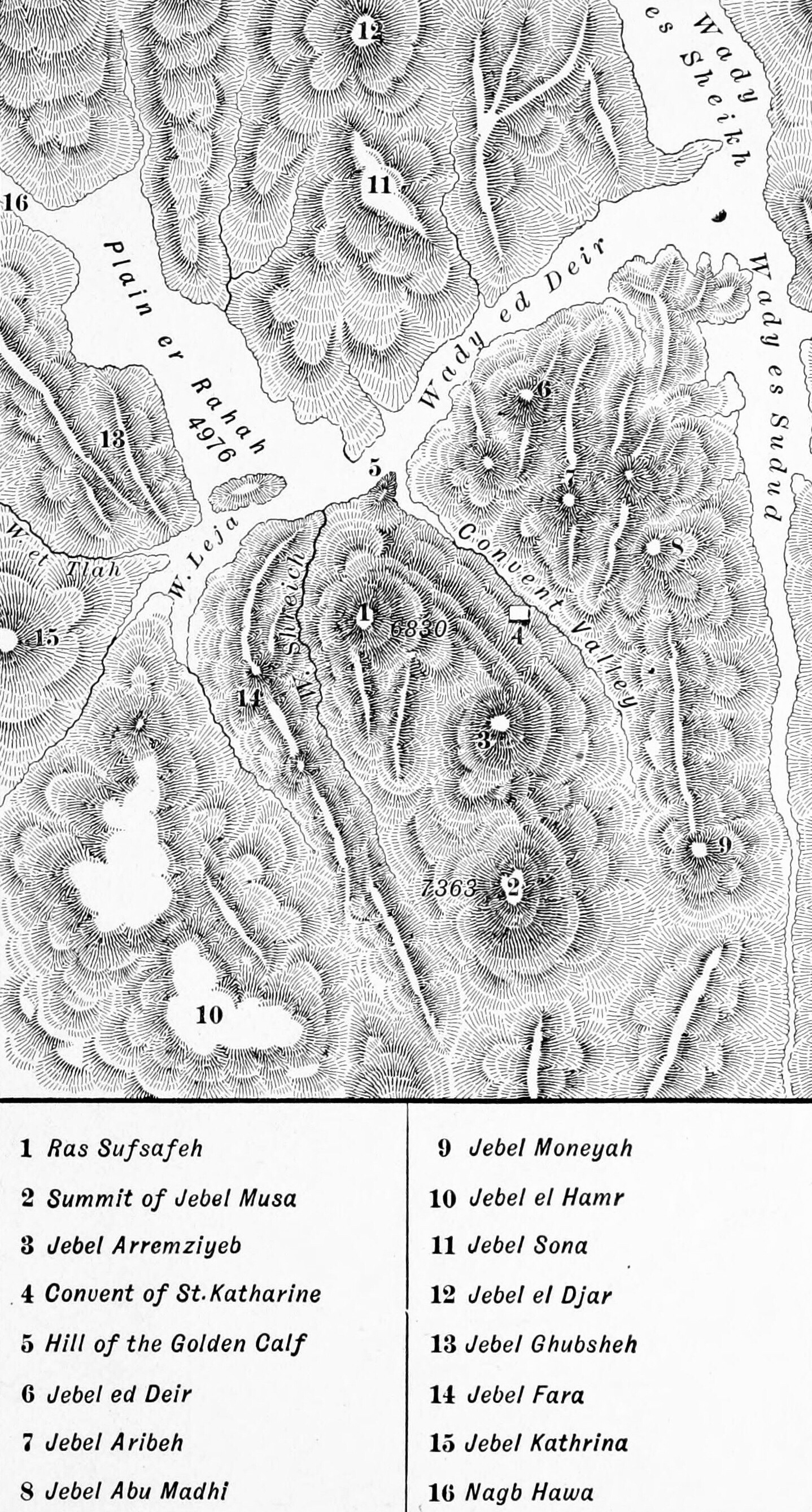
Detailed topographic map of the Mount Sinai massif showing numbered peaks and landmarks: 1 Ras Sufsafeh, 2 Summit of Jebel Musa at 7363 feet, 3 Jebel Arremziyeb, 4 Convent of St. Katharine, 5 Hill of the Golden Calf, 6 Jebel ed Deir, with the Plain of er-Rahah at 4976 feet elevation to the northwest, Wady ed Deir, Convent Valley, and the Nagb Hawa pass
Detailed topographic map of the Mt. Sinai massif showing the numbered peaks, the Plain of er-Rahah (where Israel camped), the Convent of St. Katharine, the Hill of the Golden Calf, and the Nagb Hawa pass. The numbered legend identifies every major feature of the sacred site.
Source: Maccoun, The Holy Land in Geography and in History (1899). Public domain, via Wikimedia Commons.  ·  Historical commentary by Michael Knighton  ·  Christians Standing With Israel
🗺 How to Read This Illustration
① Ras Sufsafeh (#1) and the Summit of Jebel Musa (#2) — Find numbers 1 and 2 on the map. Ras Sufsafeh (labeled #1, elevation 6830 feet) is the northwestern face of the mountain — the cliff that drops vertically to the Plain of er-Rahah. Many scholars believe this was the face visible to Israel when God descended. Number 2 (Jebel Musa summit, 7363 feet) is the highest point, where Moses ascended to receive the Law.
② The Plain of er-Rahah — Find "Plain er Rahah" labeled on the left side of the map at elevation 4976 feet. This is where Israel's two million people camped — a broad flat area capable of holding an enormous encampment. The Nagb Hawa pass (#16, upper-left) is the corridor Israel used to approach from the northwest. The plain sits directly below the cliff face of Ras Sufsafeh.
③ Hill of the Golden Calf (#5) — Find number 5 on the map — "Hill of the Golden Calf" — at the junction of the Wady Leja and the approach to the plain. This is the traditional site of the catastrophic rebellion while Moses was on the mountain. When Moses descended with the tablets and saw the calf, he threw the tablets down and broke them. Aaron's explanation — "I cast the gold into the fire, and there came out this calf" — became one of history's most infamous deflections of responsibility.
④ Convent of St. Katharine (#4) — Find the Convent of St. Katharine labeled on the map at #4. This monastery, built in the 6th century AD by Emperor Justinian, has stood at the foot of the mountain for 1,500 years — one of the oldest continuously inhabited Christian monasteries on earth. It is built near the traditional site of the burning bush, and its library contains some of the most ancient biblical manuscripts ever discovered, including the Codex Sinaiticus.
What This Image Shows
✦ Ras Sufsafeh (#1) — the face of Sinai visible to Israel
✦ Jebel Musa summit (#2) — 7363 feet elevation
✦ Plain of er-Rahah — Israel's campsite below
✦ Hill of the Golden Calf (#5) — site of the rebellion
✦ Convent of St. Katharine (#4) — 1500 years old
✦ Nagb Hawa (#16) — the approach pass
✦ Wady ed Deir — the valley below the summit
✦ Jebel Kathrina (#15) — second highest peak

The Mountain That Burned

This detailed map shows the Sinai massif with a precision that lets you understand exactly what Israel saw and experienced. Find the Plain of er-Rahah on the left side of the map — this is where Israel camped. Now look at what rises immediately to its east: the cliff face of Ras Sufsafeh (#1), dropping hundreds of feet to the plain below, with Jebel Musa summit (#2) rising higher behind it. The mountain is not a gentle slope. It is a wall of granite rising over 7,000 feet, visible from the plain in its full terrifying height.

God's instructions to Moses before the revelation were precise and sobering. The people were to be consecrated — washed, made ready — for two days. Bounds were to be set around the mountain: no one was to touch it, on pain of death. Not even an animal. Even Moses himself, when God spoke, was to come up but then descend and bring Aaron with him. The mountain was holy ground of the most severe kind.

On the third day: thunder, lightning, thick cloud, and a trumpet blast so loud that the people trembled. Smoke covered the mountain. It quaked. God descended in fire. And He spoke — audibly, directly, to the entire assembled nation — the Ten Commandments. After the commandments, the people were so overwhelmed that they fell back and begged Moses to serve as their mediator. Moses then entered the thick darkness where God was, and received the detailed body of the Law over forty days.

Find the Hill of the Golden Calf (#5) on the map — near the plain, at the base of the approach to the mountain. Moses was gone forty days. The people grew anxious and demanded Aaron make them a god. He collected their gold earrings, cast a golden calf, and declared: "These be thy gods, O Israel, which brought thee up out of the land of Egypt." Moses descended with the two stone tablets — written by the finger of God — saw the calf and the dancing, and threw the tablets down, breaking them. The rebellion at the very foot of the mountain where God had just spoken is one of the most staggering acts of faithlessness in the entire Bible. God offered to destroy the nation and start over with Moses. Moses interceded. And God relented.

Key Scripture References
Exodus 19:16–25 — God descends on Sinai; Israel trembles
Exodus 20:1–17 — The Ten Commandments spoken from the mountain
Exodus 24:12–18 — Moses ascends; forty days on the mountain
Exodus 32:1–20 — The golden calf; Moses breaks the tablets
Exodus 34:1–10 — New tablets; covenant renewed
Deuteronomy 5:22–27 — Israel recalls the voice from the fire
Illustration: Maccoun, The Holy Land in Geography and in History (1899). Public domain, via Wikimedia Commons.  ·  Historical commentary: © 2026 Michael Wayne Knighton | Christians Standing With Israel™ | All Rights Reserved.
MAP 056
The Wilderness of Sin
MAP 058
Israel at Sinai — The Tabernacle
Advertisement
Mount Sinai — The Giving of the Law | Christians Standing With Israel — Michael Knighton Mount Sinai — The Giving of the Law | Christians Standing With Israel — Michael Knighton
✡ "Pray for the peace of Jerusalem" — Psalm 122:6
Christians Standing With Israel
Home Site Map Search About Us Our Beliefs Online Bible Maps of Israel Articles Grafted In? Apple of His Eye Contact
TOPICS
Israel — Then & Now Anti-Semitism Middle East Christian Zionism Bible Prophecy US & Israel Media Bias Spiritual Deception Arab-Israeli Conflict Islamic Extremism The Iranian Threat Replacement Theology
LATEST: New article by Michael Knighton  •  Subscribe to our weekly newsletter  •  400 Maps of Israel now available  •  Online Bible (KJV) now online
Advertisement
Map 057  ·  The Patriarchs & the Exodus  ·  Exodus 19:18–20

Mount Sinai — The Giving of the Law

The mountain where God descended in fire — a detailed map of the Sinai massif showing every peak, pass, and the plain where Israel camped
"And mount Sinai was altogether on a smoke, because the LORD descended upon it in fire: and the smoke thereof ascended as the smoke of a furnace, and the whole mount quaked greatly."
— Exodus 19:18 (KJV)
Detailed topographic map of the Mount Sinai massif showing numbered peaks and landmarks: 1 Ras Sufsafeh, 2 Summit of Jebel Musa at 7363 feet, 3 Jebel Arremziyeb, 4 Convent of St. Katharine, 5 Hill of the Golden Calf, 6 Jebel ed Deir, with the Plain of er-Rahah at 4976 feet elevation to the northwest, Wady ed Deir, Convent Valley, and the Nagb Hawa pass
Detailed topographic map of the Mt. Sinai massif showing the numbered peaks, the Plain of er-Rahah (where Israel camped), the Convent of St. Katharine, the Hill of the Golden Calf, and the Nagb Hawa pass. The numbered legend identifies every major feature of the sacred site.
Source: Maccoun, The Holy Land in Geography and in History (1899). Public domain, via Wikimedia Commons.  ·  Historical commentary by Michael Knighton  ·  Christians Standing With Israel
🗺 How to Read This Illustration
① Ras Sufsafeh (#1) and the Summit of Jebel Musa (#2) — Find numbers 1 and 2 on the map. Ras Sufsafeh (labeled #1, elevation 6830 feet) is the northwestern face of the mountain — the cliff that drops vertically to the Plain of er-Rahah. Many scholars believe this was the face visible to Israel when God descended. Number 2 (Jebel Musa summit, 7363 feet) is the highest point, where Moses ascended to receive the Law.
② The Plain of er-Rahah — Find "Plain er Rahah" labeled on the left side of the map at elevation 4976 feet. This is where Israel's two million people camped — a broad flat area capable of holding an enormous encampment. The Nagb Hawa pass (#16, upper-left) is the corridor Israel used to approach from the northwest. The plain sits directly below the cliff face of Ras Sufsafeh.
③ Hill of the Golden Calf (#5) — Find number 5 on the map — "Hill of the Golden Calf" — at the junction of the Wady Leja and the approach to the plain. This is the traditional site of the catastrophic rebellion while Moses was on the mountain. When Moses descended with the tablets and saw the calf, he threw the tablets down and broke them. Aaron's explanation — "I cast the gold into the fire, and there came out this calf" — became one of history's most infamous deflections of responsibility.
④ Convent of St. Katharine (#4) — Find the Convent of St. Katharine labeled on the map at #4. This monastery, built in the 6th century AD by Emperor Justinian, has stood at the foot of the mountain for 1,500 years — one of the oldest continuously inhabited Christian monasteries on earth. It is built near the traditional site of the burning bush, and its library contains some of the most ancient biblical manuscripts ever discovered, including the Codex Sinaiticus.
What This Image Shows
✦ Ras Sufsafeh (#1) — the face of Sinai visible to Israel
✦ Jebel Musa summit (#2) — 7363 feet elevation
✦ Plain of er-Rahah — Israel's campsite below
✦ Hill of the Golden Calf (#5) — site of the rebellion
✦ Convent of St. Katharine (#4) — 1500 years old
✦ Nagb Hawa (#16) — the approach pass
✦ Wady ed Deir — the valley below the summit
✦ Jebel Kathrina (#15) — second highest peak

The Mountain That Burned

This detailed map shows the Sinai massif with a precision that lets you understand exactly what Israel saw and experienced. Find the Plain of er-Rahah on the left side of the map — this is where Israel camped. Now look at what rises immediately to its east: the cliff face of Ras Sufsafeh (#1), dropping hundreds of feet to the plain below, with Jebel Musa summit (#2) rising higher behind it. The mountain is not a gentle slope. It is a wall of granite rising over 7,000 feet, visible from the plain in its full terrifying height.

God's instructions to Moses before the revelation were precise and sobering. The people were to be consecrated — washed, made ready — for two days. Bounds were to be set around the mountain: no one was to touch it, on pain of death. Not even an animal. Even Moses himself, when God spoke, was to come up but then descend and bring Aaron with him. The mountain was holy ground of the most severe kind.

On the third day: thunder, lightning, thick cloud, and a trumpet blast so loud that the people trembled. Smoke covered the mountain. It quaked. God descended in fire. And He spoke — audibly, directly, to the entire assembled nation — the Ten Commandments. After the commandments, the people were so overwhelmed that they fell back and begged Moses to serve as their mediator. Moses then entered the thick darkness where God was, and received the detailed body of the Law over forty days.

Find the Hill of the Golden Calf (#5) on the map — near the plain, at the base of the approach to the mountain. Moses was gone forty days. The people grew anxious and demanded Aaron make them a god. He collected their gold earrings, cast a golden calf, and declared: "These be thy gods, O Israel, which brought thee up out of the land of Egypt." Moses descended with the two stone tablets — written by the finger of God — saw the calf and the dancing, and threw the tablets down, breaking them. The rebellion at the very foot of the mountain where God had just spoken is one of the most staggering acts of faithlessness in the entire Bible. God offered to destroy the nation and start over with Moses. Moses interceded. And God relented.

Key Scripture References
Exodus 19:16–25 — God descends on Sinai; Israel trembles
Exodus 20:1–17 — The Ten Commandments spoken from the mountain
Exodus 24:12–18 — Moses ascends; forty days on the mountain
Exodus 32:1–20 — The golden calf; Moses breaks the tablets
Exodus 34:1–10 — New tablets; covenant renewed
Deuteronomy 5:22–27 — Israel recalls the voice from the fire
Illustration: Maccoun, The Holy Land in Geography and in History (1899). Public domain, via Wikimedia Commons.  ·  Historical commentary: © 2026 Michael Wayne Knighton | Christians Standing With Israel™ | All Rights Reserved.
MAP 056
The Wilderness of Sin
MAP 058
Israel at Sinai — The Tabernacle
Advertisement
Mount Sinai — The Giving of the Law | Christians Standing With Israel — Michael Knighton Mount Sinai — The Giving of the Law | Christians Standing With Israel — Michael Knighton
✡ "Pray for the peace of Jerusalem" — Psalm 122:6
Christians Standing With Israel
Home Site Map Search About Us Our Beliefs Online Bible Maps of Israel Articles Grafted In? Apple of His Eye Contact
TOPICS
Israel — Then & Now Anti-Semitism Middle East Christian Zionism Bible Prophecy US & Israel Media Bias Spiritual Deception Arab-Israeli Conflict Islamic Extremism The Iranian Threat Replacement Theology
LATEST: New article by Michael Knighton  •  Subscribe to our weekly newsletter  •  400 Maps of Israel now available  •  Online Bible (KJV) now online
Advertisement
Map 057  ·  The Patriarchs & the Exodus  ·  Exodus 19:18–20

Mount Sinai — The Giving of the Law

The mountain where God descended in fire — a detailed map of the Sinai massif showing every peak, pass, and the plain where Israel camped
"And mount Sinai was altogether on a smoke, because the LORD descended upon it in fire: and the smoke thereof ascended as the smoke of a furnace, and the whole mount quaked greatly."
— Exodus 19:18 (KJV)
Detailed topographic map of the Mount Sinai massif showing numbered peaks and landmarks: 1 Ras Sufsafeh, 2 Summit of Jebel Musa at 7363 feet, 3 Jebel Arremziyeb, 4 Convent of St. Katharine, 5 Hill of the Golden Calf, 6 Jebel ed Deir, with the Plain of er-Rahah at 4976 feet elevation to the northwest, Wady ed Deir, Convent Valley, and the Nagb Hawa pass
Detailed topographic map of the Mt. Sinai massif showing the numbered peaks, the Plain of er-Rahah (where Israel camped), the Convent of St. Katharine, the Hill of the Golden Calf, and the Nagb Hawa pass. The numbered legend identifies every major feature of the sacred site.
Source: Maccoun, The Holy Land in Geography and in History (1899). Public domain, via Wikimedia Commons.  ·  Historical commentary by Michael Knighton  ·  Christians Standing With Israel
🗺 How to Read This Illustration
① Ras Sufsafeh (#1) and the Summit of Jebel Musa (#2) — Find numbers 1 and 2 on the map. Ras Sufsafeh (labeled #1, elevation 6830 feet) is the northwestern face of the mountain — the cliff that drops vertically to the Plain of er-Rahah. Many scholars believe this was the face visible to Israel when God descended. Number 2 (Jebel Musa summit, 7363 feet) is the highest point, where Moses ascended to receive the Law.
② The Plain of er-Rahah — Find "Plain er Rahah" labeled on the left side of the map at elevation 4976 feet. This is where Israel's two million people camped — a broad flat area capable of holding an enormous encampment. The Nagb Hawa pass (#16, upper-left) is the corridor Israel used to approach from the northwest. The plain sits directly below the cliff face of Ras Sufsafeh.
③ Hill of the Golden Calf (#5) — Find number 5 on the map — "Hill of the Golden Calf" — at the junction of the Wady Leja and the approach to the plain. This is the traditional site of the catastrophic rebellion while Moses was on the mountain. When Moses descended with the tablets and saw the calf, he threw the tablets down and broke them. Aaron's explanation — "I cast the gold into the fire, and there came out this calf" — became one of history's most infamous deflections of responsibility.
④ Convent of St. Katharine (#4) — Find the Convent of St. Katharine labeled on the map at #4. This monastery, built in the 6th century AD by Emperor Justinian, has stood at the foot of the mountain for 1,500 years — one of the oldest continuously inhabited Christian monasteries on earth. It is built near the traditional site of the burning bush, and its library contains some of the most ancient biblical manuscripts ever discovered, including the Codex Sinaiticus.
What This Image Shows
✦ Ras Sufsafeh (#1) — the face of Sinai visible to Israel
✦ Jebel Musa summit (#2) — 7363 feet elevation
✦ Plain of er-Rahah — Israel's campsite below
✦ Hill of the Golden Calf (#5) — site of the rebellion
✦ Convent of St. Katharine (#4) — 1500 years old
✦ Nagb Hawa (#16) — the approach pass
✦ Wady ed Deir — the valley below the summit
✦ Jebel Kathrina (#15) — second highest peak

The Mountain That Burned

This detailed map shows the Sinai massif with a precision that lets you understand exactly what Israel saw and experienced. Find the Plain of er-Rahah on the left side of the map — this is where Israel camped. Now look at what rises immediately to its east: the cliff face of Ras Sufsafeh (#1), dropping hundreds of feet to the plain below, with Jebel Musa summit (#2) rising higher behind it. The mountain is not a gentle slope. It is a wall of granite rising over 7,000 feet, visible from the plain in its full terrifying height.

God's instructions to Moses before the revelation were precise and sobering. The people were to be consecrated — washed, made ready — for two days. Bounds were to be set around the mountain: no one was to touch it, on pain of death. Not even an animal. Even Moses himself, when God spoke, was to come up but then descend and bring Aaron with him. The mountain was holy ground of the most severe kind.

On the third day: thunder, lightning, thick cloud, and a trumpet blast so loud that the people trembled. Smoke covered the mountain. It quaked. God descended in fire. And He spoke — audibly, directly, to the entire assembled nation — the Ten Commandments. After the commandments, the people were so overwhelmed that they fell back and begged Moses to serve as their mediator. Moses then entered the thick darkness where God was, and received the detailed body of the Law over forty days.

Find the Hill of the Golden Calf (#5) on the map — near the plain, at the base of the approach to the mountain. Moses was gone forty days. The people grew anxious and demanded Aaron make them a god. He collected their gold earrings, cast a golden calf, and declared: "These be thy gods, O Israel, which brought thee up out of the land of Egypt." Moses descended with the two stone tablets — written by the finger of God — saw the calf and the dancing, and threw the tablets down, breaking them. The rebellion at the very foot of the mountain where God had just spoken is one of the most staggering acts of faithlessness in the entire Bible. God offered to destroy the nation and start over with Moses. Moses interceded. And God relented.

Key Scripture References
Exodus 19:16–25 — God descends on Sinai; Israel trembles
Exodus 20:1–17 — The Ten Commandments spoken from the mountain
Exodus 24:12–18 — Moses ascends; forty days on the mountain
Exodus 32:1–20 — The golden calf; Moses breaks the tablets
Exodus 34:1–10 — New tablets; covenant renewed
Deuteronomy 5:22–27 — Israel recalls the voice from the fire
Illustration: Maccoun, The Holy Land in Geography and in History (1899). Public domain, via Wikimedia Commons.  ·  Historical commentary: © 2026 Michael Wayne Knighton | Christians Standing With Israel™ | All Rights Reserved.
MAP 056
The Wilderness of Sin
MAP 058
Israel at Sinai — The Tabernacle
Advertisement
Mount Sinai — The Giving of the Law | Christians Standing With Israel — Michael Knighton Mount Sinai — The Giving of the Law | Christians Standing With Israel — Michael Knighton
✡ "Pray for the peace of Jerusalem" — Psalm 122:6
Christians Standing With Israel
Home Site Map Search About Us Our Beliefs Online Bible Maps of Israel Articles Grafted In? Apple of His Eye Contact
TOPICS
Israel — Then & Now Anti-Semitism Middle East Christian Zionism Bible Prophecy US & Israel Media Bias Spiritual Deception Arab-Israeli Conflict Islamic Extremism The Iranian Threat Replacement Theology
LATEST: New article by Michael Knighton  •  Subscribe to our weekly newsletter  •  400 Maps of Israel now available  •  Online Bible (KJV) now online
Advertisement
Map 057  ·  The Patriarchs & the Exodus  ·  Exodus 19:18–20

Mount Sinai — The Giving of the Law

The mountain where God descended in fire — a detailed map of the Sinai massif showing every peak, pass, and the plain where Israel camped
"And mount Sinai was altogether on a smoke, because the LORD descended upon it in fire: and the smoke thereof ascended as the smoke of a furnace, and the whole mount quaked greatly."
— Exodus 19:18 (KJV)
Detailed topographic map of the Mount Sinai massif showing numbered peaks and landmarks: 1 Ras Sufsafeh, 2 Summit of Jebel Musa at 7363 feet, 3 Jebel Arremziyeb, 4 Convent of St. Katharine, 5 Hill of the Golden Calf, 6 Jebel ed Deir, with the Plain of er-Rahah at 4976 feet elevation to the northwest, Wady ed Deir, Convent Valley, and the Nagb Hawa pass
Detailed topographic map of the Mt. Sinai massif showing the numbered peaks, the Plain of er-Rahah (where Israel camped), the Convent of St. Katharine, the Hill of the Golden Calf, and the Nagb Hawa pass. The numbered legend identifies every major feature of the sacred site.
Source: Maccoun, The Holy Land in Geography and in History (1899). Public domain, via Wikimedia Commons.  ·  Historical commentary by Michael Knighton  ·  Christians Standing With Israel
🗺 How to Read This Illustration
① Ras Sufsafeh (#1) and the Summit of Jebel Musa (#2) — Find numbers 1 and 2 on the map. Ras Sufsafeh (labeled #1, elevation 6830 feet) is the northwestern face of the mountain — the cliff that drops vertically to the Plain of er-Rahah. Many scholars believe this was the face visible to Israel when God descended. Number 2 (Jebel Musa summit, 7363 feet) is the highest point, where Moses ascended to receive the Law.
② The Plain of er-Rahah — Find "Plain er Rahah" labeled on the left side of the map at elevation 4976 feet. This is where Israel's two million people camped — a broad flat area capable of holding an enormous encampment. The Nagb Hawa pass (#16, upper-left) is the corridor Israel used to approach from the northwest. The plain sits directly below the cliff face of Ras Sufsafeh.
③ Hill of the Golden Calf (#5) — Find number 5 on the map — "Hill of the Golden Calf" — at the junction of the Wady Leja and the approach to the plain. This is the traditional site of the catastrophic rebellion while Moses was on the mountain. When Moses descended with the tablets and saw the calf, he threw the tablets down and broke them. Aaron's explanation — "I cast the gold into the fire, and there came out this calf" — became one of history's most infamous deflections of responsibility.
④ Convent of St. Katharine (#4) — Find the Convent of St. Katharine labeled on the map at #4. This monastery, built in the 6th century AD by Emperor Justinian, has stood at the foot of the mountain for 1,500 years — one of the oldest continuously inhabited Christian monasteries on earth. It is built near the traditional site of the burning bush, and its library contains some of the most ancient biblical manuscripts ever discovered, including the Codex Sinaiticus.
What This Image Shows
✦ Ras Sufsafeh (#1) — the face of Sinai visible to Israel
✦ Jebel Musa summit (#2) — 7363 feet elevation
✦ Plain of er-Rahah — Israel's campsite below
✦ Hill of the Golden Calf (#5) — site of the rebellion
✦ Convent of St. Katharine (#4) — 1500 years old
✦ Nagb Hawa (#16) — the approach pass
✦ Wady ed Deir — the valley below the summit
✦ Jebel Kathrina (#15) — second highest peak

The Mountain That Burned

This detailed map shows the Sinai massif with a precision that lets you understand exactly what Israel saw and experienced. Find the Plain of er-Rahah on the left side of the map — this is where Israel camped. Now look at what rises immediately to its east: the cliff face of Ras Sufsafeh (#1), dropping hundreds of feet to the plain below, with Jebel Musa summit (#2) rising higher behind it. The mountain is not a gentle slope. It is a wall of granite rising over 7,000 feet, visible from the plain in its full terrifying height.

God's instructions to Moses before the revelation were precise and sobering. The people were to be consecrated — washed, made ready — for two days. Bounds were to be set around the mountain: no one was to touch it, on pain of death. Not even an animal. Even Moses himself, when God spoke, was to come up but then descend and bring Aaron with him. The mountain was holy ground of the most severe kind.

On the third day: thunder, lightning, thick cloud, and a trumpet blast so loud that the people trembled. Smoke covered the mountain. It quaked. God descended in fire. And He spoke — audibly, directly, to the entire assembled nation — the Ten Commandments. After the commandments, the people were so overwhelmed that they fell back and begged Moses to serve as their mediator. Moses then entered the thick darkness where God was, and received the detailed body of the Law over forty days.

Find the Hill of the Golden Calf (#5) on the map — near the plain, at the base of the approach to the mountain. Moses was gone forty days. The people grew anxious and demanded Aaron make them a god. He collected their gold earrings, cast a golden calf, and declared: "These be thy gods, O Israel, which brought thee up out of the land of Egypt." Moses descended with the two stone tablets — written by the finger of God — saw the calf and the dancing, and threw the tablets down, breaking them. The rebellion at the very foot of the mountain where God had just spoken is one of the most staggering acts of faithlessness in the entire Bible. God offered to destroy the nation and start over with Moses. Moses interceded. And God relented.

Key Scripture References
Exodus 19:16–25 — God descends on Sinai; Israel trembles
Exodus 20:1–17 — The Ten Commandments spoken from the mountain
Exodus 24:12–18 — Moses ascends; forty days on the mountain
Exodus 32:1–20 — The golden calf; Moses breaks the tablets
Exodus 34:1–10 — New tablets; covenant renewed
Deuteronomy 5:22–27 — Israel recalls the voice from the fire
Illustration: Maccoun, The Holy Land in Geography and in History (1899). Public domain, via Wikimedia Commons.  ·  Historical commentary: © 2026 Michael Wayne Knighton | Christians Standing With Israel™ | All Rights Reserved.
MAP 056
The Wilderness of Sin
MAP 058
Israel at Sinai — The Tabernacle
Advertisement
Mount Sinai — The Giving of the Law | Christians Standing With Israel — Michael Knighton Mount Sinai — The Giving of the Law | Christians Standing With Israel — Michael Knighton
✡ "Pray for the peace of Jerusalem" — Psalm 122:6
Christians Standing With Israel
Home Site Map Search About Us Our Beliefs Online Bible Maps of Israel Articles Grafted In? Apple of His Eye Contact
TOPICS
Israel — Then & Now Anti-Semitism Middle East Christian Zionism Bible Prophecy US & Israel Media Bias Spiritual Deception Arab-Israeli Conflict Islamic Extremism The Iranian Threat Replacement Theology
LATEST: New article by Michael Knighton  •  Subscribe to our weekly newsletter  •  400 Maps of Israel now available  •  Online Bible (KJV) now online
Advertisement
Map 057  ·  The Patriarchs & the Exodus  ·  Exodus 19:18–20

Mount Sinai — The Giving of the Law

The mountain where God descended in fire — a detailed map of the Sinai massif showing every peak, pass, and the plain where Israel camped
"And mount Sinai was altogether on a smoke, because the LORD descended upon it in fire: and the smoke thereof ascended as the smoke of a furnace, and the whole mount quaked greatly."
— Exodus 19:18 (KJV)
Detailed topographic map of the Mount Sinai massif showing numbered peaks and landmarks: 1 Ras Sufsafeh, 2 Summit of Jebel Musa at 7363 feet, 3 Jebel Arremziyeb, 4 Convent of St. Katharine, 5 Hill of the Golden Calf, 6 Jebel ed Deir, with the Plain of er-Rahah at 4976 feet elevation to the northwest, Wady ed Deir, Convent Valley, and the Nagb Hawa pass
Detailed topographic map of the Mt. Sinai massif showing the numbered peaks, the Plain of er-Rahah (where Israel camped), the Convent of St. Katharine, the Hill of the Golden Calf, and the Nagb Hawa pass. The numbered legend identifies every major feature of the sacred site.
Source: Maccoun, The Holy Land in Geography and in History (1899). Public domain, via Wikimedia Commons.  ·  Historical commentary by Michael Knighton  ·  Christians Standing With Israel
🗺 How to Read This Illustration
① Ras Sufsafeh (#1) and the Summit of Jebel Musa (#2) — Find numbers 1 and 2 on the map. Ras Sufsafeh (labeled #1, elevation 6830 feet) is the northwestern face of the mountain — the cliff that drops vertically to the Plain of er-Rahah. Many scholars believe this was the face visible to Israel when God descended. Number 2 (Jebel Musa summit, 7363 feet) is the highest point, where Moses ascended to receive the Law.
② The Plain of er-Rahah — Find "Plain er Rahah" labeled on the left side of the map at elevation 4976 feet. This is where Israel's two million people camped — a broad flat area capable of holding an enormous encampment. The Nagb Hawa pass (#16, upper-left) is the corridor Israel used to approach from the northwest. The plain sits directly below the cliff face of Ras Sufsafeh.
③ Hill of the Golden Calf (#5) — Find number 5 on the map — "Hill of the Golden Calf" — at the junction of the Wady Leja and the approach to the plain. This is the traditional site of the catastrophic rebellion while Moses was on the mountain. When Moses descended with the tablets and saw the calf, he threw the tablets down and broke them. Aaron's explanation — "I cast the gold into the fire, and there came out this calf" — became one of history's most infamous deflections of responsibility.
④ Convent of St. Katharine (#4) — Find the Convent of St. Katharine labeled on the map at #4. This monastery, built in the 6th century AD by Emperor Justinian, has stood at the foot of the mountain for 1,500 years — one of the oldest continuously inhabited Christian monasteries on earth. It is built near the traditional site of the burning bush, and its library contains some of the most ancient biblical manuscripts ever discovered, including the Codex Sinaiticus.
What This Image Shows
✦ Ras Sufsafeh (#1) — the face of Sinai visible to Israel
✦ Jebel Musa summit (#2) — 7363 feet elevation
✦ Plain of er-Rahah — Israel's campsite below
✦ Hill of the Golden Calf (#5) — site of the rebellion
✦ Convent of St. Katharine (#4) — 1500 years old
✦ Nagb Hawa (#16) — the approach pass
✦ Wady ed Deir — the valley below the summit
✦ Jebel Kathrina (#15) — second highest peak

The Mountain That Burned

This detailed map shows the Sinai massif with a precision that lets you understand exactly what Israel saw and experienced. Find the Plain of er-Rahah on the left side of the map — this is where Israel camped. Now look at what rises immediately to its east: the cliff face of Ras Sufsafeh (#1), dropping hundreds of feet to the plain below, with Jebel Musa summit (#2) rising higher behind it. The mountain is not a gentle slope. It is a wall of granite rising over 7,000 feet, visible from the plain in its full terrifying height.

God's instructions to Moses before the revelation were precise and sobering. The people were to be consecrated — washed, made ready — for two days. Bounds were to be set around the mountain: no one was to touch it, on pain of death. Not even an animal. Even Moses himself, when God spoke, was to come up but then descend and bring Aaron with him. The mountain was holy ground of the most severe kind.

On the third day: thunder, lightning, thick cloud, and a trumpet blast so loud that the people trembled. Smoke covered the mountain. It quaked. God descended in fire. And He spoke — audibly, directly, to the entire assembled nation — the Ten Commandments. After the commandments, the people were so overwhelmed that they fell back and begged Moses to serve as their mediator. Moses then entered the thick darkness where God was, and received the detailed body of the Law over forty days.

Find the Hill of the Golden Calf (#5) on the map — near the plain, at the base of the approach to the mountain. Moses was gone forty days. The people grew anxious and demanded Aaron make them a god. He collected their gold earrings, cast a golden calf, and declared: "These be thy gods, O Israel, which brought thee up out of the land of Egypt." Moses descended with the two stone tablets — written by the finger of God — saw the calf and the dancing, and threw the tablets down, breaking them. The rebellion at the very foot of the mountain where God had just spoken is one of the most staggering acts of faithlessness in the entire Bible. God offered to destroy the nation and start over with Moses. Moses interceded. And God relented.

Key Scripture References
Exodus 19:16–25 — God descends on Sinai; Israel trembles
Exodus 20:1–17 — The Ten Commandments spoken from the mountain
Exodus 24:12–18 — Moses ascends; forty days on the mountain
Exodus 32:1–20 — The golden calf; Moses breaks the tablets
Exodus 34:1–10 — New tablets; covenant renewed
Deuteronomy 5:22–27 — Israel recalls the voice from the fire
Illustration: Maccoun, The Holy Land in Geography and in History (1899). Public domain, via Wikimedia Commons.  ·  Historical commentary: © 2026 Michael Wayne Knighton | Christians Standing With Israel™ | All Rights Reserved.
MAP 056
The Wilderness of Sin
MAP 058
Israel at Sinai — The Tabernacle
Advertisement
Mount Sinai — The Giving of the Law | Christians Standing With Israel — Michael Knighton Mount Sinai — The Giving of the Law | Christians Standing With Israel — Michael Knighton
✡ "Pray for the peace of Jerusalem" — Psalm 122:6
Christians Standing With Israel
Home Site Map Search About Us Our Beliefs Online Bible Maps of Israel Articles Grafted In? Apple of His Eye Contact
TOPICS
Israel — Then & Now Anti-Semitism Middle East Christian Zionism Bible Prophecy US & Israel Media Bias Spiritual Deception Arab-Israeli Conflict Islamic Extremism The Iranian Threat Replacement Theology
LATEST: New article by Michael Knighton  •  Subscribe to our weekly newsletter  •  400 Maps of Israel now available  •  Online Bible (KJV) now online
Advertisement
Map 057  ·  The Patriarchs & the Exodus  ·  Exodus 19:18–20

Mount Sinai — The Giving of the Law

The mountain where God descended in fire — a detailed map of the Sinai massif showing every peak, pass, and the plain where Israel camped
"And mount Sinai was altogether on a smoke, because the LORD descended upon it in fire: and the smoke thereof ascended as the smoke of a furnace, and the whole mount quaked greatly."
— Exodus 19:18 (KJV)
Detailed topographic map of the Mount Sinai massif showing numbered peaks and landmarks: 1 Ras Sufsafeh, 2 Summit of Jebel Musa at 7363 feet, 3 Jebel Arremziyeb, 4 Convent of St. Katharine, 5 Hill of the Golden Calf, 6 Jebel ed Deir, with the Plain of er-Rahah at 4976 feet elevation to the northwest, Wady ed Deir, Convent Valley, and the Nagb Hawa pass
Detailed topographic map of the Mt. Sinai massif showing the numbered peaks, the Plain of er-Rahah (where Israel camped), the Convent of St. Katharine, the Hill of the Golden Calf, and the Nagb Hawa pass. The numbered legend identifies every major feature of the sacred site.
Source: Maccoun, The Holy Land in Geography and in History (1899). Public domain, via Wikimedia Commons.  ·  Historical commentary by Michael Knighton  ·  Christians Standing With Israel
🗺 How to Read This Illustration
① Ras Sufsafeh (#1) and the Summit of Jebel Musa (#2) — Find numbers 1 and 2 on the map. Ras Sufsafeh (labeled #1, elevation 6830 feet) is the northwestern face of the mountain — the cliff that drops vertically to the Plain of er-Rahah. Many scholars believe this was the face visible to Israel when God descended. Number 2 (Jebel Musa summit, 7363 feet) is the highest point, where Moses ascended to receive the Law.
② The Plain of er-Rahah — Find "Plain er Rahah" labeled on the left side of the map at elevation 4976 feet. This is where Israel's two million people camped — a broad flat area capable of holding an enormous encampment. The Nagb Hawa pass (#16, upper-left) is the corridor Israel used to approach from the northwest. The plain sits directly below the cliff face of Ras Sufsafeh.
③ Hill of the Golden Calf (#5) — Find number 5 on the map — "Hill of the Golden Calf" — at the junction of the Wady Leja and the approach to the plain. This is the traditional site of the catastrophic rebellion while Moses was on the mountain. When Moses descended with the tablets and saw the calf, he threw the tablets down and broke them. Aaron's explanation — "I cast the gold into the fire, and there came out this calf" — became one of history's most infamous deflections of responsibility.
④ Convent of St. Katharine (#4) — Find the Convent of St. Katharine labeled on the map at #4. This monastery, built in the 6th century AD by Emperor Justinian, has stood at the foot of the mountain for 1,500 years — one of the oldest continuously inhabited Christian monasteries on earth. It is built near the traditional site of the burning bush, and its library contains some of the most ancient biblical manuscripts ever discovered, including the Codex Sinaiticus.
What This Image Shows
✦ Ras Sufsafeh (#1) — the face of Sinai visible to Israel
✦ Jebel Musa summit (#2) — 7363 feet elevation
✦ Plain of er-Rahah — Israel's campsite below
✦ Hill of the Golden Calf (#5) — site of the rebellion
✦ Convent of St. Katharine (#4) — 1500 years old
✦ Nagb Hawa (#16) — the approach pass
✦ Wady ed Deir — the valley below the summit
✦ Jebel Kathrina (#15) — second highest peak

The Mountain That Burned

This detailed map shows the Sinai massif with a precision that lets you understand exactly what Israel saw and experienced. Find the Plain of er-Rahah on the left side of the map — this is where Israel camped. Now look at what rises immediately to its east: the cliff face of Ras Sufsafeh (#1), dropping hundreds of feet to the plain below, with Jebel Musa summit (#2) rising higher behind it. The mountain is not a gentle slope. It is a wall of granite rising over 7,000 feet, visible from the plain in its full terrifying height.

God's instructions to Moses before the revelation were precise and sobering. The people were to be consecrated — washed, made ready — for two days. Bounds were to be set around the mountain: no one was to touch it, on pain of death. Not even an animal. Even Moses himself, when God spoke, was to come up but then descend and bring Aaron with him. The mountain was holy ground of the most severe kind.

On the third day: thunder, lightning, thick cloud, and a trumpet blast so loud that the people trembled. Smoke covered the mountain. It quaked. God descended in fire. And He spoke — audibly, directly, to the entire assembled nation — the Ten Commandments. After the commandments, the people were so overwhelmed that they fell back and begged Moses to serve as their mediator. Moses then entered the thick darkness where God was, and received the detailed body of the Law over forty days.

Find the Hill of the Golden Calf (#5) on the map — near the plain, at the base of the approach to the mountain. Moses was gone forty days. The people grew anxious and demanded Aaron make them a god. He collected their gold earrings, cast a golden calf, and declared: "These be thy gods, O Israel, which brought thee up out of the land of Egypt." Moses descended with the two stone tablets — written by the finger of God — saw the calf and the dancing, and threw the tablets down, breaking them. The rebellion at the very foot of the mountain where God had just spoken is one of the most staggering acts of faithlessness in the entire Bible. God offered to destroy the nation and start over with Moses. Moses interceded. And God relented.

Key Scripture References
Exodus 19:16–25 — God descends on Sinai; Israel trembles
Exodus 20:1–17 — The Ten Commandments spoken from the mountain
Exodus 24:12–18 — Moses ascends; forty days on the mountain
Exodus 32:1–20 — The golden calf; Moses breaks the tablets
Exodus 34:1–10 — New tablets; covenant renewed
Deuteronomy 5:22–27 — Israel recalls the voice from the fire
Illustration: Maccoun, The Holy Land in Geography and in History (1899). Public domain, via Wikimedia Commons.  ·  Historical commentary: © 2026 Michael Wayne Knighton | Christians Standing With Israel™ | All Rights Reserved.
MAP 056
The Wilderness of Sin
MAP 058
Israel at Sinai — The Tabernacle
Advertisement
Mount Sinai — The Giving of the Law | Christians Standing With Israel — Michael Knighton Mount Sinai — The Giving of the Law | Christians Standing With Israel — Michael Knighton
✡ "Pray for the peace of Jerusalem" — Psalm 122:6
Christians Standing With Israel
Home Site Map Search About Us Our Beliefs Online Bible Maps of Israel Articles Grafted In? Apple of His Eye Contact
TOPICS
Israel — Then & Now Anti-Semitism Middle East Christian Zionism Bible Prophecy US & Israel Media Bias Spiritual Deception Arab-Israeli Conflict Islamic Extremism The Iranian Threat Replacement Theology
LATEST: New article by Michael Knighton  •  Subscribe to our weekly newsletter  •  400 Maps of Israel now available  •  Online Bible (KJV) now online
Advertisement
Map 057  ·  The Patriarchs & the Exodus  ·  Exodus 19:18–20

Mount Sinai — The Giving of the Law

The mountain where God descended in fire — a detailed map of the Sinai massif showing every peak, pass, and the plain where Israel camped
"And mount Sinai was altogether on a smoke, because the LORD descended upon it in fire: and the smoke thereof ascended as the smoke of a furnace, and the whole mount quaked greatly."
— Exodus 19:18 (KJV)
Detailed topographic map of the Mount Sinai massif showing numbered peaks and landmarks: 1 Ras Sufsafeh, 2 Summit of Jebel Musa at 7363 feet, 3 Jebel Arremziyeb, 4 Convent of St. Katharine, 5 Hill of the Golden Calf, 6 Jebel ed Deir, with the Plain of er-Rahah at 4976 feet elevation to the northwest, Wady ed Deir, Convent Valley, and the Nagb Hawa pass
Detailed topographic map of the Mt. Sinai massif showing the numbered peaks, the Plain of er-Rahah (where Israel camped), the Convent of St. Katharine, the Hill of the Golden Calf, and the Nagb Hawa pass. The numbered legend identifies every major feature of the sacred site.
Source: Maccoun, The Holy Land in Geography and in History (1899). Public domain, via Wikimedia Commons.  ·  Historical commentary by Michael Knighton  ·  Christians Standing With Israel
🗺 How to Read This Illustration
① Ras Sufsafeh (#1) and the Summit of Jebel Musa (#2) — Find numbers 1 and 2 on the map. Ras Sufsafeh (labeled #1, elevation 6830 feet) is the northwestern face of the mountain — the cliff that drops vertically to the Plain of er-Rahah. Many scholars believe this was the face visible to Israel when God descended. Number 2 (Jebel Musa summit, 7363 feet) is the highest point, where Moses ascended to receive the Law.
② The Plain of er-Rahah — Find "Plain er Rahah" labeled on the left side of the map at elevation 4976 feet. This is where Israel's two million people camped — a broad flat area capable of holding an enormous encampment. The Nagb Hawa pass (#16, upper-left) is the corridor Israel used to approach from the northwest. The plain sits directly below the cliff face of Ras Sufsafeh.
③ Hill of the Golden Calf (#5) — Find number 5 on the map — "Hill of the Golden Calf" — at the junction of the Wady Leja and the approach to the plain. This is the traditional site of the catastrophic rebellion while Moses was on the mountain. When Moses descended with the tablets and saw the calf, he threw the tablets down and broke them. Aaron's explanation — "I cast the gold into the fire, and there came out this calf" — became one of history's most infamous deflections of responsibility.
④ Convent of St. Katharine (#4) — Find the Convent of St. Katharine labeled on the map at #4. This monastery, built in the 6th century AD by Emperor Justinian, has stood at the foot of the mountain for 1,500 years — one of the oldest continuously inhabited Christian monasteries on earth. It is built near the traditional site of the burning bush, and its library contains some of the most ancient biblical manuscripts ever discovered, including the Codex Sinaiticus.
What This Image Shows
✦ Ras Sufsafeh (#1) — the face of Sinai visible to Israel
✦ Jebel Musa summit (#2) — 7363 feet elevation
✦ Plain of er-Rahah — Israel's campsite below
✦ Hill of the Golden Calf (#5) — site of the rebellion
✦ Convent of St. Katharine (#4) — 1500 years old
✦ Nagb Hawa (#16) — the approach pass
✦ Wady ed Deir — the valley below the summit
✦ Jebel Kathrina (#15) — second highest peak

The Mountain That Burned

This detailed map shows the Sinai massif with a precision that lets you understand exactly what Israel saw and experienced. Find the Plain of er-Rahah on the left side of the map — this is where Israel camped. Now look at what rises immediately to its east: the cliff face of Ras Sufsafeh (#1), dropping hundreds of feet to the plain below, with Jebel Musa summit (#2) rising higher behind it. The mountain is not a gentle slope. It is a wall of granite rising over 7,000 feet, visible from the plain in its full terrifying height.

God's instructions to Moses before the revelation were precise and sobering. The people were to be consecrated — washed, made ready — for two days. Bounds were to be set around the mountain: no one was to touch it, on pain of death. Not even an animal. Even Moses himself, when God spoke, was to come up but then descend and bring Aaron with him. The mountain was holy ground of the most severe kind.

On the third day: thunder, lightning, thick cloud, and a trumpet blast so loud that the people trembled. Smoke covered the mountain. It quaked. God descended in fire. And He spoke — audibly, directly, to the entire assembled nation — the Ten Commandments. After the commandments, the people were so overwhelmed that they fell back and begged Moses to serve as their mediator. Moses then entered the thick darkness where God was, and received the detailed body of the Law over forty days.

Find the Hill of the Golden Calf (#5) on the map — near the plain, at the base of the approach to the mountain. Moses was gone forty days. The people grew anxious and demanded Aaron make them a god. He collected their gold earrings, cast a golden calf, and declared: "These be thy gods, O Israel, which brought thee up out of the land of Egypt." Moses descended with the two stone tablets — written by the finger of God — saw the calf and the dancing, and threw the tablets down, breaking them. The rebellion at the very foot of the mountain where God had just spoken is one of the most staggering acts of faithlessness in the entire Bible. God offered to destroy the nation and start over with Moses. Moses interceded. And God relented.

Key Scripture References
Exodus 19:16–25 — God descends on Sinai; Israel trembles
Exodus 20:1–17 — The Ten Commandments spoken from the mountain
Exodus 24:12–18 — Moses ascends; forty days on the mountain
Exodus 32:1–20 — The golden calf; Moses breaks the tablets
Exodus 34:1–10 — New tablets; covenant renewed
Deuteronomy 5:22–27 — Israel recalls the voice from the fire
Illustration: Maccoun, The Holy Land in Geography and in History (1899). Public domain, via Wikimedia Commons.  ·  Historical commentary: © 2026 Michael Wayne Knighton | Christians Standing With Israel™ | All Rights Reserved.
MAP 056
The Wilderness of Sin
MAP 058
Israel at Sinai — The Tabernacle
Advertisement
Mount Sinai — The Giving of the Law | Christians Standing With Israel — Michael Knighton Mount Sinai — The Giving of the Law | Christians Standing With Israel — Michael Knighton
✡ "Pray for the peace of Jerusalem" — Psalm 122:6
Christians Standing With Israel
Home Site Map Search About Us Our Beliefs Online Bible Maps of Israel Articles Grafted In? Apple of His Eye Contact
TOPICS
Israel — Then & Now Anti-Semitism Middle East Christian Zionism Bible Prophecy US & Israel Media Bias Spiritual Deception Arab-Israeli Conflict Islamic Extremism The Iranian Threat Replacement Theology
LATEST: New article by Michael Knighton  •  Subscribe to our weekly newsletter  •  400 Maps of Israel now available  •  Online Bible (KJV) now online
Advertisement
Map 057  ·  The Patriarchs & the Exodus  ·  Exodus 19:18–20

Mount Sinai — The Giving of the Law

The mountain where God descended in fire — a detailed map of the Sinai massif showing every peak, pass, and the plain where Israel camped
"And mount Sinai was altogether on a smoke, because the LORD descended upon it in fire: and the smoke thereof ascended as the smoke of a furnace, and the whole mount quaked greatly."
— Exodus 19:18 (KJV)
Detailed topographic map of the Mount Sinai massif showing numbered peaks and landmarks: 1 Ras Sufsafeh, 2 Summit of Jebel Musa at 7363 feet, 3 Jebel Arremziyeb, 4 Convent of St. Katharine, 5 Hill of the Golden Calf, 6 Jebel ed Deir, with the Plain of er-Rahah at 4976 feet elevation to the northwest, Wady ed Deir, Convent Valley, and the Nagb Hawa pass
Detailed topographic map of the Mt. Sinai massif showing the numbered peaks, the Plain of er-Rahah (where Israel camped), the Convent of St. Katharine, the Hill of the Golden Calf, and the Nagb Hawa pass. The numbered legend identifies every major feature of the sacred site.
Source: Maccoun, The Holy Land in Geography and in History (1899). Public domain, via Wikimedia Commons.  ·  Historical commentary by Michael Knighton  ·  Christians Standing With Israel
🗺 How to Read This Illustration
① Ras Sufsafeh (#1) and the Summit of Jebel Musa (#2) — Find numbers 1 and 2 on the map. Ras Sufsafeh (labeled #1, elevation 6830 feet) is the northwestern face of the mountain — the cliff that drops vertically to the Plain of er-Rahah. Many scholars believe this was the face visible to Israel when God descended. Number 2 (Jebel Musa summit, 7363 feet) is the highest point, where Moses ascended to receive the Law.
② The Plain of er-Rahah — Find "Plain er Rahah" labeled on the left side of the map at elevation 4976 feet. This is where Israel's two million people camped — a broad flat area capable of holding an enormous encampment. The Nagb Hawa pass (#16, upper-left) is the corridor Israel used to approach from the northwest. The plain sits directly below the cliff face of Ras Sufsafeh.
③ Hill of the Golden Calf (#5) — Find number 5 on the map — "Hill of the Golden Calf" — at the junction of the Wady Leja and the approach to the plain. This is the traditional site of the catastrophic rebellion while Moses was on the mountain. When Moses descended with the tablets and saw the calf, he threw the tablets down and broke them. Aaron's explanation — "I cast the gold into the fire, and there came out this calf" — became one of history's most infamous deflections of responsibility.
④ Convent of St. Katharine (#4) — Find the Convent of St. Katharine labeled on the map at #4. This monastery, built in the 6th century AD by Emperor Justinian, has stood at the foot of the mountain for 1,500 years — one of the oldest continuously inhabited Christian monasteries on earth. It is built near the traditional site of the burning bush, and its library contains some of the most ancient biblical manuscripts ever discovered, including the Codex Sinaiticus.
What This Image Shows
✦ Ras Sufsafeh (#1) — the face of Sinai visible to Israel
✦ Jebel Musa summit (#2) — 7363 feet elevation
✦ Plain of er-Rahah — Israel's campsite below
✦ Hill of the Golden Calf (#5) — site of the rebellion
✦ Convent of St. Katharine (#4) — 1500 years old
✦ Nagb Hawa (#16) — the approach pass
✦ Wady ed Deir — the valley below the summit
✦ Jebel Kathrina (#15) — second highest peak

The Mountain That Burned

This detailed map shows the Sinai massif with a precision that lets you understand exactly what Israel saw and experienced. Find the Plain of er-Rahah on the left side of the map — this is where Israel camped. Now look at what rises immediately to its east: the cliff face of Ras Sufsafeh (#1), dropping hundreds of feet to the plain below, with Jebel Musa summit (#2) rising higher behind it. The mountain is not a gentle slope. It is a wall of granite rising over 7,000 feet, visible from the plain in its full terrifying height.

God's instructions to Moses before the revelation were precise and sobering. The people were to be consecrated — washed, made ready — for two days. Bounds were to be set around the mountain: no one was to touch it, on pain of death. Not even an animal. Even Moses himself, when God spoke, was to come up but then descend and bring Aaron with him. The mountain was holy ground of the most severe kind.

On the third day: thunder, lightning, thick cloud, and a trumpet blast so loud that the people trembled. Smoke covered the mountain. It quaked. God descended in fire. And He spoke — audibly, directly, to the entire assembled nation — the Ten Commandments. After the commandments, the people were so overwhelmed that they fell back and begged Moses to serve as their mediator. Moses then entered the thick darkness where God was, and received the detailed body of the Law over forty days.

Find the Hill of the Golden Calf (#5) on the map — near the plain, at the base of the approach to the mountain. Moses was gone forty days. The people grew anxious and demanded Aaron make them a god. He collected their gold earrings, cast a golden calf, and declared: "These be thy gods, O Israel, which brought thee up out of the land of Egypt." Moses descended with the two stone tablets — written by the finger of God — saw the calf and the dancing, and threw the tablets down, breaking them. The rebellion at the very foot of the mountain where God had just spoken is one of the most staggering acts of faithlessness in the entire Bible. God offered to destroy the nation and start over with Moses. Moses interceded. And God relented.

Key Scripture References
Exodus 19:16–25 — God descends on Sinai; Israel trembles
Exodus 20:1–17 — The Ten Commandments spoken from the mountain
Exodus 24:12–18 — Moses ascends; forty days on the mountain
Exodus 32:1–20 — The golden calf; Moses breaks the tablets
Exodus 34:1–10 — New tablets; covenant renewed
Deuteronomy 5:22–27 — Israel recalls the voice from the fire
Illustration: Maccoun, The Holy Land in Geography and in History (1899). Public domain, via Wikimedia Commons.  ·  Historical commentary: © 2026 Michael Wayne Knighton | Christians Standing With Israel™ | All Rights Reserved.
MAP 056
The Wilderness of Sin
MAP 058
Israel at Sinai — The Tabernacle
Advertisement