✡ "Pray for the peace of Jerusalem" — Psalm 122:6
Christians Standing With Israel
Home Site Map Search About Us Our Beliefs Online Bible Maps of Israel Articles Grafted In? Apple of His Eye Contact
TOPICS
Israel — Then & Now Anti-Semitism Middle East Christian Zionism Bible Prophecy US & Israel Media Bias Spiritual Deception Arab-Israeli Conflict Islamic Extremism The Iranian Threat Replacement Theology
LATEST: New article by Michael Knighton  •  Subscribe to our weekly newsletter  •  400 Maps of Israel now available  •  Online Bible (KJV) now online
Advertisement
Map 058  ·  The Patriarchs & the Exodus  ·  Exodus 40:34

Israel at Sinai — The Tabernacle

The view from the cleft of Mount Sinai — looking down at the plain where Israel camped, built the Tabernacle, and spent a year in the presence of God
"Then a cloud covered the tent of the congregation, and the glory of the LORD filled the tabernacle. And Moses was not able to enter into the tent of the congregation, because the cloud abode thereon, and the glory of the LORD filled the tabernacle."
— Exodus 40:34–35 (KJV)
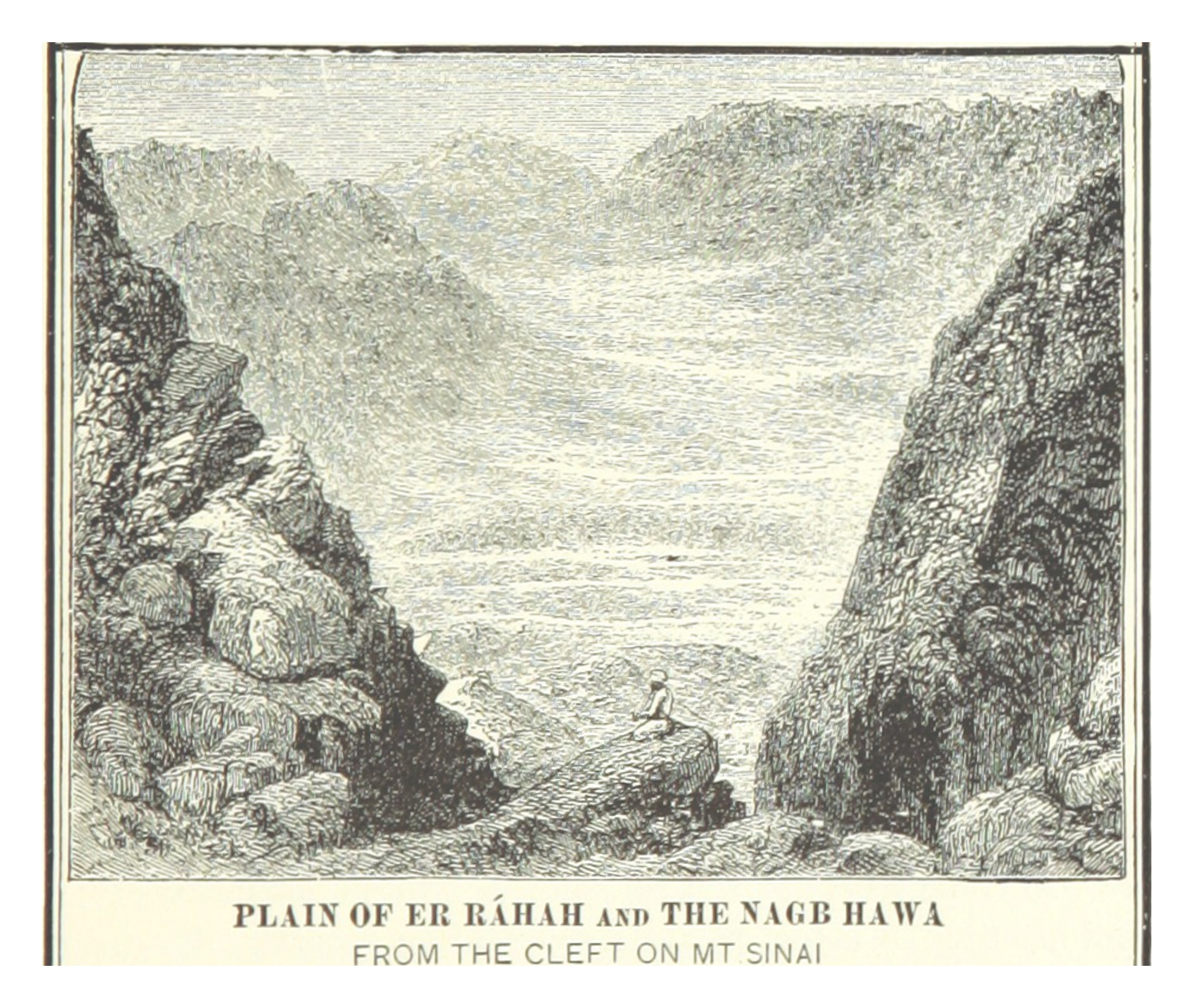
Engraving titled Plain of Er Rahah and the Nagb Hawa from the Cleft on Mt. Sinai showing the view looking down from a rocky cleft high on the mountain through a V-shaped gap in the granite rocks, with the vast Plain of er-Rahah spreading below and the Nagb Hawa pass visible in the far distance, a lone figure sitting on the rocks in the foreground
"Plain of Er Rahah and the Nagb Hawa from the Cleft on Mt. Sinai." This engraving shows the view Moses and the elders would have seen looking down from the mountain toward the plain — the broad camping ground of Israel spread below, with the Nagb Hawa pass in the distance through which they had arrived.
Source: Maccoun, The Holy Land in Geography and in History (1899). Public domain, via Wikimedia Commons.  ·  Historical commentary by Michael Knighton  ·  Christians Standing With Israel
🗺 How to Read This Illustration
① The Cleft of the Rock — You are looking through a narrow rocky cleft — a V-shaped gap between two massive granite walls. This is the perspective from partway up the mountain, looking down toward the plain below. In Exodus 33:21–22, God told Moses: "There is a place by me, and thou shalt stand upon a rock: And it shall come to pass, while my glory passeth by, that I will put thee in a clift of the rock, and will cover thee with mine hand." This engraving may show that very type of cleft.
② The Plain of Er-Rahah Below — The broad flat expanse visible through the cleft is the Plain of er-Rahah — the campsite of Israel. Look at the scale: from this height on the mountain, the plain appears enormous. This is where Israel's Tabernacle stood — the tent of meeting, the ark of the covenant, the altar of burnt offering, the lampstand, the table of showbread. The cloud of God's glory rested over this tent for a year while Israel remained at Sinai.
③ The Nagb Hawa in the Distance — Through the opening in the rock, you can see the Nagb Hawa pass in the far distance — the corridor through which Israel approached Sinai from the northwest. This is the visual connection between the place of revelation (the mountain) and the way of approach (the pass). From the mountain, God could see the entire camp spread below and the way Israel had come.
④ The Lone Figure — Note the solitary figure sitting on the rocks in the lower center of the engraving, looking out over the plain. This figure — drawn tiny against the immensity of granite and sky — captures the human experience of Sinai: one person before an infinite God, looking out from a crack in the mountain at a nation below. Moses spent eighty total days on this mountain — two periods of forty days each.
What This Image Shows
✦ The cleft of the rock — Moses' hiding place
✦ The Plain of er-Rahah spread below
✦ The Nagb Hawa pass in the far distance
✦ The granite walls of the mountain
✦ Israel's campsite and Tabernacle location
✦ The scale of mountain vs. human figure
✦ The view from God's perspective
✦ The year Israel spent at Sinai

A Year in the Presence of God

Look at this engraving carefully. You are looking through a cleft in the rock of Mount Sinai, down toward the plain below. The plain you see is the Plain of er-Rahah — the campsite of Israel. Somewhere on that vast flat expanse, the Tabernacle stood for nearly a year while Israel remained at Sinai, learning who they were as a covenant nation.

The Tabernacle itself is one of the most detailed architectural descriptions in the entire Bible. Exodus 25–40 devotes sixteen full chapters to its construction — materials, dimensions, furniture, priestly garments, consecration procedures, sacrificial system. Nothing in the patriarchal narratives approaches this level of detail. God cared intensely about how He was approached, what the worship structure looked like, and how it was built. The reason was theological: the Tabernacle was not merely a tent. It was a portable representation of God's dwelling among His people — a theology in fabric and wood and gold, with every element pointing to the eventual High Priest who would offer the perfect sacrifice once for all.

The centerpiece was the Ark of the Covenant — an acacia wood chest covered in gold, with two golden cherubim spreading their wings over the mercy seat. The ark contained the two stone tablets of the Law. Above the mercy seat, between the cherubim, was the shekinah — the manifest presence of God. This was the holiest object in Israel's world, and it was right there on the plain below this mountain, visible to the entire nation through the entrance of the Tabernacle court.

When Moses completed the construction exactly as God had commanded, the cloud of God's glory descended and filled the Tabernacle so completely that Moses himself could not enter. The cloud rested on it by day; fire appeared over it by night. This was Israel's signal system for the entire wilderness journey: when the cloud lifted, they moved. When it rested, they stayed. Forty years of wilderness travel was not random wandering — it was a nation being led, day by day and camp by camp, by the visible presence of God.

Key Scripture References
Exodus 25:8–9 — God commands Israel to build the Tabernacle
Exodus 33:21–23 — God places Moses in the cleft of the rock
Exodus 40:17–33 — The Tabernacle completed and set up
Exodus 40:34–38 — The cloud fills the Tabernacle; Israel follows
Numbers 9:15–23 — The cloud guides every movement
Hebrews 9:1–12 — The Tabernacle as a shadow of the heavenly
Illustration: Maccoun, The Holy Land in Geography and in History (1899). Public domain, via Wikimedia Commons.  ·  Historical commentary: © 2026 Michael Wayne Knighton | Christians Standing With Israel™ | All Rights Reserved.
MAP 057
Mount Sinai — The Giving of the Law
MAP 059
The Full Exodus Route
Advertisement
Israel at Sinai — The Tabernacle | Christians Standing With Israel — Michael Knighton Israel at Sinai — The Tabernacle | Christians Standing With Israel — Michael Knighton
✡ "Pray for the peace of Jerusalem" — Psalm 122:6
Christians Standing With Israel
Home Site Map Search About Us Our Beliefs Online Bible Maps of Israel Articles Grafted In? Apple of His Eye Contact
TOPICS
Israel — Then & Now Anti-Semitism Middle East Christian Zionism Bible Prophecy US & Israel Media Bias Spiritual Deception Arab-Israeli Conflict Islamic Extremism The Iranian Threat Replacement Theology
LATEST: New article by Michael Knighton  •  Subscribe to our weekly newsletter  •  400 Maps of Israel now available  •  Online Bible (KJV) now online
Advertisement
Map 058  ·  The Patriarchs & the Exodus  ·  Exodus 40:34

Israel at Sinai — The Tabernacle

The view from the cleft of Mount Sinai — looking down at the plain where Israel camped, built the Tabernacle, and spent a year in the presence of God
"Then a cloud covered the tent of the congregation, and the glory of the LORD filled the tabernacle. And Moses was not able to enter into the tent of the congregation, because the cloud abode thereon, and the glory of the LORD filled the tabernacle."
— Exodus 40:34–35 (KJV)
Engraving titled Plain of Er Rahah and the Nagb Hawa from the Cleft on Mt. Sinai showing the view looking down from a rocky cleft high on the mountain through a V-shaped gap in the granite rocks, with the vast Plain of er-Rahah spreading below and the Nagb Hawa pass visible in the far distance, a lone figure sitting on the rocks in the foreground
"Plain of Er Rahah and the Nagb Hawa from the Cleft on Mt. Sinai." This engraving shows the view Moses and the elders would have seen looking down from the mountain toward the plain — the broad camping ground of Israel spread below, with the Nagb Hawa pass in the distance through which they had arrived.
Source: Maccoun, The Holy Land in Geography and in History (1899). Public domain, via Wikimedia Commons.  ·  Historical commentary by Michael Knighton  ·  Christians Standing With Israel
🗺 How to Read This Illustration
① The Cleft of the Rock — You are looking through a narrow rocky cleft — a V-shaped gap between two massive granite walls. This is the perspective from partway up the mountain, looking down toward the plain below. In Exodus 33:21–22, God told Moses: "There is a place by me, and thou shalt stand upon a rock: And it shall come to pass, while my glory passeth by, that I will put thee in a clift of the rock, and will cover thee with mine hand." This engraving may show that very type of cleft.
② The Plain of Er-Rahah Below — The broad flat expanse visible through the cleft is the Plain of er-Rahah — the campsite of Israel. Look at the scale: from this height on the mountain, the plain appears enormous. This is where Israel's Tabernacle stood — the tent of meeting, the ark of the covenant, the altar of burnt offering, the lampstand, the table of showbread. The cloud of God's glory rested over this tent for a year while Israel remained at Sinai.
③ The Nagb Hawa in the Distance — Through the opening in the rock, you can see the Nagb Hawa pass in the far distance — the corridor through which Israel approached Sinai from the northwest. This is the visual connection between the place of revelation (the mountain) and the way of approach (the pass). From the mountain, God could see the entire camp spread below and the way Israel had come.
④ The Lone Figure — Note the solitary figure sitting on the rocks in the lower center of the engraving, looking out over the plain. This figure — drawn tiny against the immensity of granite and sky — captures the human experience of Sinai: one person before an infinite God, looking out from a crack in the mountain at a nation below. Moses spent eighty total days on this mountain — two periods of forty days each.
What This Image Shows
✦ The cleft of the rock — Moses' hiding place
✦ The Plain of er-Rahah spread below
✦ The Nagb Hawa pass in the far distance
✦ The granite walls of the mountain
✦ Israel's campsite and Tabernacle location
✦ The scale of mountain vs. human figure
✦ The view from God's perspective
✦ The year Israel spent at Sinai

A Year in the Presence of God

Look at this engraving carefully. You are looking through a cleft in the rock of Mount Sinai, down toward the plain below. The plain you see is the Plain of er-Rahah — the campsite of Israel. Somewhere on that vast flat expanse, the Tabernacle stood for nearly a year while Israel remained at Sinai, learning who they were as a covenant nation.

The Tabernacle itself is one of the most detailed architectural descriptions in the entire Bible. Exodus 25–40 devotes sixteen full chapters to its construction — materials, dimensions, furniture, priestly garments, consecration procedures, sacrificial system. Nothing in the patriarchal narratives approaches this level of detail. God cared intensely about how He was approached, what the worship structure looked like, and how it was built. The reason was theological: the Tabernacle was not merely a tent. It was a portable representation of God's dwelling among His people — a theology in fabric and wood and gold, with every element pointing to the eventual High Priest who would offer the perfect sacrifice once for all.

The centerpiece was the Ark of the Covenant — an acacia wood chest covered in gold, with two golden cherubim spreading their wings over the mercy seat. The ark contained the two stone tablets of the Law. Above the mercy seat, between the cherubim, was the shekinah — the manifest presence of God. This was the holiest object in Israel's world, and it was right there on the plain below this mountain, visible to the entire nation through the entrance of the Tabernacle court.

When Moses completed the construction exactly as God had commanded, the cloud of God's glory descended and filled the Tabernacle so completely that Moses himself could not enter. The cloud rested on it by day; fire appeared over it by night. This was Israel's signal system for the entire wilderness journey: when the cloud lifted, they moved. When it rested, they stayed. Forty years of wilderness travel was not random wandering — it was a nation being led, day by day and camp by camp, by the visible presence of God.

Key Scripture References
Exodus 25:8–9 — God commands Israel to build the Tabernacle
Exodus 33:21–23 — God places Moses in the cleft of the rock
Exodus 40:17–33 — The Tabernacle completed and set up
Exodus 40:34–38 — The cloud fills the Tabernacle; Israel follows
Numbers 9:15–23 — The cloud guides every movement
Hebrews 9:1–12 — The Tabernacle as a shadow of the heavenly
Illustration: Maccoun, The Holy Land in Geography and in History (1899). Public domain, via Wikimedia Commons.  ·  Historical commentary: © 2026 Michael Wayne Knighton | Christians Standing With Israel™ | All Rights Reserved.
MAP 057
Mount Sinai — The Giving of the Law
MAP 059
The Full Exodus Route
Advertisement
Israel at Sinai — The Tabernacle | Christians Standing With Israel — Michael Knighton Israel at Sinai — The Tabernacle | Christians Standing With Israel — Michael Knighton
✡ "Pray for the peace of Jerusalem" — Psalm 122:6
Christians Standing With Israel
Home Site Map Search About Us Our Beliefs Online Bible Maps of Israel Articles Grafted In? Apple of His Eye Contact
TOPICS
Israel — Then & Now Anti-Semitism Middle East Christian Zionism Bible Prophecy US & Israel Media Bias Spiritual Deception Arab-Israeli Conflict Islamic Extremism The Iranian Threat Replacement Theology
LATEST: New article by Michael Knighton  •  Subscribe to our weekly newsletter  •  400 Maps of Israel now available  •  Online Bible (KJV) now online
Advertisement
Map 058  ·  The Patriarchs & the Exodus  ·  Exodus 40:34

Israel at Sinai — The Tabernacle

The view from the cleft of Mount Sinai — looking down at the plain where Israel camped, built the Tabernacle, and spent a year in the presence of God
"Then a cloud covered the tent of the congregation, and the glory of the LORD filled the tabernacle. And Moses was not able to enter into the tent of the congregation, because the cloud abode thereon, and the glory of the LORD filled the tabernacle."
— Exodus 40:34–35 (KJV)
Engraving titled Plain of Er Rahah and the Nagb Hawa from the Cleft on Mt. Sinai showing the view looking down from a rocky cleft high on the mountain through a V-shaped gap in the granite rocks, with the vast Plain of er-Rahah spreading below and the Nagb Hawa pass visible in the far distance, a lone figure sitting on the rocks in the foreground
"Plain of Er Rahah and the Nagb Hawa from the Cleft on Mt. Sinai." This engraving shows the view Moses and the elders would have seen looking down from the mountain toward the plain — the broad camping ground of Israel spread below, with the Nagb Hawa pass in the distance through which they had arrived.
Source: Maccoun, The Holy Land in Geography and in History (1899). Public domain, via Wikimedia Commons.  ·  Historical commentary by Michael Knighton  ·  Christians Standing With Israel
🗺 How to Read This Illustration
① The Cleft of the Rock — You are looking through a narrow rocky cleft — a V-shaped gap between two massive granite walls. This is the perspective from partway up the mountain, looking down toward the plain below. In Exodus 33:21–22, God told Moses: "There is a place by me, and thou shalt stand upon a rock: And it shall come to pass, while my glory passeth by, that I will put thee in a clift of the rock, and will cover thee with mine hand." This engraving may show that very type of cleft.
② The Plain of Er-Rahah Below — The broad flat expanse visible through the cleft is the Plain of er-Rahah — the campsite of Israel. Look at the scale: from this height on the mountain, the plain appears enormous. This is where Israel's Tabernacle stood — the tent of meeting, the ark of the covenant, the altar of burnt offering, the lampstand, the table of showbread. The cloud of God's glory rested over this tent for a year while Israel remained at Sinai.
③ The Nagb Hawa in the Distance — Through the opening in the rock, you can see the Nagb Hawa pass in the far distance — the corridor through which Israel approached Sinai from the northwest. This is the visual connection between the place of revelation (the mountain) and the way of approach (the pass). From the mountain, God could see the entire camp spread below and the way Israel had come.
④ The Lone Figure — Note the solitary figure sitting on the rocks in the lower center of the engraving, looking out over the plain. This figure — drawn tiny against the immensity of granite and sky — captures the human experience of Sinai: one person before an infinite God, looking out from a crack in the mountain at a nation below. Moses spent eighty total days on this mountain — two periods of forty days each.
What This Image Shows
✦ The cleft of the rock — Moses' hiding place
✦ The Plain of er-Rahah spread below
✦ The Nagb Hawa pass in the far distance
✦ The granite walls of the mountain
✦ Israel's campsite and Tabernacle location
✦ The scale of mountain vs. human figure
✦ The view from God's perspective
✦ The year Israel spent at Sinai

A Year in the Presence of God

Look at this engraving carefully. You are looking through a cleft in the rock of Mount Sinai, down toward the plain below. The plain you see is the Plain of er-Rahah — the campsite of Israel. Somewhere on that vast flat expanse, the Tabernacle stood for nearly a year while Israel remained at Sinai, learning who they were as a covenant nation.

The Tabernacle itself is one of the most detailed architectural descriptions in the entire Bible. Exodus 25–40 devotes sixteen full chapters to its construction — materials, dimensions, furniture, priestly garments, consecration procedures, sacrificial system. Nothing in the patriarchal narratives approaches this level of detail. God cared intensely about how He was approached, what the worship structure looked like, and how it was built. The reason was theological: the Tabernacle was not merely a tent. It was a portable representation of God's dwelling among His people — a theology in fabric and wood and gold, with every element pointing to the eventual High Priest who would offer the perfect sacrifice once for all.

The centerpiece was the Ark of the Covenant — an acacia wood chest covered in gold, with two golden cherubim spreading their wings over the mercy seat. The ark contained the two stone tablets of the Law. Above the mercy seat, between the cherubim, was the shekinah — the manifest presence of God. This was the holiest object in Israel's world, and it was right there on the plain below this mountain, visible to the entire nation through the entrance of the Tabernacle court.

When Moses completed the construction exactly as God had commanded, the cloud of God's glory descended and filled the Tabernacle so completely that Moses himself could not enter. The cloud rested on it by day; fire appeared over it by night. This was Israel's signal system for the entire wilderness journey: when the cloud lifted, they moved. When it rested, they stayed. Forty years of wilderness travel was not random wandering — it was a nation being led, day by day and camp by camp, by the visible presence of God.

Key Scripture References
Exodus 25:8–9 — God commands Israel to build the Tabernacle
Exodus 33:21–23 — God places Moses in the cleft of the rock
Exodus 40:17–33 — The Tabernacle completed and set up
Exodus 40:34–38 — The cloud fills the Tabernacle; Israel follows
Numbers 9:15–23 — The cloud guides every movement
Hebrews 9:1–12 — The Tabernacle as a shadow of the heavenly
Illustration: Maccoun, The Holy Land in Geography and in History (1899). Public domain, via Wikimedia Commons.  ·  Historical commentary: © 2026 Michael Wayne Knighton | Christians Standing With Israel™ | All Rights Reserved.
MAP 057
Mount Sinai — The Giving of the Law
MAP 059
The Full Exodus Route
Advertisement
Israel at Sinai — The Tabernacle | Christians Standing With Israel — Michael Knighton Israel at Sinai — The Tabernacle | Christians Standing With Israel — Michael Knighton
✡ "Pray for the peace of Jerusalem" — Psalm 122:6
Christians Standing With Israel
Home Site Map Search About Us Our Beliefs Online Bible Maps of Israel Articles Grafted In? Apple of His Eye Contact
TOPICS
Israel — Then & Now Anti-Semitism Middle East Christian Zionism Bible Prophecy US & Israel Media Bias Spiritual Deception Arab-Israeli Conflict Islamic Extremism The Iranian Threat Replacement Theology
LATEST: New article by Michael Knighton  •  Subscribe to our weekly newsletter  •  400 Maps of Israel now available  •  Online Bible (KJV) now online
Advertisement
Map 058  ·  The Patriarchs & the Exodus  ·  Exodus 40:34

Israel at Sinai — The Tabernacle

The view from the cleft of Mount Sinai — looking down at the plain where Israel camped, built the Tabernacle, and spent a year in the presence of God
"Then a cloud covered the tent of the congregation, and the glory of the LORD filled the tabernacle. And Moses was not able to enter into the tent of the congregation, because the cloud abode thereon, and the glory of the LORD filled the tabernacle."
— Exodus 40:34–35 (KJV)
Engraving titled Plain of Er Rahah and the Nagb Hawa from the Cleft on Mt. Sinai showing the view looking down from a rocky cleft high on the mountain through a V-shaped gap in the granite rocks, with the vast Plain of er-Rahah spreading below and the Nagb Hawa pass visible in the far distance, a lone figure sitting on the rocks in the foreground
"Plain of Er Rahah and the Nagb Hawa from the Cleft on Mt. Sinai." This engraving shows the view Moses and the elders would have seen looking down from the mountain toward the plain — the broad camping ground of Israel spread below, with the Nagb Hawa pass in the distance through which they had arrived.
Source: Maccoun, The Holy Land in Geography and in History (1899). Public domain, via Wikimedia Commons.  ·  Historical commentary by Michael Knighton  ·  Christians Standing With Israel
🗺 How to Read This Illustration
① The Cleft of the Rock — You are looking through a narrow rocky cleft — a V-shaped gap between two massive granite walls. This is the perspective from partway up the mountain, looking down toward the plain below. In Exodus 33:21–22, God told Moses: "There is a place by me, and thou shalt stand upon a rock: And it shall come to pass, while my glory passeth by, that I will put thee in a clift of the rock, and will cover thee with mine hand." This engraving may show that very type of cleft.
② The Plain of Er-Rahah Below — The broad flat expanse visible through the cleft is the Plain of er-Rahah — the campsite of Israel. Look at the scale: from this height on the mountain, the plain appears enormous. This is where Israel's Tabernacle stood — the tent of meeting, the ark of the covenant, the altar of burnt offering, the lampstand, the table of showbread. The cloud of God's glory rested over this tent for a year while Israel remained at Sinai.
③ The Nagb Hawa in the Distance — Through the opening in the rock, you can see the Nagb Hawa pass in the far distance — the corridor through which Israel approached Sinai from the northwest. This is the visual connection between the place of revelation (the mountain) and the way of approach (the pass). From the mountain, God could see the entire camp spread below and the way Israel had come.
④ The Lone Figure — Note the solitary figure sitting on the rocks in the lower center of the engraving, looking out over the plain. This figure — drawn tiny against the immensity of granite and sky — captures the human experience of Sinai: one person before an infinite God, looking out from a crack in the mountain at a nation below. Moses spent eighty total days on this mountain — two periods of forty days each.
What This Image Shows
✦ The cleft of the rock — Moses' hiding place
✦ The Plain of er-Rahah spread below
✦ The Nagb Hawa pass in the far distance
✦ The granite walls of the mountain
✦ Israel's campsite and Tabernacle location
✦ The scale of mountain vs. human figure
✦ The view from God's perspective
✦ The year Israel spent at Sinai

A Year in the Presence of God

Look at this engraving carefully. You are looking through a cleft in the rock of Mount Sinai, down toward the plain below. The plain you see is the Plain of er-Rahah — the campsite of Israel. Somewhere on that vast flat expanse, the Tabernacle stood for nearly a year while Israel remained at Sinai, learning who they were as a covenant nation.

The Tabernacle itself is one of the most detailed architectural descriptions in the entire Bible. Exodus 25–40 devotes sixteen full chapters to its construction — materials, dimensions, furniture, priestly garments, consecration procedures, sacrificial system. Nothing in the patriarchal narratives approaches this level of detail. God cared intensely about how He was approached, what the worship structure looked like, and how it was built. The reason was theological: the Tabernacle was not merely a tent. It was a portable representation of God's dwelling among His people — a theology in fabric and wood and gold, with every element pointing to the eventual High Priest who would offer the perfect sacrifice once for all.

The centerpiece was the Ark of the Covenant — an acacia wood chest covered in gold, with two golden cherubim spreading their wings over the mercy seat. The ark contained the two stone tablets of the Law. Above the mercy seat, between the cherubim, was the shekinah — the manifest presence of God. This was the holiest object in Israel's world, and it was right there on the plain below this mountain, visible to the entire nation through the entrance of the Tabernacle court.

When Moses completed the construction exactly as God had commanded, the cloud of God's glory descended and filled the Tabernacle so completely that Moses himself could not enter. The cloud rested on it by day; fire appeared over it by night. This was Israel's signal system for the entire wilderness journey: when the cloud lifted, they moved. When it rested, they stayed. Forty years of wilderness travel was not random wandering — it was a nation being led, day by day and camp by camp, by the visible presence of God.

Key Scripture References
Exodus 25:8–9 — God commands Israel to build the Tabernacle
Exodus 33:21–23 — God places Moses in the cleft of the rock
Exodus 40:17–33 — The Tabernacle completed and set up
Exodus 40:34–38 — The cloud fills the Tabernacle; Israel follows
Numbers 9:15–23 — The cloud guides every movement
Hebrews 9:1–12 — The Tabernacle as a shadow of the heavenly
Illustration: Maccoun, The Holy Land in Geography and in History (1899). Public domain, via Wikimedia Commons.  ·  Historical commentary: © 2026 Michael Wayne Knighton | Christians Standing With Israel™ | All Rights Reserved.
MAP 057
Mount Sinai — The Giving of the Law
MAP 059
The Full Exodus Route
Advertisement