
The Egyptian Empire at Its Height
Historical & Biblical Background
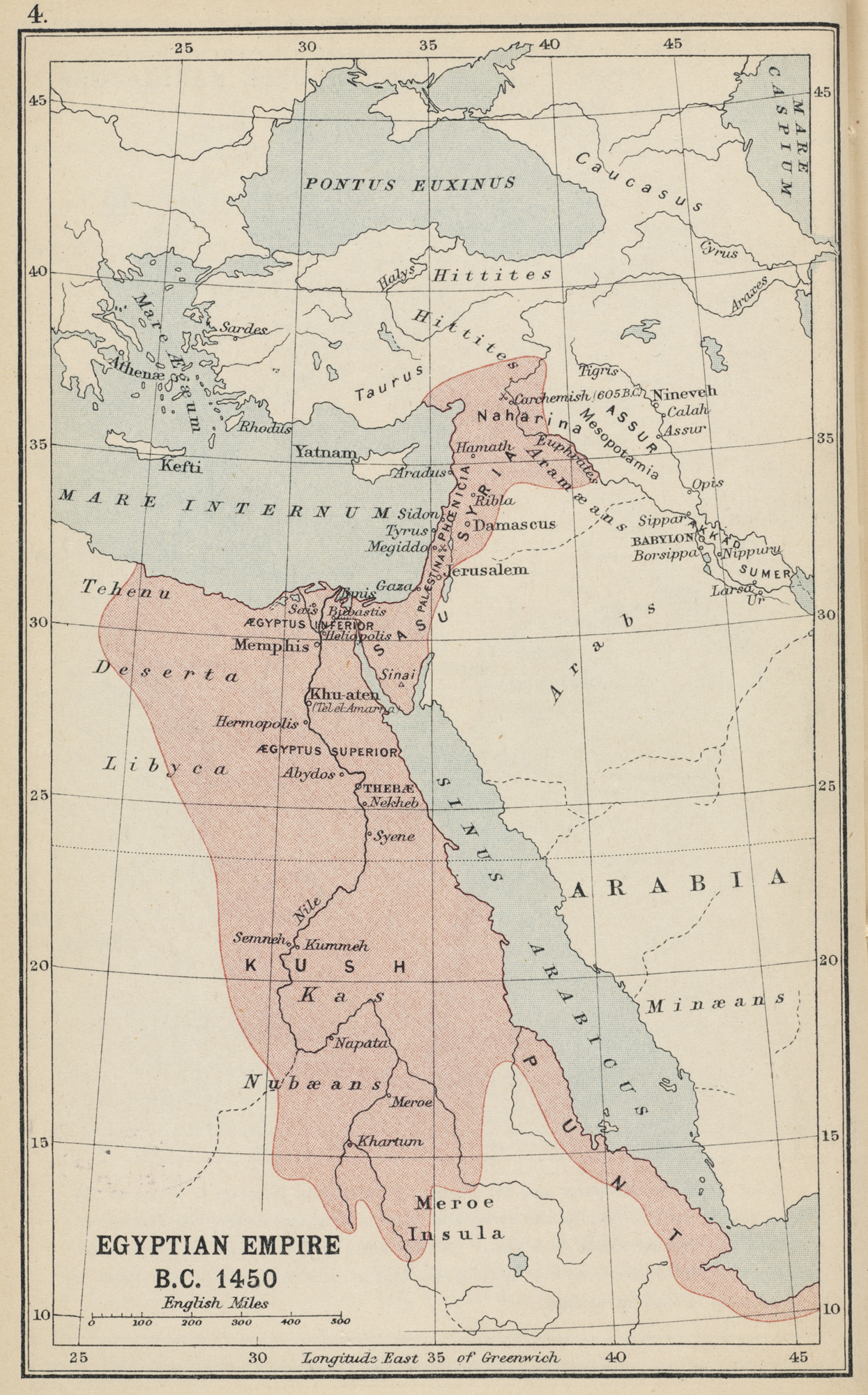
This map shows Egypt at precisely the moment the Bible places Israel in bondage — approximately 1450 BC, during the height of Egypt's New Kingdom period. At this moment in history, Egypt was the undisputed superpower of the ancient world, its empire stretching from the scorching deserts of Kush in the south to the borders of the Hittite Empire in the north, and from the Libyan desert in the west to the Euphrates in the east. It was against this colossal empire that God chose to display His power through the ten plagues and the Exodus.
Egypt's New Kingdom — The Empire at Its Peak
The New Kingdom (c. 1550–1070 BC) represents Egypt at its most powerful and expansive. The great pharaohs of this era — Thutmose III, Amenhotep II, Ramesses II — pushed Egypt's boundaries to their greatest extent. Thutmose III, who reigned around 1479–1425 BC, is often called the "Napoleon of Ancient Egypt," conducting seventeen military campaigns into Canaan and Syria. The pink shading on this map represents this maximum extent — an empire encompassing most of what we today call the Middle East.
Israel in the Shadow of Pharaoh
Notice on this map that Canaan — the land God had promised to Abraham — sits squarely within Egypt's sphere of influence. Jerusalem, Gaza, Megiddo, and the entire coast of Palestine are shown under Egyptian control. This is the world into which Moses was born, in which Israel groaned under slavery, and from which God promised deliverance. When God said "I have seen the affliction of my people which are in Egypt" (Exodus 3:7), it was this empire — the most powerful on earth — that He was about to confront.
The Ten Plagues as Theological Warfare
The ten plagues were not random catastrophes. Each one was a direct assault on a specific Egyptian deity — the Nile god Hapi, the frog goddess Heqet, the sun god Ra, and ultimately Pharaoh himself, who was worshiped as a god. God declared to Moses: "Against all the gods of Egypt I will execute judgment" (Exodus 12:12). The Exodus was a theological demolition of the greatest empire on earth, executed by the God of a nation of slaves.
Why This Map Matters
Seeing the scale of the Egyptian Empire at 1450 BC makes the Exodus all the more extraordinary. Israel did not escape a minor regional power. They escaped the greatest empire the ancient world had ever seen — and God did it with ten plagues, a pillar of cloud and fire, and a path through the sea. "Who is like unto thee, O LORD, among the gods? who is like thee, glorious in holiness, fearful in praises, doing wonders?" (Exodus 15:11).
"Who is like unto thee, O LORD, among the gods? who is like thee, glorious in holiness, fearful in praises, doing wonders?"— Exodus 15:11 (KJV)
Key Scripture References
Exodus 3:7–8 — God sees Israel's affliction and acts
Exodus 7–12 — The ten plagues against Egypt and her gods
Exodus 12:12 — "Against all the gods of Egypt I will execute judgment"
Exodus 15:1–21 — The Song of Moses after crossing the Red Sea
Deuteronomy 7:18–19 — Remember what God did to Pharaoh and Egypt
Isaiah 31:1–3 — Warning against trusting Egypt over God
Ezekiel 29:3 — Prophecy against Pharaoh, the great dragon in the Nile