
The Ancient City of Jericho
Historical & Biblical Background
Jericho is one of the most ancient cities on earth. Archaeological excavations at Tell es-Sultan — the mound that marks the site of ancient Jericho — have revealed continuous occupation dating back to approximately 9000 BC, making it among the earliest known permanently settled communities in human history. It sits in the deep Jordan Valley, about 850 feet below sea level — the lowest city on earth — watered by a powerful spring (Ein es-Sultan) that made it a lush oasis in an otherwise arid landscape. When Joshua led Israel across the Jordan, Jericho was the first fortress he faced — and God's instructions for taking it could not have been more unexpected.
The Crossing at Adam
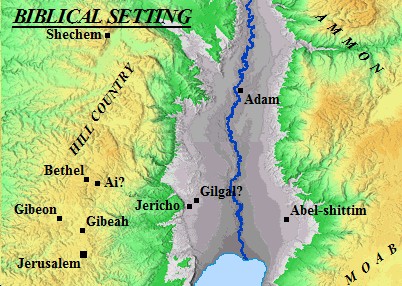
This map shows the city of Adam at the northern end of the Jordan Valley — and it is there that the miracle of the Jordan crossing took place. Joshua 3:16 records that "the waters which came down from above stood and rose up upon a heap very far from the city Adam, that is beside Zaretan: and those that came down toward the sea of the plain, even the salt sea, failed, and were cut off." The entire Jordan River stopped flowing at Adam, and Israel crossed on dry ground — a deliberate echo of the Red Sea crossing forty years earlier, establishing Joshua as Moses's true successor.
Gilgal — The Camp of Circumcision
After crossing the Jordan, Israel camped at Gilgal — visible on this map just east of Jericho. There God commanded Joshua to circumcise all the males born in the wilderness, "for all the people that were born in the wilderness by the way as they came forth out of Egypt, them they had not circumcised" (Joshua 5:5). The reproach of Egypt was rolled away at Gilgal (the name may mean "rolling"). It was from Gilgal that the armies marched out each day to circle Jericho, and to Gilgal they returned each night.
The Battle of Jericho — God's Strategy
God's battle plan for Jericho was designed to make one thing unmistakably clear: the conquest of Canaan was not a military achievement. It was a divine gift. Israel was to march around the city once per day for six days, with seven priests carrying ram's horn trumpets before the Ark of the Covenant, and in silence. On the seventh day they were to march seven times, the priests were to blow the trumpets, and the people were to shout — and the walls would fall flat. No siege engines. No assault ladders. No military tactics. Just obedience, faith, and the word of God. When Israel obeyed, "the wall fell down flat, so that the people went up into the city" (Joshua 6:20).
Rahab — Grace in the Ruins
The one exception in Jericho's destruction was Rahab the harlot, who had hidden the Israelite spies and tied a scarlet thread in her window. She and her household were spared. More than spared — Rahab married into Israel, became the mother of Boaz, the grandmother of Jesse, and the great-grandmother of King David. Her name appears in the genealogy of Jesus Christ (Matthew 1:5). The scarlet thread in Rahab's window has been seen by theologians as a type of the blood of Christ — the mark that causes the destroyer to pass over.
"By faith the walls of Jericho fell down, after they were compassed about seven days. By faith the harlot Rahab perished not with them that believed not, when she had received the spies with peace."— Hebrews 11:30–31 (KJV)
Key Scripture References
Joshua 2:1–24 — The two spies in Jericho; Rahab's scarlet thread
Joshua 3:14–17 — The Jordan stops at Adam; Israel crosses on dry ground
Joshua 4:19–20 — Israel camps at Gilgal; twelve memorial stones
Joshua 5:1–12 — Circumcision at Gilgal; the reproach of Egypt rolled away
Joshua 6:1–27 — The march, the trumpets, the shout, the falling walls
Joshua 6:17–25 — Rahab and her household saved
Hebrews 11:30–31 — Jericho and Rahab listed among the heroes of faith
Matthew 1:5 — Rahab in the genealogy of Jesus Christ