
Genesis 10 is unlike any other chapter in the book — and unlike almost any other document in the ancient world. It is a geographical and ethnological register of the nations of the known world, tracing the descent of seventy peoples from the three sons of Noah after the Flood. Ancient Near Eastern literature has no real parallel to it. Where other ancient peoples told myths of divine creation producing isolated groups, Genesis 10 presents a coherent vision of human unity: one family, one Flood, one repopulated world descending from three brothers.
The three lines of descent are distinct and purposeful. Japheth's fourteen descendants spread northward and westward — into Anatolia, the Aegean, Greece, and ultimately Europe. Many of his listed sons correspond to peoples well-known from ancient history: Gomer (the Cimmerians), Madai (the Medes), Javan (the Greeks — the Hebrew word for Greece, Yavan, derives directly from this name), Tubal and Meshech (peoples of Anatolia mentioned repeatedly in Ezekiel), and Tiras (possibly the Thracians or Tyrrhenians).
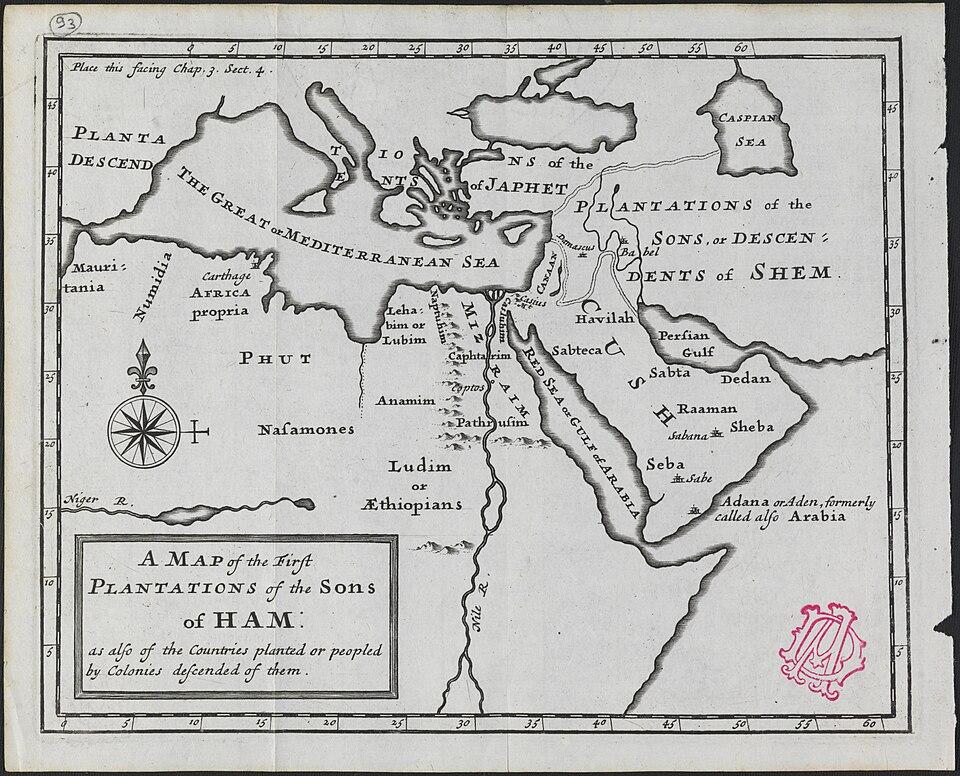
Ham's thirty descendants spread southward into Africa and into the critical land bridge of Canaan. His sons include Cush (Ethiopia/Nubia), Mizraim (Egypt — still the Hebrew name for Egypt today), Put (Libya), and Canaan — whose descendants became the very peoples Israel was commanded to displace. Within Ham's line appears Nimrod, described as "a mighty hunter before the LORD" and the founder of the world's first empire: Babel, Erech, Accad, and Calneh in Shinar, then Nineveh and the other cities of Assyria. Nimrod is the first conqueror in biblical history — the archetype of human ambition organized against God.
Shem's twenty-six descendants occupy Arabia and Mesopotamia — the heartland of the Semitic world. From Shem descends Eber, whose name gives us the word "Hebrew." From Eber's son Peleg — whose name means "division," with the text noting that "in his days was the earth divided" — runs the line that leads directly to Terah, father of Abraham. The entire patriarchal story, and the entire history of Israel, flows from this single genealogical thread buried in Genesis 10.
The theological implications of the Table of Nations are profound. It establishes that all human beings share a common ancestry — a truth that runs against every form of racial superiority. It explains why the peoples surrounding Israel in the biblical narrative have the characteristics they do: the Canaanites are Hamites under a specific curse (Genesis 9:25); the Philistines trace to Casluhim, a son of Mizraim; the Amorites, Jebusites, and Hittites all appear here as Canaanite peoples. The enemies of Israel in the conquest narratives are not strangers appearing from nowhere — they are cousins, known quantities in a family map that Genesis laid out centuries before.
The number seventy is almost certainly deliberate. Jewish tradition counts seventy nations in the Table. Jesus sent out seventy disciples (Luke 10:1). The Septuagint lists seventy-two members of Jacob's family who descended into Egypt. The number seventy in Hebrew thought represents completeness, totality — all the nations of the earth. Genesis 10 is saying: here is everyone. Here is the whole human family, spread across the whole earth, all descended from one man saved by grace from a world-destroying Flood.