✡ "Pray for the peace of Jerusalem" — Psalm 122:6
Christians Standing With Israel
Home Site Map Search About Us Our Beliefs Online Bible Maps of Israel Articles Grafted In? Apple of His Eye Contact
TOPICS
Israel — Then & Now Anti-Semitism Middle East Christian Zionism Bible Prophecy US & Israel Media Bias Spiritual Deception Arab-Israeli Conflict Islamic Extremism The Iranian Threat Replacement Theology
LATEST: New article by Michael Knighton  •  Subscribe to our weekly newsletter  •  400 Maps of Israel now available  •  Online Bible (KJV) now online
Advertisement
Map 054  ·  The Patriarchs & the Exodus  ·  Exodus 14:21–31

The Crossing of the Red Sea

The sea parted, Israel walked through on dry ground, and the army of Egypt was destroyed — the supreme act of deliverance in the Old Testament
"And Moses stretched out his hand over the sea; and the LORD caused the sea to go back by a strong east wind all that night, and made the sea dry land, and the waters were divided. And the children of Israel went into the midst of the sea upon the dry ground."
— Exodus 14:21–22 (KJV)
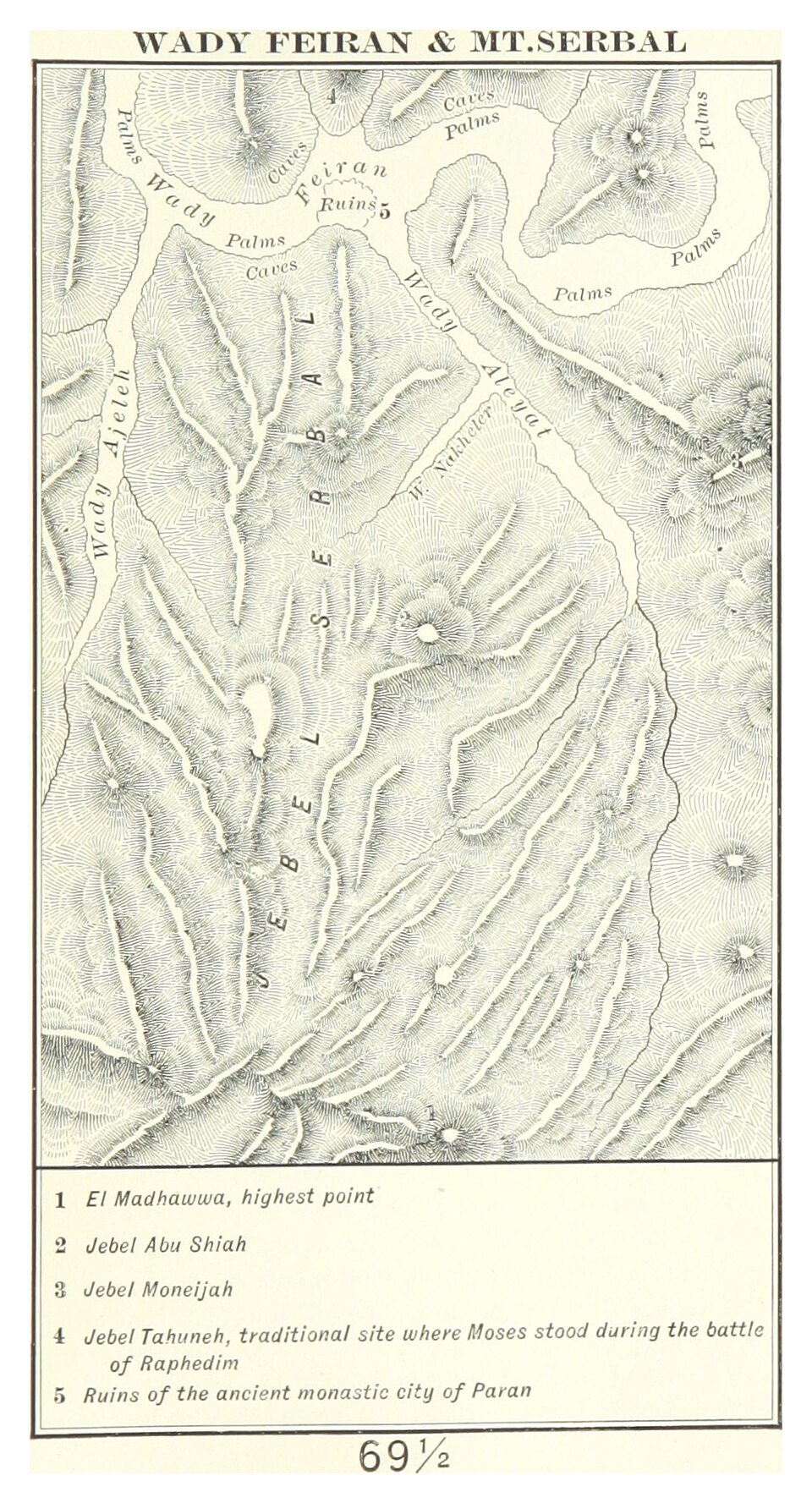
Detailed topographic map of Wady Feiran and Mt. Serbal in the southern Sinai showing the rugged mountain terrain, the Wady Feiran valley with palm groves and ruins, the Wady Aleyat, and numbered landmarks including Jebel Tahuneh — the traditional site where Moses stood during the battle of Rephidim — the ancient monastic ruins of Paran, and the high peaks of the Jebel es Serbal massif
"Wady Feiran & Mt. Serbal." This detailed map shows the terrain Israel passed through after the Red Sea crossing — the deep wadis and granite peaks of the southern Sinai, including Wady Feiran (Israel's probable route) and Mt. Serbal. The legend identifies Jebel Tahuneh as the traditional site where Moses stood with raised hands during the battle against Amalek at Rephidim.
Source: Maccoun, The Holy Land in Geography and in History (1899). Public domain, via Wikimedia Commons.  ·  Historical commentary by Michael Knighton  ·  Christians Standing With Israel
🗺 How to Read This Map
① The Post-Crossing Terrain — This map shows what Israel entered after crossing the sea — the deep granite mountains of the southern Sinai Peninsula. The rugged topography you see — tight wadis, soaring peaks, no roads — represents the terrain Israel was navigating. After the miracle of the crossing, this was the daily reality: difficult mountain travel with millions of people and their flocks.
② Wady Feiran — The Route — Find "Wady Feiran" at the top of the map, with "Ruins" and "Palms" labeled. Wady Feiran is the largest oasis in the Sinai Peninsula and the most viable route through the southern mountains. Many scholars identify this wady as Israel's path from the coast to Sinai. The ruins here are of an ancient city — possibly Rephidim itself, or the later monastic city of Paran (labeled #5 in the legend).
③ Jebel Tahuneh — Moses' Hilltop — Read the legend at the bottom of the map: item 4 reads "Jebel Tahuneh, traditional site where Moses stood during the battle of Raphedim." Find the number 4 labeled on the map near Wady Feiran. This is the hill where Aaron and Hur held Moses' arms raised all day while Joshua fought the Amalekites below. When Moses' hands fell, Israel lost ground. When his hands were raised, Israel prevailed.
④ The Scale of the Terrain — Note how deep the wadis cut between the peaks — some cliffs rise hundreds of meters. This is the wilderness that God led two million people through. Every morning the manna appeared on the ground. Every evening quail covered the camp. The pillar of cloud by day and fire by night led every step. The logistics were impossible by human calculation. They were sustained entirely by God.
What This Map Shows
✦ The southern Sinai mountain terrain
✦ Wady Feiran — the main access route
✦ Jebel Tahuneh — Moses' hilltop at Rephidim
✦ The Jebel es Serbal massif
✦ Ancient ruins of Paran monastic city
✦ The deep granite wadis of Sinai
✦ Palm groves — signs of water in the wilderness
✦ The route from the Red Sea toward Sinai

Through the Sea on Dry Ground

The Red Sea crossing is the climactic act of the Exodus narrative — the moment God demonstrated beyond all doubt that He was Israel's God and Pharaoh's army was finished. Look at the terrain on this map. This is what Israel entered after the crossing — the deep granite mountains of the southern Sinai. The deliverance at the sea was not the end of the journey; it was the beginning of the wilderness. But what a beginning.

The sequence leading to the crossing was carefully designed by God to produce maximum dramatic impact. He had led Israel toward the sea deliberately — making them appear trapped. Pharaoh looked at the geography and concluded that Israel was "entangled in the land, the wilderness hath shut them in" (Exodus 14:3). He mobilized his entire chariot force — six hundred chosen chariots — and pursued. Israel saw the army coming and panicked. Their complaint to Moses is memorable in its accuracy: "Were there no graves in Egypt, that thou hast brought us away here to die in the wilderness?" (Exodus 14:11). Moses' reply became one of the defining declarations of biblical faith: "Fear ye not, stand still, and see the salvation of the LORD... The LORD shall fight for you, and ye shall hold your peace."

God told Moses to lift his staff and stretch his hand over the sea. The pillar of cloud moved to stand behind Israel, separating them from the Egyptian army all night. A strong east wind blew all night and the sea divided — walls of water on both sides, dry ground in between. Israel walked through. The Egyptian army followed at dawn — and God looked down through the pillar of fire and confused them. Their chariot wheels came off. "Let us flee from the face of Israel," the Egyptians said, "for the LORD fighteth for them." Too late. Moses stretched his hand over the sea again and it closed.

Exodus 14:28 reports the result: "And the waters returned, and covered the chariots, and the horsemen, and all the host of Pharaoh that came into the sea after them; there remained not so much as one of them." The entire Egyptian pursuing force was destroyed. Israel stood on the far shore and saw them dead on the beach. And Moses led the nation in song — the Song of Moses, recorded in Exodus 15 — the first great hymn of the Bible. Find Wady Feiran on this map, and the terrain beyond it: this is the wilderness God had just led His delivered people into.

Key Scripture References
Exodus 14:1–4 — God commands Israel to turn toward the sea
Exodus 14:10–14 — Israel panics; Moses declares God will fight for them
Exodus 14:19–20 — The pillar of cloud moves to protect Israel
Exodus 14:21–29 — The sea divides; Israel crosses; Egypt destroyed
Exodus 14:30–31 — Israel sees the Egyptians dead on the shore
Exodus 15:1–21 — The Song of Moses
Map: Maccoun, The Holy Land in Geography and in History (1899). Public domain, via Wikimedia Commons.  ·  Historical commentary: © 2026 Michael Wayne Knighton | Christians Standing With Israel™ | All Rights Reserved.
MAP 053
Exodus Route — Rameses to Red Sea
MAP 055
The Wilderness of Shur
Advertisement
The Crossing of the Red Sea | Christians Standing With Israel — Michael Knighton The Crossing of the Red Sea | Christians Standing With Israel — Michael Knighton
✡ "Pray for the peace of Jerusalem" — Psalm 122:6
Christians Standing With Israel
Home Site Map Search About Us Our Beliefs Online Bible Maps of Israel Articles Grafted In? Apple of His Eye Contact
TOPICS
Israel — Then & Now Anti-Semitism Middle East Christian Zionism Bible Prophecy US & Israel Media Bias Spiritual Deception Arab-Israeli Conflict Islamic Extremism The Iranian Threat Replacement Theology
LATEST: New article by Michael Knighton  •  Subscribe to our weekly newsletter  •  400 Maps of Israel now available  •  Online Bible (KJV) now online
Advertisement
Map 054  ·  The Patriarchs & the Exodus  ·  Exodus 14:21–31

The Crossing of the Red Sea

The sea parted, Israel walked through on dry ground, and the army of Egypt was destroyed — the supreme act of deliverance in the Old Testament
"And Moses stretched out his hand over the sea; and the LORD caused the sea to go back by a strong east wind all that night, and made the sea dry land, and the waters were divided. And the children of Israel went into the midst of the sea upon the dry ground."
— Exodus 14:21–22 (KJV)
Detailed topographic map of Wady Feiran and Mt. Serbal in the southern Sinai showing the rugged mountain terrain, the Wady Feiran valley with palm groves and ruins, the Wady Aleyat, and numbered landmarks including Jebel Tahuneh — the traditional site where Moses stood during the battle of Rephidim — the ancient monastic ruins of Paran, and the high peaks of the Jebel es Serbal massif
"Wady Feiran & Mt. Serbal." This detailed map shows the terrain Israel passed through after the Red Sea crossing — the deep wadis and granite peaks of the southern Sinai, including Wady Feiran (Israel's probable route) and Mt. Serbal. The legend identifies Jebel Tahuneh as the traditional site where Moses stood with raised hands during the battle against Amalek at Rephidim.
Source: Maccoun, The Holy Land in Geography and in History (1899). Public domain, via Wikimedia Commons.  ·  Historical commentary by Michael Knighton  ·  Christians Standing With Israel
🗺 How to Read This Map
① The Post-Crossing Terrain — This map shows what Israel entered after crossing the sea — the deep granite mountains of the southern Sinai Peninsula. The rugged topography you see — tight wadis, soaring peaks, no roads — represents the terrain Israel was navigating. After the miracle of the crossing, this was the daily reality: difficult mountain travel with millions of people and their flocks.
② Wady Feiran — The Route — Find "Wady Feiran" at the top of the map, with "Ruins" and "Palms" labeled. Wady Feiran is the largest oasis in the Sinai Peninsula and the most viable route through the southern mountains. Many scholars identify this wady as Israel's path from the coast to Sinai. The ruins here are of an ancient city — possibly Rephidim itself, or the later monastic city of Paran (labeled #5 in the legend).
③ Jebel Tahuneh — Moses' Hilltop — Read the legend at the bottom of the map: item 4 reads "Jebel Tahuneh, traditional site where Moses stood during the battle of Raphedim." Find the number 4 labeled on the map near Wady Feiran. This is the hill where Aaron and Hur held Moses' arms raised all day while Joshua fought the Amalekites below. When Moses' hands fell, Israel lost ground. When his hands were raised, Israel prevailed.
④ The Scale of the Terrain — Note how deep the wadis cut between the peaks — some cliffs rise hundreds of meters. This is the wilderness that God led two million people through. Every morning the manna appeared on the ground. Every evening quail covered the camp. The pillar of cloud by day and fire by night led every step. The logistics were impossible by human calculation. They were sustained entirely by God.
What This Map Shows
✦ The southern Sinai mountain terrain
✦ Wady Feiran — the main access route
✦ Jebel Tahuneh — Moses' hilltop at Rephidim
✦ The Jebel es Serbal massif
✦ Ancient ruins of Paran monastic city
✦ The deep granite wadis of Sinai
✦ Palm groves — signs of water in the wilderness
✦ The route from the Red Sea toward Sinai

Through the Sea on Dry Ground

The Red Sea crossing is the climactic act of the Exodus narrative — the moment God demonstrated beyond all doubt that He was Israel's God and Pharaoh's army was finished. Look at the terrain on this map. This is what Israel entered after the crossing — the deep granite mountains of the southern Sinai. The deliverance at the sea was not the end of the journey; it was the beginning of the wilderness. But what a beginning.

The sequence leading to the crossing was carefully designed by God to produce maximum dramatic impact. He had led Israel toward the sea deliberately — making them appear trapped. Pharaoh looked at the geography and concluded that Israel was "entangled in the land, the wilderness hath shut them in" (Exodus 14:3). He mobilized his entire chariot force — six hundred chosen chariots — and pursued. Israel saw the army coming and panicked. Their complaint to Moses is memorable in its accuracy: "Were there no graves in Egypt, that thou hast brought us away here to die in the wilderness?" (Exodus 14:11). Moses' reply became one of the defining declarations of biblical faith: "Fear ye not, stand still, and see the salvation of the LORD... The LORD shall fight for you, and ye shall hold your peace."

God told Moses to lift his staff and stretch his hand over the sea. The pillar of cloud moved to stand behind Israel, separating them from the Egyptian army all night. A strong east wind blew all night and the sea divided — walls of water on both sides, dry ground in between. Israel walked through. The Egyptian army followed at dawn — and God looked down through the pillar of fire and confused them. Their chariot wheels came off. "Let us flee from the face of Israel," the Egyptians said, "for the LORD fighteth for them." Too late. Moses stretched his hand over the sea again and it closed.

Exodus 14:28 reports the result: "And the waters returned, and covered the chariots, and the horsemen, and all the host of Pharaoh that came into the sea after them; there remained not so much as one of them." The entire Egyptian pursuing force was destroyed. Israel stood on the far shore and saw them dead on the beach. And Moses led the nation in song — the Song of Moses, recorded in Exodus 15 — the first great hymn of the Bible. Find Wady Feiran on this map, and the terrain beyond it: this is the wilderness God had just led His delivered people into.

Key Scripture References
Exodus 14:1–4 — God commands Israel to turn toward the sea
Exodus 14:10–14 — Israel panics; Moses declares God will fight for them
Exodus 14:19–20 — The pillar of cloud moves to protect Israel
Exodus 14:21–29 — The sea divides; Israel crosses; Egypt destroyed
Exodus 14:30–31 — Israel sees the Egyptians dead on the shore
Exodus 15:1–21 — The Song of Moses
Map: Maccoun, The Holy Land in Geography and in History (1899). Public domain, via Wikimedia Commons.  ·  Historical commentary: © 2026 Michael Wayne Knighton | Christians Standing With Israel™ | All Rights Reserved.
MAP 053
Exodus Route — Rameses to Red Sea
MAP 055
The Wilderness of Shur
Advertisement