✡ "Pray for the peace of Jerusalem" — Psalm 122:6
Christians Standing With Israel
Home Site Map Search About Us Our Beliefs Online Bible Maps of Israel Articles Grafted In? Apple of His Eye Contact
TOPICS
Israel — Then & Now Anti-Semitism Middle East Christian Zionism Bible Prophecy US & Israel Media Bias Spiritual Deception Arab-Israeli Conflict Islamic Extremism The Iranian Threat Replacement Theology
LATEST: New article by Michael Knighton  •  Subscribe to our weekly newsletter  •  400 Maps of Israel now available  •  Online Bible (KJV) now online
Advertisement
Map 053  ·  The Patriarchs & the Exodus  ·  Exodus 13:17–14:2

Exodus Route — Rameses to the Red Sea

The coastal road south from Egypt through the Wilderness of Sin — the terrain Israel crossed in the first weeks of freedom
"And they took their journey from Elim, and all the congregation of the children of Israel came unto the wilderness of Sin, which is between Elim and Sinai."
— Exodus 16:1 (KJV)
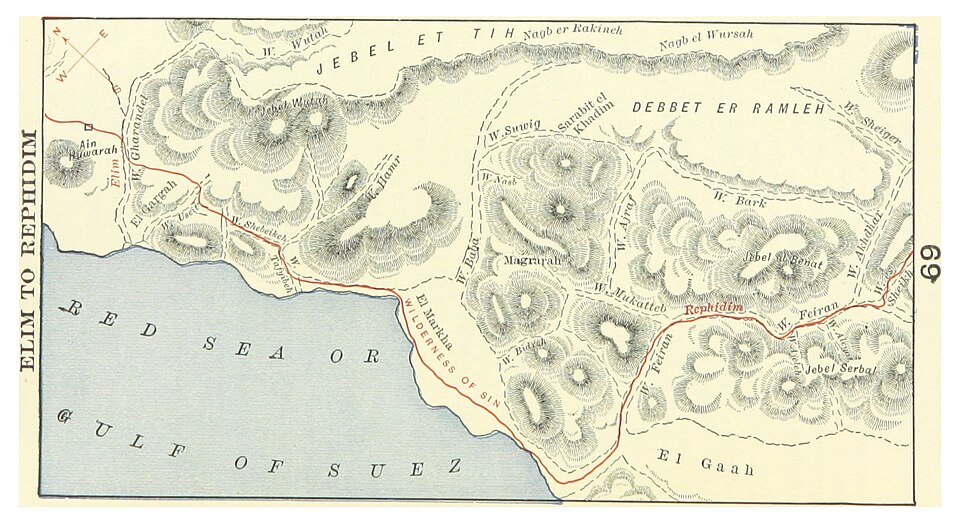
Map titled Elim to Rephidim showing the western Sinai Peninsula coast along the Red Sea and Gulf of Suez with the route marked in red from Elim through the Wilderness of Sin eastward to Rephidim, showing Jebel El Tih plateau to the north, Wady Gharandel, Debbet Er Ramleh, and the rugged mountain terrain of the southern Sinai
"Elim to Rephidim." This map shows the coastal and inland route through the western Sinai Peninsula — from Elim on the Red Sea coast (upper-left) through the Wilderness of Sin to Rephidim at the foot of the Sinai mountains. The red line traces Israel's march through this terrain immediately after crossing the sea.
Source: Maccoun, The Holy Land in Geography and in History (1899). Public domain, via Wikimedia Commons.  ·  Historical commentary by Michael Knighton  ·  Christians Standing With Israel
🗺 How to Read This Map
① Elim — The First Good Camp — Find 'Elim' in the upper-left corner of the map, near the Red Sea coast. After the bitter water of Marah, God led Israel to Elim — twelve wells and seventy palm trees. This was Israel's first genuinely pleasant camp after leaving Egypt. It sits at the mouth of Wady Gharandel, one of the main wadis of the western Sinai coast, still identifiable today by its vegetation.
② The Red Sea / Gulf of Suez — The blue shaded area on the left of the map is the Red Sea — specifically the Gulf of Suez, the western arm of the Red Sea. Israel's crossing took place further north, but this is the coast they were now marching along southward. The rugged cliffs and narrow coastal plain you see on the map accurately represent the terrain — a demanding march for a nation including elderly, women, children, and livestock.
③ The Wilderness of Sin — Find 'WILDERNESS OF SIN' labeled in the center of the map. This is not a moral description but a geographic name — the Wilderness of Sin was the flat sandy plain between the mountains and the sea on the western Sinai coast. It was here that the congregation began to murmur against Moses and Aaron: "Would to God we had died by the hand of the LORD in the land of Egypt... for ye have brought us forth into this wilderness, to kill this whole assembly with hunger" (Exodus 16:3).
④ Rephidim — The Final Pre-Sinai Camp — Find 'Rephidim' labeled in the right portion of the map, marked in red among the mountain terrain. Rephidim was Israel's last major camp before reaching Sinai. It was here that there was no water, Moses struck the rock at Horeb, and the Amalekites attacked Israel from behind — the first military battle of the newly freed nation.
What This Map Shows
✦ Elim — twelve wells and seventy palms
✦ The Red Sea/Gulf of Suez coastline
✦ The Wilderness of Sin — where manna began
✦ Rephidim — water from the rock; Amalek battle
✦ The Jebel El Tih plateau — northern barrier
✦ Wady Gharandel — Elim's valley
✦ The rugged western Sinai terrain
✦ The route from freedom toward the mountain of God

The First Weeks of Freedom

Look at this map carefully. The rugged terrain you see — the packed mountain ranges, the narrow coastal plain along the blue Gulf of Suez, the deep wadis cutting through the rock — is exactly what Israel was marching through in the first weeks after leaving Egypt. These were not easy roads. The Sinai Peninsula is severe, dry, and demanding. But God had led them here deliberately, and every hardship served a purpose.

Find Elim in the upper-left. This was the good news after Marah — after Israel arrived at bitter water and Moses threw in the tree God showed him to make it sweet. Elim had twelve springs and seventy palms (Exodus 15:27). Israel camped here and rested. But the march continued south and east. Find the Wilderness of Sin in the center of the map — the broad plain between the mountains and the sea. It was here, about six weeks after leaving Egypt, that the food supply they had brought from Egypt ran out.

The murmuring at this point is understandable in human terms. Six weeks in the wilderness, food gone, no farming possible. "Would to God we had died by the hand of the LORD in the land of Egypt, when we sat by the flesh pots, and when we did eat bread to the full" (Exodus 16:3). This is the first of many complaints that will mark the wilderness years — and God's response is characteristic: not anger, but provision. He rained manna from heaven in the morning and quail in the evening. Every day. Except the Sabbath. For forty years.

Follow the red route east to Rephidim. Find it labeled in the right portion of the map among the mountains. At Rephidim there was no water, and the people were ready to stone Moses. God told him to strike the rock at Horeb — "and thou shalt smite the rock, and there shall come water out of it" (Exodus 17:6). Then the Amalekites attacked. Joshua led the army; Moses stood on the hill with his hands raised; when his hands fell from exhaustion, Israel lost ground. Aaron and Hur held his arms up all day. Israel prevailed. And then — just beyond Rephidim, around the next mountain — they arrived at Sinai.

Key Scripture References
Exodus 15:27 — Elim: twelve springs and seventy palms
Exodus 16:1–4 — The Wilderness of Sin; manna promised
Exodus 16:13–36 — Manna and quail provided
Exodus 17:1–7 — No water at Rephidim; water from the rock
Exodus 17:8–16 — Amalek attacks; Joshua fights; Moses intercedes
Exodus 19:1–2 — Israel arrives at the wilderness of Sinai
Map: Maccoun, The Holy Land in Geography and in History (1899). Public domain, via Wikimedia Commons.  ·  Historical commentary: © 2026 Michael Wayne Knighton | Christians Standing With Israel™ | All Rights Reserved.
MAP 052
The Passover & Night of Exodus
MAP 054
The Crossing of the Red Sea
Advertisement
Exodus Route — Rameses to the Red Sea | Christians Standing With Israel — Michael Knighton Exodus Route — Rameses to the Red Sea | Christians Standing With Israel — Michael Knighton
✡ "Pray for the peace of Jerusalem" — Psalm 122:6
Christians Standing With Israel
Home Site Map Search About Us Our Beliefs Online Bible Maps of Israel Articles Grafted In? Apple of His Eye Contact
TOPICS
Israel — Then & Now Anti-Semitism Middle East Christian Zionism Bible Prophecy US & Israel Media Bias Spiritual Deception Arab-Israeli Conflict Islamic Extremism The Iranian Threat Replacement Theology
LATEST: New article by Michael Knighton  •  Subscribe to our weekly newsletter  •  400 Maps of Israel now available  •  Online Bible (KJV) now online
Advertisement
Map 053  ·  The Patriarchs & the Exodus  ·  Exodus 13:17–14:2

Exodus Route — Rameses to the Red Sea

The coastal road south from Egypt through the Wilderness of Sin — the terrain Israel crossed in the first weeks of freedom
"And they took their journey from Elim, and all the congregation of the children of Israel came unto the wilderness of Sin, which is between Elim and Sinai."
— Exodus 16:1 (KJV)
Map titled Elim to Rephidim showing the western Sinai Peninsula coast along the Red Sea and Gulf of Suez with the route marked in red from Elim through the Wilderness of Sin eastward to Rephidim, showing Jebel El Tih plateau to the north, Wady Gharandel, Debbet Er Ramleh, and the rugged mountain terrain of the southern Sinai
"Elim to Rephidim." This map shows the coastal and inland route through the western Sinai Peninsula — from Elim on the Red Sea coast (upper-left) through the Wilderness of Sin to Rephidim at the foot of the Sinai mountains. The red line traces Israel's march through this terrain immediately after crossing the sea.
Source: Maccoun, The Holy Land in Geography and in History (1899). Public domain, via Wikimedia Commons.  ·  Historical commentary by Michael Knighton  ·  Christians Standing With Israel
🗺 How to Read This Map
① Elim — The First Good Camp — Find 'Elim' in the upper-left corner of the map, near the Red Sea coast. After the bitter water of Marah, God led Israel to Elim — twelve wells and seventy palm trees. This was Israel's first genuinely pleasant camp after leaving Egypt. It sits at the mouth of Wady Gharandel, one of the main wadis of the western Sinai coast, still identifiable today by its vegetation.
② The Red Sea / Gulf of Suez — The blue shaded area on the left of the map is the Red Sea — specifically the Gulf of Suez, the western arm of the Red Sea. Israel's crossing took place further north, but this is the coast they were now marching along southward. The rugged cliffs and narrow coastal plain you see on the map accurately represent the terrain — a demanding march for a nation including elderly, women, children, and livestock.
③ The Wilderness of Sin — Find 'WILDERNESS OF SIN' labeled in the center of the map. This is not a moral description but a geographic name — the Wilderness of Sin was the flat sandy plain between the mountains and the sea on the western Sinai coast. It was here that the congregation began to murmur against Moses and Aaron: "Would to God we had died by the hand of the LORD in the land of Egypt... for ye have brought us forth into this wilderness, to kill this whole assembly with hunger" (Exodus 16:3).
④ Rephidim — The Final Pre-Sinai Camp — Find 'Rephidim' labeled in the right portion of the map, marked in red among the mountain terrain. Rephidim was Israel's last major camp before reaching Sinai. It was here that there was no water, Moses struck the rock at Horeb, and the Amalekites attacked Israel from behind — the first military battle of the newly freed nation.
What This Map Shows
✦ Elim — twelve wells and seventy palms
✦ The Red Sea/Gulf of Suez coastline
✦ The Wilderness of Sin — where manna began
✦ Rephidim — water from the rock; Amalek battle
✦ The Jebel El Tih plateau — northern barrier
✦ Wady Gharandel — Elim's valley
✦ The rugged western Sinai terrain
✦ The route from freedom toward the mountain of God

The First Weeks of Freedom

Look at this map carefully. The rugged terrain you see — the packed mountain ranges, the narrow coastal plain along the blue Gulf of Suez, the deep wadis cutting through the rock — is exactly what Israel was marching through in the first weeks after leaving Egypt. These were not easy roads. The Sinai Peninsula is severe, dry, and demanding. But God had led them here deliberately, and every hardship served a purpose.

Find Elim in the upper-left. This was the good news after Marah — after Israel arrived at bitter water and Moses threw in the tree God showed him to make it sweet. Elim had twelve springs and seventy palms (Exodus 15:27). Israel camped here and rested. But the march continued south and east. Find the Wilderness of Sin in the center of the map — the broad plain between the mountains and the sea. It was here, about six weeks after leaving Egypt, that the food supply they had brought from Egypt ran out.

The murmuring at this point is understandable in human terms. Six weeks in the wilderness, food gone, no farming possible. "Would to God we had died by the hand of the LORD in the land of Egypt, when we sat by the flesh pots, and when we did eat bread to the full" (Exodus 16:3). This is the first of many complaints that will mark the wilderness years — and God's response is characteristic: not anger, but provision. He rained manna from heaven in the morning and quail in the evening. Every day. Except the Sabbath. For forty years.

Follow the red route east to Rephidim. Find it labeled in the right portion of the map among the mountains. At Rephidim there was no water, and the people were ready to stone Moses. God told him to strike the rock at Horeb — "and thou shalt smite the rock, and there shall come water out of it" (Exodus 17:6). Then the Amalekites attacked. Joshua led the army; Moses stood on the hill with his hands raised; when his hands fell from exhaustion, Israel lost ground. Aaron and Hur held his arms up all day. Israel prevailed. And then — just beyond Rephidim, around the next mountain — they arrived at Sinai.

Key Scripture References
Exodus 15:27 — Elim: twelve springs and seventy palms
Exodus 16:1–4 — The Wilderness of Sin; manna promised
Exodus 16:13–36 — Manna and quail provided
Exodus 17:1–7 — No water at Rephidim; water from the rock
Exodus 17:8–16 — Amalek attacks; Joshua fights; Moses intercedes
Exodus 19:1–2 — Israel arrives at the wilderness of Sinai
Map: Maccoun, The Holy Land in Geography and in History (1899). Public domain, via Wikimedia Commons.  ·  Historical commentary: © 2026 Michael Wayne Knighton | Christians Standing With Israel™ | All Rights Reserved.
MAP 052
The Passover & Night of Exodus
MAP 054
The Crossing of the Red Sea
Advertisement
Exodus Route — Rameses to the Red Sea | Christians Standing With Israel — Michael Knighton Exodus Route — Rameses to the Red Sea | Christians Standing With Israel — Michael Knighton
✡ "Pray for the peace of Jerusalem" — Psalm 122:6
Christians Standing With Israel
Home Site Map Search About Us Our Beliefs Online Bible Maps of Israel Articles Grafted In? Apple of His Eye Contact
TOPICS
Israel — Then & Now Anti-Semitism Middle East Christian Zionism Bible Prophecy US & Israel Media Bias Spiritual Deception Arab-Israeli Conflict Islamic Extremism The Iranian Threat Replacement Theology
LATEST: New article by Michael Knighton  •  Subscribe to our weekly newsletter  •  400 Maps of Israel now available  •  Online Bible (KJV) now online
Advertisement
Map 053  ·  The Patriarchs & the Exodus  ·  Exodus 13:17–14:2

Exodus Route — Rameses to the Red Sea

The coastal road south from Egypt through the Wilderness of Sin — the terrain Israel crossed in the first weeks of freedom
"And they took their journey from Elim, and all the congregation of the children of Israel came unto the wilderness of Sin, which is between Elim and Sinai."
— Exodus 16:1 (KJV)
Map titled Elim to Rephidim showing the western Sinai Peninsula coast along the Red Sea and Gulf of Suez with the route marked in red from Elim through the Wilderness of Sin eastward to Rephidim, showing Jebel El Tih plateau to the north, Wady Gharandel, Debbet Er Ramleh, and the rugged mountain terrain of the southern Sinai
"Elim to Rephidim." This map shows the coastal and inland route through the western Sinai Peninsula — from Elim on the Red Sea coast (upper-left) through the Wilderness of Sin to Rephidim at the foot of the Sinai mountains. The red line traces Israel's march through this terrain immediately after crossing the sea.
Source: Maccoun, The Holy Land in Geography and in History (1899). Public domain, via Wikimedia Commons.  ·  Historical commentary by Michael Knighton  ·  Christians Standing With Israel
🗺 How to Read This Map
① Elim — The First Good Camp — Find 'Elim' in the upper-left corner of the map, near the Red Sea coast. After the bitter water of Marah, God led Israel to Elim — twelve wells and seventy palm trees. This was Israel's first genuinely pleasant camp after leaving Egypt. It sits at the mouth of Wady Gharandel, one of the main wadis of the western Sinai coast, still identifiable today by its vegetation.
② The Red Sea / Gulf of Suez — The blue shaded area on the left of the map is the Red Sea — specifically the Gulf of Suez, the western arm of the Red Sea. Israel's crossing took place further north, but this is the coast they were now marching along southward. The rugged cliffs and narrow coastal plain you see on the map accurately represent the terrain — a demanding march for a nation including elderly, women, children, and livestock.
③ The Wilderness of Sin — Find 'WILDERNESS OF SIN' labeled in the center of the map. This is not a moral description but a geographic name — the Wilderness of Sin was the flat sandy plain between the mountains and the sea on the western Sinai coast. It was here that the congregation began to murmur against Moses and Aaron: "Would to God we had died by the hand of the LORD in the land of Egypt... for ye have brought us forth into this wilderness, to kill this whole assembly with hunger" (Exodus 16:3).
④ Rephidim — The Final Pre-Sinai Camp — Find 'Rephidim' labeled in the right portion of the map, marked in red among the mountain terrain. Rephidim was Israel's last major camp before reaching Sinai. It was here that there was no water, Moses struck the rock at Horeb, and the Amalekites attacked Israel from behind — the first military battle of the newly freed nation.
What This Map Shows
✦ Elim — twelve wells and seventy palms
✦ The Red Sea/Gulf of Suez coastline
✦ The Wilderness of Sin — where manna began
✦ Rephidim — water from the rock; Amalek battle
✦ The Jebel El Tih plateau — northern barrier
✦ Wady Gharandel — Elim's valley
✦ The rugged western Sinai terrain
✦ The route from freedom toward the mountain of God

The First Weeks of Freedom

Look at this map carefully. The rugged terrain you see — the packed mountain ranges, the narrow coastal plain along the blue Gulf of Suez, the deep wadis cutting through the rock — is exactly what Israel was marching through in the first weeks after leaving Egypt. These were not easy roads. The Sinai Peninsula is severe, dry, and demanding. But God had led them here deliberately, and every hardship served a purpose.

Find Elim in the upper-left. This was the good news after Marah — after Israel arrived at bitter water and Moses threw in the tree God showed him to make it sweet. Elim had twelve springs and seventy palms (Exodus 15:27). Israel camped here and rested. But the march continued south and east. Find the Wilderness of Sin in the center of the map — the broad plain between the mountains and the sea. It was here, about six weeks after leaving Egypt, that the food supply they had brought from Egypt ran out.

The murmuring at this point is understandable in human terms. Six weeks in the wilderness, food gone, no farming possible. "Would to God we had died by the hand of the LORD in the land of Egypt, when we sat by the flesh pots, and when we did eat bread to the full" (Exodus 16:3). This is the first of many complaints that will mark the wilderness years — and God's response is characteristic: not anger, but provision. He rained manna from heaven in the morning and quail in the evening. Every day. Except the Sabbath. For forty years.

Follow the red route east to Rephidim. Find it labeled in the right portion of the map among the mountains. At Rephidim there was no water, and the people were ready to stone Moses. God told him to strike the rock at Horeb — "and thou shalt smite the rock, and there shall come water out of it" (Exodus 17:6). Then the Amalekites attacked. Joshua led the army; Moses stood on the hill with his hands raised; when his hands fell from exhaustion, Israel lost ground. Aaron and Hur held his arms up all day. Israel prevailed. And then — just beyond Rephidim, around the next mountain — they arrived at Sinai.

Key Scripture References
Exodus 15:27 — Elim: twelve springs and seventy palms
Exodus 16:1–4 — The Wilderness of Sin; manna promised
Exodus 16:13–36 — Manna and quail provided
Exodus 17:1–7 — No water at Rephidim; water from the rock
Exodus 17:8–16 — Amalek attacks; Joshua fights; Moses intercedes
Exodus 19:1–2 — Israel arrives at the wilderness of Sinai
Map: Maccoun, The Holy Land in Geography and in History (1899). Public domain, via Wikimedia Commons.  ·  Historical commentary: © 2026 Michael Wayne Knighton | Christians Standing With Israel™ | All Rights Reserved.
MAP 052
The Passover & Night of Exodus
MAP 054
The Crossing of the Red Sea
Advertisement
Exodus Route — Rameses to the Red Sea | Christians Standing With Israel — Michael Knighton Exodus Route — Rameses to the Red Sea | Christians Standing With Israel — Michael Knighton
✡ "Pray for the peace of Jerusalem" — Psalm 122:6
Christians Standing With Israel
Home Site Map Search About Us Our Beliefs Online Bible Maps of Israel Articles Grafted In? Apple of His Eye Contact
TOPICS
Israel — Then & Now Anti-Semitism Middle East Christian Zionism Bible Prophecy US & Israel Media Bias Spiritual Deception Arab-Israeli Conflict Islamic Extremism The Iranian Threat Replacement Theology
LATEST: New article by Michael Knighton  •  Subscribe to our weekly newsletter  •  400 Maps of Israel now available  •  Online Bible (KJV) now online
Advertisement
Map 053  ·  The Patriarchs & the Exodus  ·  Exodus 13:17–14:2

Exodus Route — Rameses to the Red Sea

The coastal road south from Egypt through the Wilderness of Sin — the terrain Israel crossed in the first weeks of freedom
"And they took their journey from Elim, and all the congregation of the children of Israel came unto the wilderness of Sin, which is between Elim and Sinai."
— Exodus 16:1 (KJV)
Map titled Elim to Rephidim showing the western Sinai Peninsula coast along the Red Sea and Gulf of Suez with the route marked in red from Elim through the Wilderness of Sin eastward to Rephidim, showing Jebel El Tih plateau to the north, Wady Gharandel, Debbet Er Ramleh, and the rugged mountain terrain of the southern Sinai
"Elim to Rephidim." This map shows the coastal and inland route through the western Sinai Peninsula — from Elim on the Red Sea coast (upper-left) through the Wilderness of Sin to Rephidim at the foot of the Sinai mountains. The red line traces Israel's march through this terrain immediately after crossing the sea.
Source: Maccoun, The Holy Land in Geography and in History (1899). Public domain, via Wikimedia Commons.  ·  Historical commentary by Michael Knighton  ·  Christians Standing With Israel
🗺 How to Read This Map
① Elim — The First Good Camp — Find 'Elim' in the upper-left corner of the map, near the Red Sea coast. After the bitter water of Marah, God led Israel to Elim — twelve wells and seventy palm trees. This was Israel's first genuinely pleasant camp after leaving Egypt. It sits at the mouth of Wady Gharandel, one of the main wadis of the western Sinai coast, still identifiable today by its vegetation.
② The Red Sea / Gulf of Suez — The blue shaded area on the left of the map is the Red Sea — specifically the Gulf of Suez, the western arm of the Red Sea. Israel's crossing took place further north, but this is the coast they were now marching along southward. The rugged cliffs and narrow coastal plain you see on the map accurately represent the terrain — a demanding march for a nation including elderly, women, children, and livestock.
③ The Wilderness of Sin — Find 'WILDERNESS OF SIN' labeled in the center of the map. This is not a moral description but a geographic name — the Wilderness of Sin was the flat sandy plain between the mountains and the sea on the western Sinai coast. It was here that the congregation began to murmur against Moses and Aaron: "Would to God we had died by the hand of the LORD in the land of Egypt... for ye have brought us forth into this wilderness, to kill this whole assembly with hunger" (Exodus 16:3).
④ Rephidim — The Final Pre-Sinai Camp — Find 'Rephidim' labeled in the right portion of the map, marked in red among the mountain terrain. Rephidim was Israel's last major camp before reaching Sinai. It was here that there was no water, Moses struck the rock at Horeb, and the Amalekites attacked Israel from behind — the first military battle of the newly freed nation.
What This Map Shows
✦ Elim — twelve wells and seventy palms
✦ The Red Sea/Gulf of Suez coastline
✦ The Wilderness of Sin — where manna began
✦ Rephidim — water from the rock; Amalek battle
✦ The Jebel El Tih plateau — northern barrier
✦ Wady Gharandel — Elim's valley
✦ The rugged western Sinai terrain
✦ The route from freedom toward the mountain of God

The First Weeks of Freedom

Look at this map carefully. The rugged terrain you see — the packed mountain ranges, the narrow coastal plain along the blue Gulf of Suez, the deep wadis cutting through the rock — is exactly what Israel was marching through in the first weeks after leaving Egypt. These were not easy roads. The Sinai Peninsula is severe, dry, and demanding. But God had led them here deliberately, and every hardship served a purpose.

Find Elim in the upper-left. This was the good news after Marah — after Israel arrived at bitter water and Moses threw in the tree God showed him to make it sweet. Elim had twelve springs and seventy palms (Exodus 15:27). Israel camped here and rested. But the march continued south and east. Find the Wilderness of Sin in the center of the map — the broad plain between the mountains and the sea. It was here, about six weeks after leaving Egypt, that the food supply they had brought from Egypt ran out.

The murmuring at this point is understandable in human terms. Six weeks in the wilderness, food gone, no farming possible. "Would to God we had died by the hand of the LORD in the land of Egypt, when we sat by the flesh pots, and when we did eat bread to the full" (Exodus 16:3). This is the first of many complaints that will mark the wilderness years — and God's response is characteristic: not anger, but provision. He rained manna from heaven in the morning and quail in the evening. Every day. Except the Sabbath. For forty years.

Follow the red route east to Rephidim. Find it labeled in the right portion of the map among the mountains. At Rephidim there was no water, and the people were ready to stone Moses. God told him to strike the rock at Horeb — "and thou shalt smite the rock, and there shall come water out of it" (Exodus 17:6). Then the Amalekites attacked. Joshua led the army; Moses stood on the hill with his hands raised; when his hands fell from exhaustion, Israel lost ground. Aaron and Hur held his arms up all day. Israel prevailed. And then — just beyond Rephidim, around the next mountain — they arrived at Sinai.

Key Scripture References
Exodus 15:27 — Elim: twelve springs and seventy palms
Exodus 16:1–4 — The Wilderness of Sin; manna promised
Exodus 16:13–36 — Manna and quail provided
Exodus 17:1–7 — No water at Rephidim; water from the rock
Exodus 17:8–16 — Amalek attacks; Joshua fights; Moses intercedes
Exodus 19:1–2 — Israel arrives at the wilderness of Sinai
Map: Maccoun, The Holy Land in Geography and in History (1899). Public domain, via Wikimedia Commons.  ·  Historical commentary: © 2026 Michael Wayne Knighton | Christians Standing With Israel™ | All Rights Reserved.
MAP 052
The Passover & Night of Exodus
MAP 054
The Crossing of the Red Sea
Advertisement