
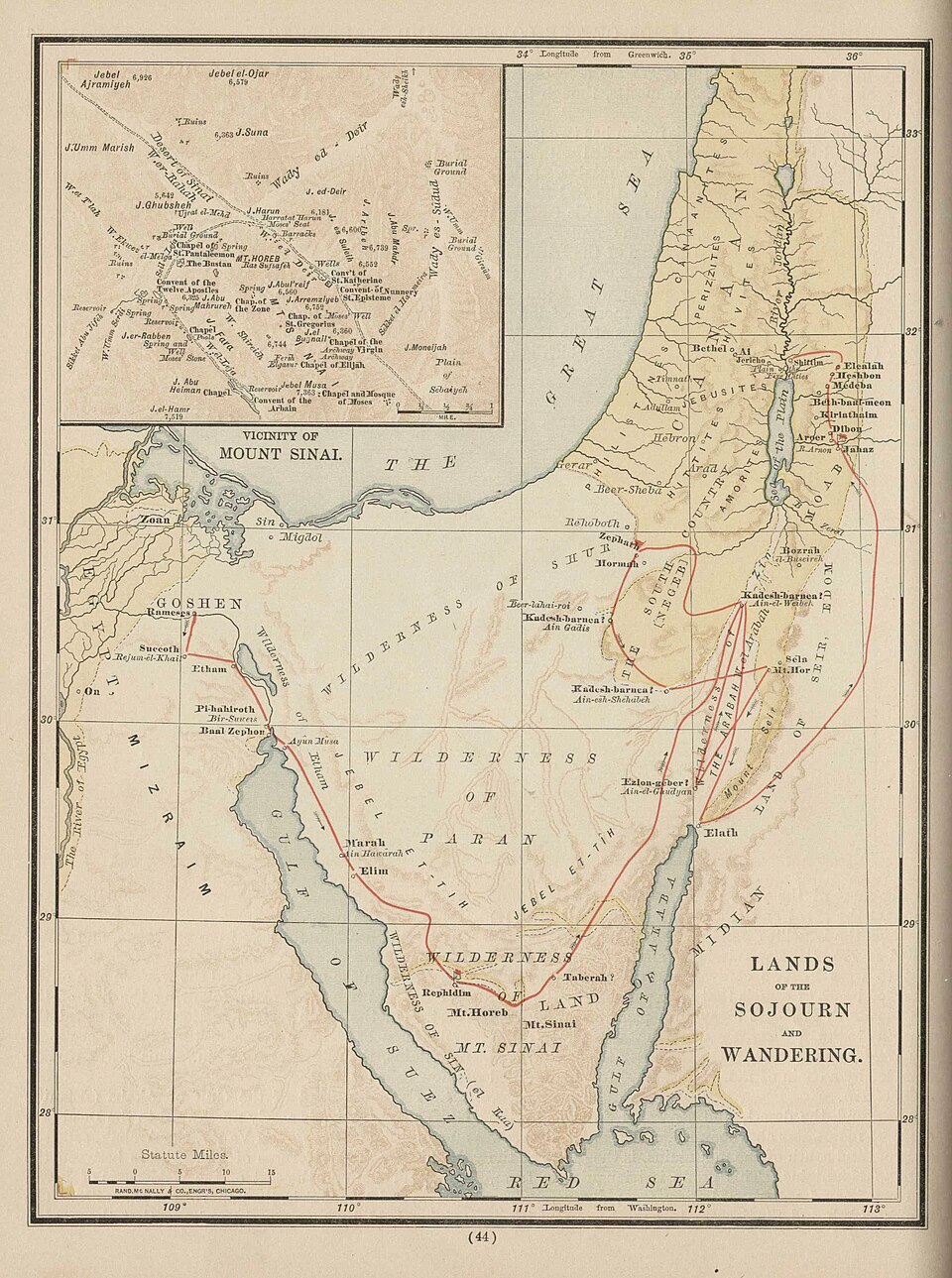
Find the eastern shore of the Dead Sea on this map — Moab, with its cities labeled. Just northeast of that shoreline, on the edge of the plateau, stands Mt. Nebo. Moses climbed it alone. He was a hundred and twenty years old. Deuteronomy 34:7 notes that "his eye was not dim, nor his natural force abated" — he was not climbing with failing legs or clouded vision. He climbed fully, saw clearly, and died with the land spread out before him.
The view from Mt. Nebo is real and verifiable. From its summit on a clear day, you can see across the Jordan Valley to Jericho, to the hills of Judea, and — depending on conditions — all the way to Jerusalem. On the horizon north, the hills of Gilead roll away. South stretches the Dead Sea. God was not showing Moses a vision disconnected from geography; He was letting Moses see with his own eyes the actual land that Abraham had been promised, that Isaac had walked, that Jacob had named place by place, and that Joseph had told his brothers he would return to. "I have caused thee to see it with thine eyes," God said, "but thou shalt not go over thither."
Moses' death at Nebo is one of the most theologically charged moments in the entire Old Testament. The greatest prophet Israel ever had — the man who spoke to God face to face, who led the nation out of Egypt, who received the Law at Sinai — did not enter the land. His life's work was complete, but its fruit was for others to inherit. God Himself buried Moses "in a valley in the land of Moab, over against Beth-peor: but no man knoweth of his sepulchre unto this day" (Deuteronomy 34:6). No shrine. No tomb. No pilgrimage site. A secret burial, known only to God.
Look at the inset of Mt. Sinai in the upper left of this map. Moses' ministry began near that mountain — at a burning bush that wouldn't stop burning. It ended on a mountain with a view he couldn't cross toward. In between: the plagues, the Exodus, the Red Sea, forty years of manna, the Law, the Tabernacle, the rebellions, the intercessions. When Israel mourned him for thirty days in the plains of Moab, they were mourning the man who had carried an entire nation from slavery to the edge of their destiny. And the last thing he saw, before God closed his eyes, was everything he had spent his life working toward.