✡ "Pray for the peace of Jerusalem" — Psalm 122:6
Christians Standing With Israel
Home Site Map Search About Us Our Beliefs Online Bible Maps of Israel Articles Grafted In? Apple of His Eye Contact
TOPICS
Israel — Then & Now Anti-Semitism Middle East Christian Zionism Bible Prophecy US & Israel Media Bias Spiritual Deception Arab-Israeli Conflict Islamic Extremism The Iranian Threat Replacement Theology
LATEST: New article by Michael Knighton  •  Subscribe to our weekly newsletter  •  400 Maps of Israel now available  •  Online Bible (KJV) now online
Advertisement
Map 049  ·  The Patriarchs & the Exodus  ·  Exodus 1:11

The Cities of the Exodus

Rameses, Pithom, Succoth, Etham, Pi-hahiroth — the real cities of slavery and the first steps of the greatest deliverance in history
"Therefore they did set over them taskmasters to afflict them with their burdens. And they built for Pharaoh treasure cities, Pithom and Raamses."
— Exodus 1:11 (KJV)
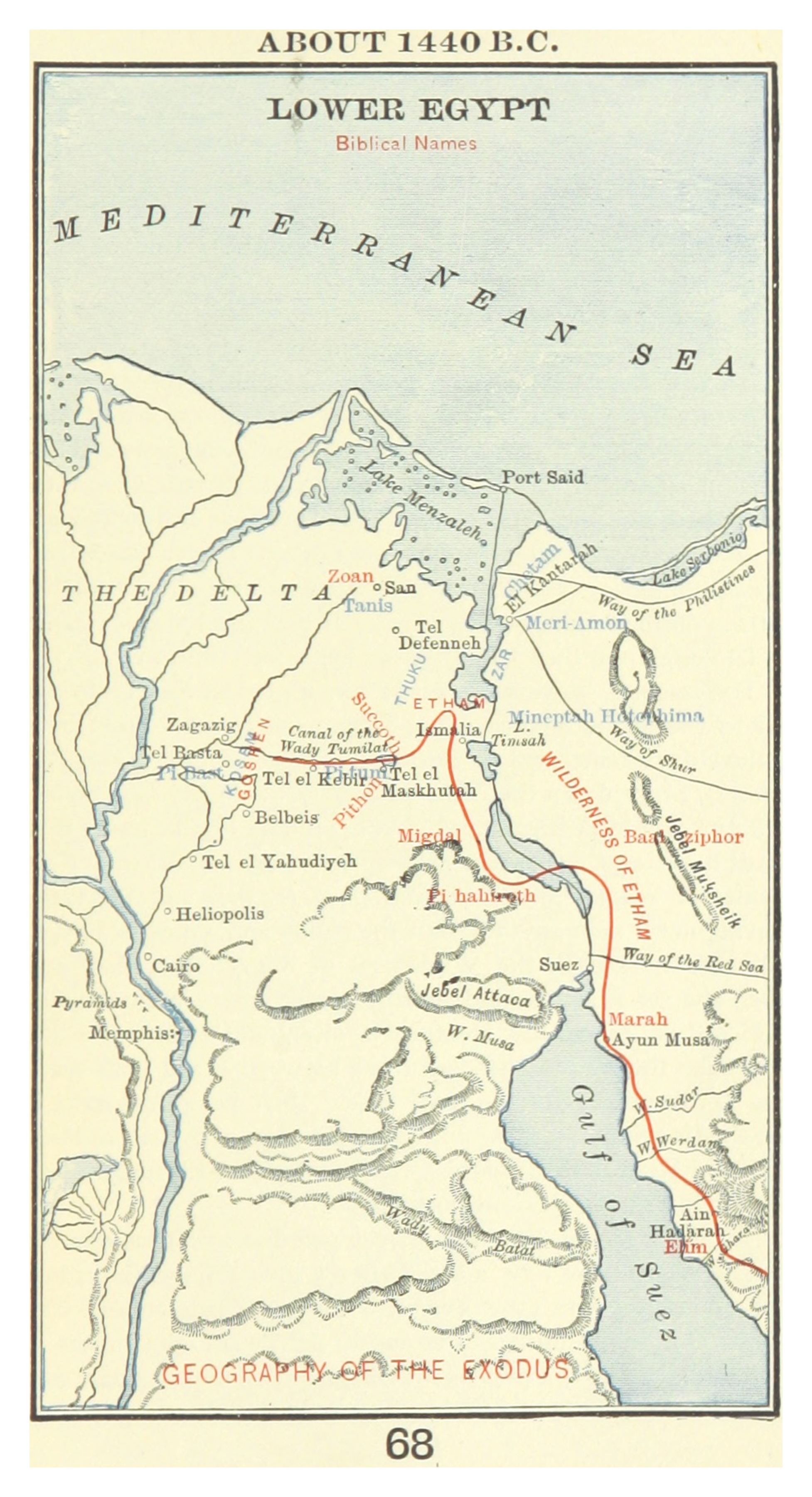
Map of Lower Egypt About 1440 BC with Biblical Names showing the Geography of the Exodus — the Nile Delta with Zoan (Rameses/Tanis) and Tanis highlighted in red, Pithom at Tel el Maskhutah, Succoth, Etham, Pi-hahiroth, Migdal, Marah and Ayun Musa marked in red along the Exodus route, the Wilderness of Etham, the Gulf of Suez, Memphis, Cairo, and the Pyramids.
"About 1440 B.C. — Lower Egypt, Biblical Names — Geography of the Exodus." The map shows the Nile Delta with the store-cities of Pithom (Tel el Maskhutah) and Rameses (Zoan/Tanis), the Exodus route in red through Succoth, Etham, Pi-hahiroth, and Marah, with the Gulf of Suez and the Wilderness of Etham clearly labeled.
Source: Maccoun, The Holy Land in Geography and in History (1899). Public domain, via Wikimedia Commons.  ·  Historical commentary by Michael Knighton  ·  Christians Standing With Israel
🗺 How to Read This Map
① Rameses (Zoan/Tanis) — Start of the Exodus — Find 'Zoan' highlighted in red at the top of the Delta — this is identified with Rameses, the store-city Israel built and the city from which they departed at the Exodus (Exodus 12:37). The red Exodus route on this map begins here. Six hundred thousand men, plus women and children — perhaps two million people — marched out of this city in a single night.
② Pithom — Tel el Maskhutah — Find 'Tel el Maskhutah' (Pithom) labeled in the eastern Delta near Succoth. This is the second store-city Israel built. Archaeologists at this site found large brick storage chambers — exactly the kind of treasure-city structures described in Exodus. Note 'Succoth' labeled nearby — Israel's very first camp after leaving Rameses (Exodus 12:37).
③ The Red Exodus Route — Follow the red line on this map. It begins at Rameses/Zoan in the north, moves south through Succoth, then to Etham ('at the edge of the wilderness'), then turns back to Pi-hahiroth and Migdal near the water — a seemingly confused route that God directed deliberately to bring Israel to the crossing point. Trace it south to Marah (Ayun Musa) after the sea crossing.
④ Pi-hahiroth, Migdal, and Baal-Zephon — Find 'Pi hahiroth' and 'Migdal' labeled on the red route, east of the Delta near the water. This is where Israel camped before the sea crossing — with the sea before them, mountains on both sides, and the Egyptian army behind them. Pharaoh thought he had trapped them. God had positioned them perfectly.
What This Map Shows
✦ Rameses (Zoan/Tanis) — Israel's starting point
✦ Pithom (Tel el Maskhutah) — store-city built by slaves
✦ Succoth — first Exodus camp
✦ Etham — edge of the wilderness
✦ Pi-hahiroth — campsite before sea crossing
✦ Migdal — military post near the crossing
✦ Marah (Ayun Musa) — bitter water after crossing
✦ The Wilderness of Etham — entry to Sinai

Out in One Night

Look at the red line on this map. It traces the first steps of the most significant mass movement of people in the ancient world — the Exodus of Israel from Egypt. The route begins at Zoan/Rameses in the upper Delta — find it highlighted in red at the top of the map. This is where Israel had labored for decades making bricks for Pharaoh's building projects. On the night of the tenth plague — the death of every Egyptian firstborn — they left.

Exodus 12:37 gives the number: "six hundred thousand on foot that were men, beside children." Add women, children, and the "mixed multitude" that came with them (Exodus 12:38), and the total was likely over two million people — plus their flocks and herds. Egypt woke up the morning after the Passover to the sound of national mourning and found its workforce gone. "There was not a house where there was not one dead" (Exodus 12:30). Pharaoh called Moses and Aaron in the night and said: "Rise up, and get you forth from among my people... and go, serve the LORD, as ye have said. Also take your flocks and your herds... and be gone."

Follow the red line south from Rameses. Find Succoth — Israel's first camp, just south of the Goshen region. From there they moved to Etham, "at the edge of the wilderness" — the boundary between the Delta and the Sinai desert. But then God gave a strange command: turn back. Go toward Pi-hahiroth, between Migdal and the sea. Find Pi-hahiroth on the map, east of the Delta near the water. This looked like a tactical error — Israel appeared trapped with the sea ahead and the Egyptian army coming behind. It was not an error. It was a setup.

The ten plagues that preceded the Exodus were not random acts of power. They were systematic demolitions of the Egyptian pantheon — each plague striking at a specific Egyptian deity. The Nile turned to blood (Hapi, the Nile god, judged). The sun went dark (Ra, the sun god, silenced). The firstborn died (Pharaoh himself, considered divine, broken). By the time Israel walked out of Rameses, Egypt had been judged not just politically but theologically. The gods of Egypt had been shown to be nothing before the God of Israel.

Key Scripture References
Exodus 1:11 — Pithom and Rameses built by forced labor
Exodus 12:29–36 — The tenth plague; Pharaoh releases Israel
Exodus 12:37–41 — Departure from Rameses; 600,000 men
Exodus 13:17–22 — God leads by pillar of cloud and fire
Exodus 14:1–4 — God commands Israel to turn toward Pi-hahiroth
Exodus 14:21–31 — The crossing; Egyptian army destroyed
Map: Maccoun, The Holy Land in Geography and in History (1899). Public domain, via Wikimedia Commons.  ·  Historical commentary: © 2026 Michael Wayne Knighton | Christians Standing With Israel™ | All Rights Reserved.
MAP 048
The Land of Goshen
MAP 050
Moses in Midian — The Burning Bush
Advertisement
The Cities of the Exodus | Christians Standing With Israel — Michael Knighton The Cities of the Exodus | Christians Standing With Israel — Michael Knighton
✡ "Pray for the peace of Jerusalem" — Psalm 122:6
Christians Standing With Israel
Home Site Map Search About Us Our Beliefs Online Bible Maps of Israel Articles Grafted In? Apple of His Eye Contact
TOPICS
Israel — Then & Now Anti-Semitism Middle East Christian Zionism Bible Prophecy US & Israel Media Bias Spiritual Deception Arab-Israeli Conflict Islamic Extremism The Iranian Threat Replacement Theology
LATEST: New article by Michael Knighton  •  Subscribe to our weekly newsletter  •  400 Maps of Israel now available  •  Online Bible (KJV) now online
Advertisement
Map 049  ·  The Patriarchs & the Exodus  ·  Exodus 1:11

The Cities of the Exodus

Rameses, Pithom, Succoth, Etham, Pi-hahiroth — the real cities of slavery and the first steps of the greatest deliverance in history
"Therefore they did set over them taskmasters to afflict them with their burdens. And they built for Pharaoh treasure cities, Pithom and Raamses."
— Exodus 1:11 (KJV)
Map of Lower Egypt About 1440 BC with Biblical Names showing the Geography of the Exodus — the Nile Delta with Zoan (Rameses/Tanis) and Tanis highlighted in red, Pithom at Tel el Maskhutah, Succoth, Etham, Pi-hahiroth, Migdal, Marah and Ayun Musa marked in red along the Exodus route, the Wilderness of Etham, the Gulf of Suez, Memphis, Cairo, and the Pyramids.
"About 1440 B.C. — Lower Egypt, Biblical Names — Geography of the Exodus." The map shows the Nile Delta with the store-cities of Pithom (Tel el Maskhutah) and Rameses (Zoan/Tanis), the Exodus route in red through Succoth, Etham, Pi-hahiroth, and Marah, with the Gulf of Suez and the Wilderness of Etham clearly labeled.
Source: Maccoun, The Holy Land in Geography and in History (1899). Public domain, via Wikimedia Commons.  ·  Historical commentary by Michael Knighton  ·  Christians Standing With Israel
🗺 How to Read This Map
① Rameses (Zoan/Tanis) — Start of the Exodus — Find 'Zoan' highlighted in red at the top of the Delta — this is identified with Rameses, the store-city Israel built and the city from which they departed at the Exodus (Exodus 12:37). The red Exodus route on this map begins here. Six hundred thousand men, plus women and children — perhaps two million people — marched out of this city in a single night.
② Pithom — Tel el Maskhutah — Find 'Tel el Maskhutah' (Pithom) labeled in the eastern Delta near Succoth. This is the second store-city Israel built. Archaeologists at this site found large brick storage chambers — exactly the kind of treasure-city structures described in Exodus. Note 'Succoth' labeled nearby — Israel's very first camp after leaving Rameses (Exodus 12:37).
③ The Red Exodus Route — Follow the red line on this map. It begins at Rameses/Zoan in the north, moves south through Succoth, then to Etham ('at the edge of the wilderness'), then turns back to Pi-hahiroth and Migdal near the water — a seemingly confused route that God directed deliberately to bring Israel to the crossing point. Trace it south to Marah (Ayun Musa) after the sea crossing.
④ Pi-hahiroth, Migdal, and Baal-Zephon — Find 'Pi hahiroth' and 'Migdal' labeled on the red route, east of the Delta near the water. This is where Israel camped before the sea crossing — with the sea before them, mountains on both sides, and the Egyptian army behind them. Pharaoh thought he had trapped them. God had positioned them perfectly.
What This Map Shows
✦ Rameses (Zoan/Tanis) — Israel's starting point
✦ Pithom (Tel el Maskhutah) — store-city built by slaves
✦ Succoth — first Exodus camp
✦ Etham — edge of the wilderness
✦ Pi-hahiroth — campsite before sea crossing
✦ Migdal — military post near the crossing
✦ Marah (Ayun Musa) — bitter water after crossing
✦ The Wilderness of Etham — entry to Sinai

Out in One Night

Look at the red line on this map. It traces the first steps of the most significant mass movement of people in the ancient world — the Exodus of Israel from Egypt. The route begins at Zoan/Rameses in the upper Delta — find it highlighted in red at the top of the map. This is where Israel had labored for decades making bricks for Pharaoh's building projects. On the night of the tenth plague — the death of every Egyptian firstborn — they left.

Exodus 12:37 gives the number: "six hundred thousand on foot that were men, beside children." Add women, children, and the "mixed multitude" that came with them (Exodus 12:38), and the total was likely over two million people — plus their flocks and herds. Egypt woke up the morning after the Passover to the sound of national mourning and found its workforce gone. "There was not a house where there was not one dead" (Exodus 12:30). Pharaoh called Moses and Aaron in the night and said: "Rise up, and get you forth from among my people... and go, serve the LORD, as ye have said. Also take your flocks and your herds... and be gone."

Follow the red line south from Rameses. Find Succoth — Israel's first camp, just south of the Goshen region. From there they moved to Etham, "at the edge of the wilderness" — the boundary between the Delta and the Sinai desert. But then God gave a strange command: turn back. Go toward Pi-hahiroth, between Migdal and the sea. Find Pi-hahiroth on the map, east of the Delta near the water. This looked like a tactical error — Israel appeared trapped with the sea ahead and the Egyptian army coming behind. It was not an error. It was a setup.

The ten plagues that preceded the Exodus were not random acts of power. They were systematic demolitions of the Egyptian pantheon — each plague striking at a specific Egyptian deity. The Nile turned to blood (Hapi, the Nile god, judged). The sun went dark (Ra, the sun god, silenced). The firstborn died (Pharaoh himself, considered divine, broken). By the time Israel walked out of Rameses, Egypt had been judged not just politically but theologically. The gods of Egypt had been shown to be nothing before the God of Israel.

Key Scripture References
Exodus 1:11 — Pithom and Rameses built by forced labor
Exodus 12:29–36 — The tenth plague; Pharaoh releases Israel
Exodus 12:37–41 — Departure from Rameses; 600,000 men
Exodus 13:17–22 — God leads by pillar of cloud and fire
Exodus 14:1–4 — God commands Israel to turn toward Pi-hahiroth
Exodus 14:21–31 — The crossing; Egyptian army destroyed
Map: Maccoun, The Holy Land in Geography and in History (1899). Public domain, via Wikimedia Commons.  ·  Historical commentary: © 2026 Michael Wayne Knighton | Christians Standing With Israel™ | All Rights Reserved.
MAP 048
The Land of Goshen
MAP 050
Moses in Midian — The Burning Bush
Advertisement