
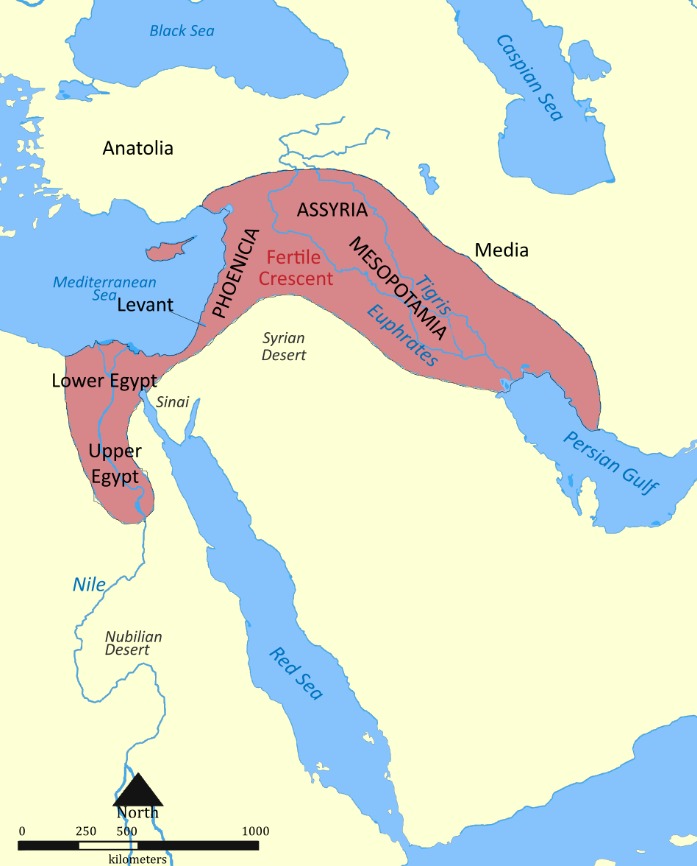
The term "Fertile Crescent" was coined in 1916 by the Egyptologist James Henry Breasted to describe the arc of arable land that sweeps from the Nile Delta northward through Canaan and Syria, then curves southeast along the Tigris and Euphrates rivers to the Persian Gulf. It is shaped, broadly, like a crescent moon — the green arc of cultivable land surrounded on all sides by desert, sea, and mountains. For most of human history, it was the most important piece of real estate on earth.
Every major civilization of the biblical world existed within or along the edges of this crescent. Egypt dominated its southwestern end, watered by the Nile's annual floods. Sumer arose at its southeastern end, between the Tigris and Euphrates, producing the world's first writing, first cities, and first law codes. Canaan occupied the central spine — the land bridge connecting the two great river civilizations and the arena of almost every major event in the Old Testament. The Hittites controlled its northern reaches in Anatolia. Assyria and Babylon rose and fell in its eastern heart.
When God called Abraham out of Ur of the Chaldees, he was summoning him from the richest, most sophisticated urban culture in the world and asking him to walk across the entire length of the Fertile Crescent. The journey from Ur to Haran follows the arc of the crescent northward along the Euphrates — the only practical route through the otherwise impassable Syrian Desert. From Haran, Abraham turned south and west into Canaan, arriving at Shechem in the central highlands. The route was not arbitrary. It followed the ancient trade roads that had connected Mesopotamia to Egypt for centuries. Abraham was walking through the most traveled corridor in the ancient world, and God had something to say about every step of it.
The Fertile Crescent is also the context for understanding why Canaan mattered so much. It was not a large territory — roughly the size of New Jersey. But its position at the center of the crescent made it the land bridge between every major power of the ancient world. Whoever controlled Canaan controlled the flow of commerce, armies, and influence between Egypt and Mesopotamia. That is one reason why every empire — Egyptian, Assyrian, Babylonian, Persian, Greek, Roman — fought to possess it. And that is why God chose it as the stage for His covenant with Abraham and the history of His people.
The rivers of the Fertile Crescent carry direct biblical significance. The Tigris and Euphrates appear in Genesis 2:14 as two of the four rivers of Eden. The Nile gave Egypt its legendary agricultural abundance and enabled the civilization that enslaved Israel for four hundred years. The Jordan River — running south through the center of Canaan — divided the Promised Land from the wilderness east of it and became the boundary Abraham's descendants crossed under Joshua. These are not incidental geographical details. They are the physical landscape through which God's redemptive purposes moved across millennia.