
The Tribe of Judah — Its Territory
Joshua 15:1–63
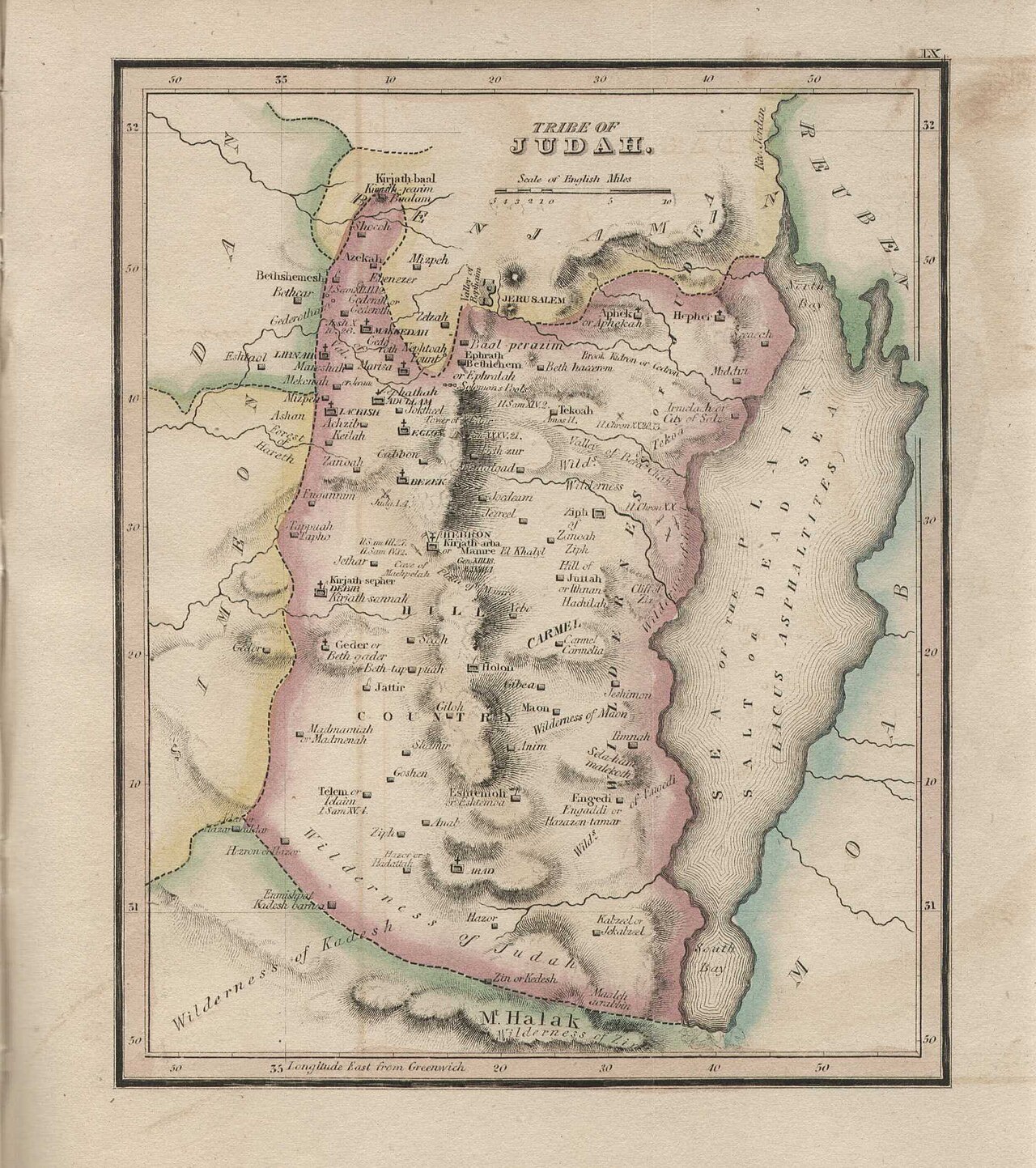
Tribe of Judah — a dedicated 19th century cartographic study of Judah's tribal territory with all major cities and boundaries. Public domain.
What You Are Looking At
This map is dedicated entirely to the territory of the Tribe of Judah — the largest and most historically significant of all the tribal allotments. The title “Tribe of Judah” appears prominently at the top, and Judah's territory is highlighted in a distinctive rose/pink shading so that its boundaries are immediately visible against the surrounding regions. At the top of the map, on the northern boundary, sits Jerusalem — the city that straddled the border between Judah and Benjamin and that would eventually become the eternal capital of the Davidic kingdom. Moving south through the heart of the territory, Bethlehem appears in the central highlands — the birthplace of both King David and Jesus Christ. Further south is Hebron (also labeled Kirjath-Arba and Manre El Khalyl), the ancient patriarchal city where Abraham, Isaac, Jacob, Sarah, Rebekah, and Leah were buried in the cave of Machpelah. The Dead Sea (labeled “Salt Sea” or “Lacus Asphaltites”) defines Judah's eastern boundary from the southern tip of the Jordan Valley all the way to the Negev. The western foothills of the Shephelah appear on the left side of the map, and the deep south is covered by the Wilderness of Judah and the Wilderness of Kadesh. The map is filled with dozens of named towns precisely as they appear in Joshua 15 — making it an invaluable companion to a reading of that chapter.
“This was the lot of the tribe of the children of Judah according to their families: The border of Edom at the Wilderness of Zin southward was the extreme southern boundary... This is the inheritance of the tribe of the children of Judah according to their families.”
— Joshua 15:1, 20 (NKJV)
The Largest Allotment
The Tribe of Judah received the first and largest allotment in the initial distribution at Gilgal. Its territory ran from the Wilderness of Zin in the south, bordering Edom, all the way to Jerusalem in the north — a distance of roughly 55 miles. East to west it stretched from the Dead Sea to beyond the Shephelah foothills near the Philistine coastal plain. Within this territory lay some of the most historically significant geography in the entire Bible: the Valley of Elah (where David would later fight Goliath), the Judean highlands around Hebron where Abraham had lived, the city of Bethlehem, and the Wilderness of Judah where David would hide from Saul and where John the Baptist would later minister.
Joshua 15 lists 115 named cities in Judah's territory — more than any other tribe. The cities are organized by geographic region: the Negev, the Shephelah, the hill country, and the wilderness. This detailed catalog is not bureaucratic filler. It is a legal deed of inheritance, documenting precisely what God was giving to the descendants of Judah.
Caleb's Inheritance at Hebron
Within Judah's allotment, a special portion was set aside for Caleb son of Jephunneh, one of the two faithful spies from forty-five years earlier. Caleb came to Joshua at Gilgal and reminded him of Moses' promise of the hill country of Hebron. He was now 85 years old. His famous declaration — “Give me this mountain” (Joshua 14:12) — is one of the great expressions of faith in Scripture. He was not asking for the easy territory. He was asking for the land of the giant Anakim. Joshua blessed him and gave him Hebron. Caleb drove out the three sons of Anak and took possession of the city that Abraham had worshipped in and near which the patriarchs were buried.
Jerusalem — Unconquered
Joshua 15:63 makes an honest admission: “As for the Jebusites, the inhabitants of Jerusalem, the children of Judah could not drive them out.” Despite being within Judah's assigned territory, Jerusalem remained in Jebusite hands for another four centuries. It was David who finally captured it (2 Samuel 5:6–9) and made it the capital of the united kingdom — and by choosing a city that technically belonged to neither Judah nor Ephraim, David created a politically neutral capital acceptable to all twelve tribes.
Judah's Prophetic Destiny
The assignment of Judah's territory carried the weight of a royal destiny established centuries before. Jacob's deathbed blessing in Genesis 49:10 declared: “The scepter shall not depart from Judah, nor a lawgiver from between his feet, until Shiloh comes.” Judah was the royal tribe — from it would come David, Solomon, and the entire Davidic dynasty. And according to Matthew 1 and Luke 3, Jesus of Nazareth was of the tribe of Judah, the Lion of Judah (Revelation 5:5), fulfilling the ancient promise made to Jacob in the very territory now shown on this map.
© 2026 Michael Knighton | Christians Standing With Israel™ | All Rights Reserved