
The Tribe of Benjamin — Its Territory
Joshua 18:11–28
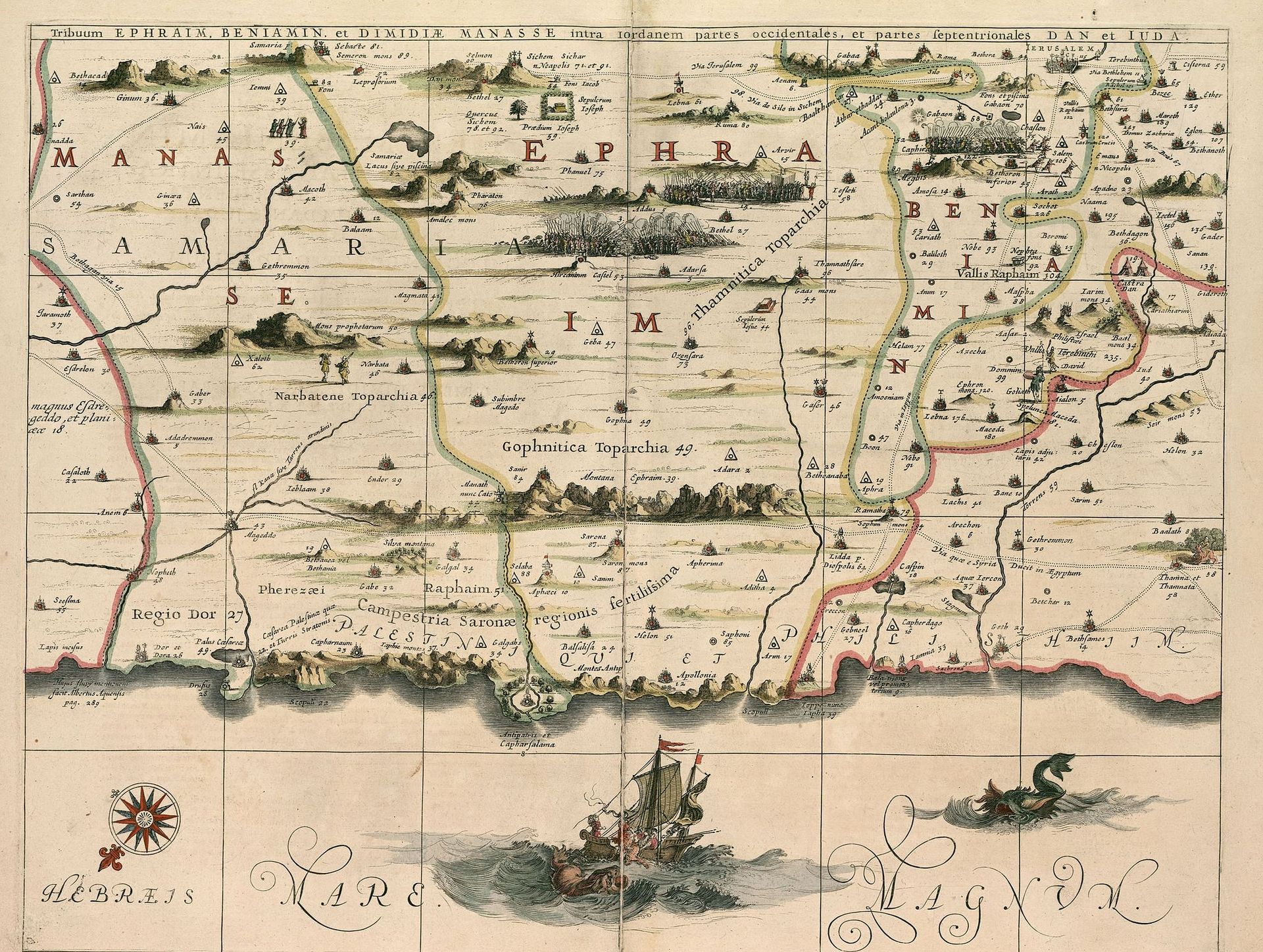
Tribuum Ephraim, Beniamin, et Dimidiae Manasse — an engraved historical map of the tribal territories of Ephraim, Benjamin, and the half-tribe of Manasseh in central Canaan, with Dan and Judah visible. Public domain.
What You Are Looking At
This detailed engraved historical map bears the Latin title “Tribuum Ephraim, Beniamin, et Dimidiae Manasse intra Iordanem partes occidentales, et partes septentrionales Dan et Iuda” — meaning “The Tribes of Ephraim, Benjamin, and the half-tribe of Manasseh within the Jordan, western parts, and the northern parts of Dan and Judah.” It covers central Canaan — the most strategically significant corridor in the entire land. The tribe of BENIAMIN is labeled across the central section of the map, sandwiched between EPHRAIM (and Manasseh) to the north and the northern edge of Judah to the south. Look for Bethel in the northern part of Benjamin's territory, near the Ephraim border. Jerusalem (labeled “Jebus” or similar) appears on or very near Benjamin's southern boundary. Jericho, listed in Joshua 18:21 as one of Benjamin's cities, appears at the eastern edge of the map near the Jordan. Gibeon, the city whose treaty with Joshua triggered the Southern Campaign, is visible within Benjamin's central territory. The map also shows the territories of neighboring tribes, making Benjamin's small but strategically vital position between the two dominant tribal powers visually clear.
“Now the lot of the tribe of the children of Benjamin came up according to their families, and the territory of their lot came out between the children of Judah and the children of Joseph... Now the cities of the tribe of the children of Benjamin according to their families were Jericho, Beth Hoglah, Emek Keziz... and Jebus (which is Jerusalem)... twenty-eight cities with their villages.”
— Joshua 18:11, 21, 28 (NKJV)
Small Territory, Immense Significance
Benjamin received the smallest tribal territory west of the Jordan — a narrow strip approximately 15 miles east-to-west and 25 miles north-to-south. Yet its strategic importance was out of all proportion to its size. It sat at the geographic heart of the land, between the two dominant tribes: Judah in the south and Ephraim in the north. Every major north-south road through the central highlands passed through Benjamin's territory. The passes at Beth-Horon, visible on this map, controlled the primary descent from the highland plateau to the coastal plain and were the site of multiple significant battles throughout Israelite history.
Benjamin's twenty-eight cities included places central to the entire biblical narrative. Jericho — the first city captured in the conquest — fell within Benjamin's allotment. Gibeon, whose deceptive alliance with Joshua triggered the Southern Campaign, was a Benjaminite city. Ramah, the hometown of Samuel the prophet and judge of Israel, was in Benjamin. And the Valley of the Son of Hinnom, forming part of the boundary between Benjamin and Judah on Jerusalem's south side, would later become the site of the most grievous idolatrous practices in Israelite history — giving its name to the New Testament word Gehenna.
Jerusalem on the Boundary
One of the most historically significant features of Benjamin's territory is its relationship to Jerusalem. The city sat precisely on the boundary between Benjamin and Judah. Neither tribe was able to fully dislodge the Jebusites. This ambiguity proved providential: when David captured Jerusalem and made it his capital, he chose a city that belonged in full to neither Judah nor the rival northern tribes, making it a politically acceptable neutral capital for all Israel.
Famous Benjaminites
Despite its small territory, the tribe of Benjamin produced some of the most consequential figures in Israel's history. Ehud, who delivered Israel from Moabite oppression, was a Benjaminite (Judges 3:15). King Saul, Israel's first king, was from Benjamin (1 Samuel 9:1–2). The prophet Jeremiah, who ministered through Jerusalem's fall to Babylon, was from Anathoth in Benjamin (Jeremiah 1:1). And the Apostle Paul, who carried the gospel of Jesus Christ throughout the Roman world, identified himself in Philippians 3:5 as “of the tribe of Benjamin” — a lineage he counted among his most valued credentials.
© 2026 Michael Knighton | Christians Standing With Israel™ | All Rights Reserved