
The Tribal Allotments of Israel — Overview
Joshua 13–21
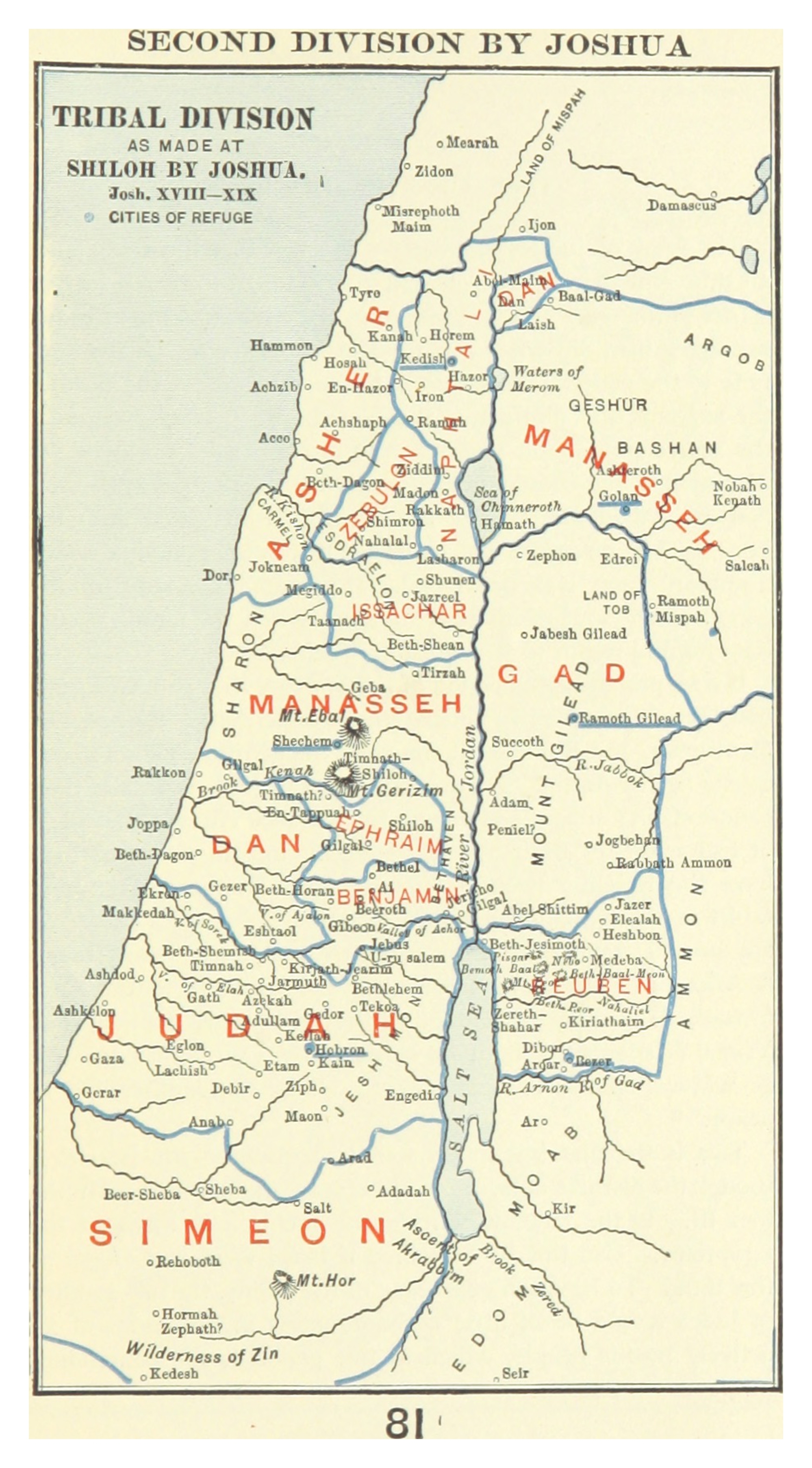
Second Division by Joshua — Tribal Division as Made at Shiloh, Josh. XVIII–XIX. From Maccoun's The Holy Land in Geography and in History (1899). Public domain.
What You Are Looking At
This Maccoun 1899 map is titled “Second Division by Joshua — Tribal Division as Made at Shiloh by Joshua, Josh. XVIII–XIX.” It shows all twelve tribal territories across the full length of Canaan, from Dan in the far north to Simeon in the far south. The Jordan River runs down the center-right of the map; the three eastern tribes of Reuben, Gad, and eastern Manasseh appear to the right of it. The western tribes fill the land between the Jordan and the Mediterranean coast. Key geographic features are labeled: the Sea of Chinneroth (Sea of Galilee), the Salt Sea (Dead Sea), Mount Ebal, and major rivers. Cities of Refuge are marked with distinctive symbols — Kedesh, Shechem, Hebron, Bezer, Ramoth Gilead, and Golan — six cities distributed throughout the land to provide asylum for those who accidentally caused a death. Shiloh, where the Tabernacle was erected and from which Joshua administered the second tribal distribution, appears in the territory of Ephraim near the center of the map. The map makes the relative size and position of each tribe immediately apparent and is an essential visual companion to Joshua 13–21.
“Now Joshua was old and advanced in years. And the Lord said to him: You are old, advanced in years, and there remains very much land yet to be possessed... Now therefore, divide this land as an inheritance to the nine tribes and half the tribe of Manasseh.”
— Joshua 13:1, 7 (NKJV)
Two Stages of Distribution
The division of the Promised Land took place in two distinct phases. The first phase (Joshua 14–17) was conducted at Gilgal. Judah received the largest allotment in the south, and the two Joseph tribes — Ephraim and the western half of Manasseh — received the central highlands. Caleb, the eighty-five-year-old companion of Joshua from the days of the twelve spies, made his famous request at Gilgal: “Give me this mountain” (Joshua 14:12) — the hill country of Hebron, the very territory he had scouted forty-five years earlier. It was granted, and Caleb drove out the Anakim and took possession of Hebron.
The second phase (Joshua 18–19) took place at Shiloh, after the Tabernacle was established there. Seven tribes had still not received their inheritance. Joshua rebuked them: “How long will you neglect to go and possess the land which the Lord God of your fathers has given you?” (Joshua 18:3). He directed men from each tribe to survey the remaining land, divide it into seven portions in writing, and return to Shiloh where the final allotments would be made by lot before the Lord.
The Sacred Lot
The use of the lot (Hebrew goral) to assign tribal territories was a method of directly consulting God. Proverbs 16:33 states: “The lot is cast into the lap, but its every decision is from the Lord.” By assigning territories through the sacred lot at Shiloh, Joshua ensured that no tribe could accuse another of favoritism, and every tribe would understand its territory as a divine gift rather than a human political decision. The land each tribe received was the land God had chosen for them.
Cities of Refuge and Levitical Cities
Woven into the tribal allotments were two special systems. Six cities of refuge (Joshua 20) — three on each side of the Jordan — provided safe haven for anyone who accidentally killed another person, protecting them from the avenger of blood until a fair hearing could be held. These cities were distributed so no person would be more than a day's journey from one. The tribe of Levi received no territorial block but was given 48 cities distributed among all the other tribes (Joshua 21), along with surrounding pasturelands. This arrangement ensured that priests and Levites were spread throughout all Israel, maintaining the religious and covenantal life of the nation in every region of the land.
© 2026 Michael Knighton | Christians Standing With Israel™ | All Rights Reserved