
The Southern Campaign — Joshua Defeats Five Kings
Joshua 10:1–43
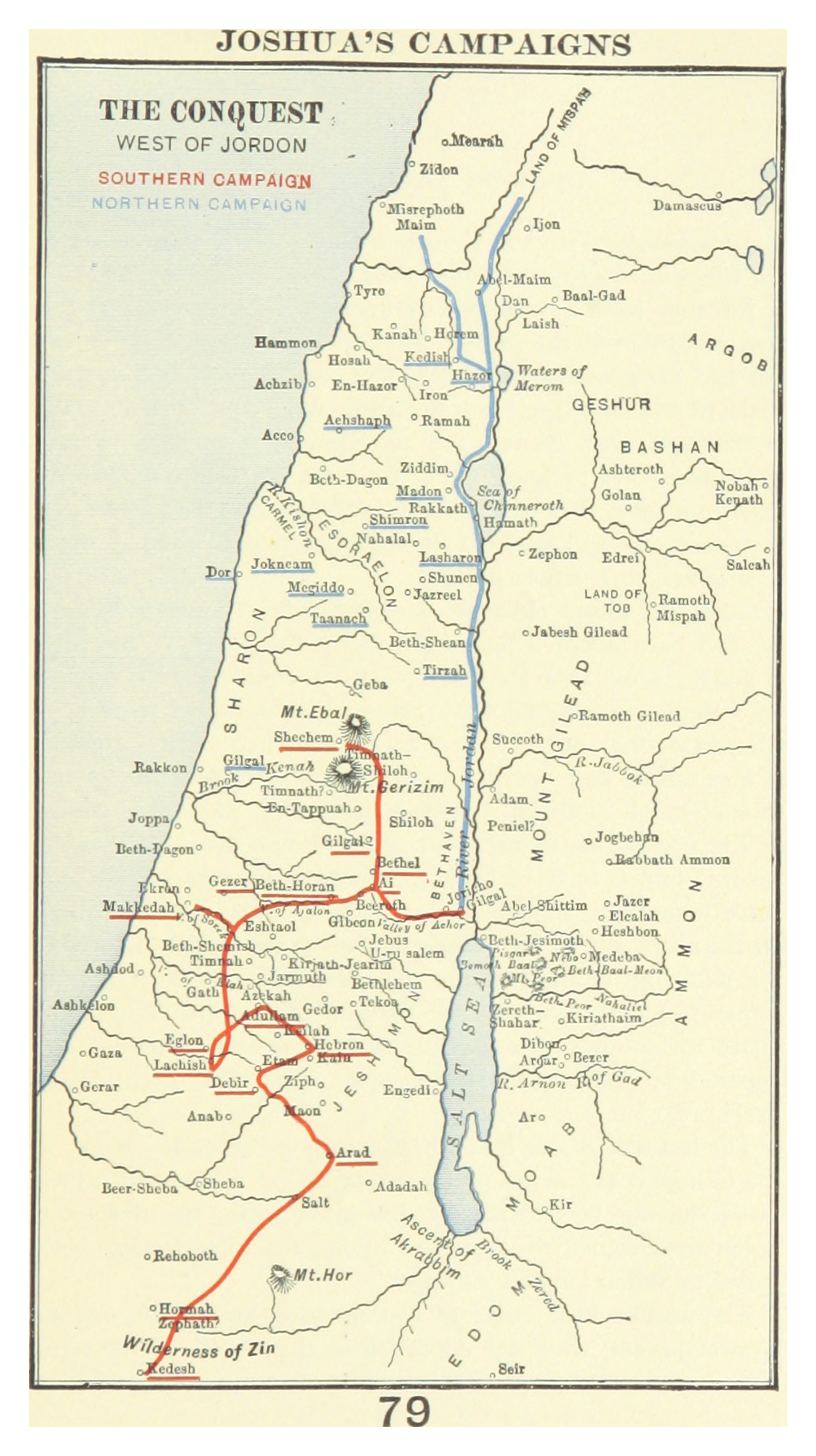
Joshua's Campaigns — The Conquest West of Jordan. The red line traces the Southern Campaign route; the blue line shows the Northern Campaign. From Maccoun's The Holy Land in Geography and in History (1899). Public domain.
What You Are Looking At
This Maccoun 1899 map bears the title “Joshua's Campaigns — The Conquest West of Jordan,” and it is one of the most useful single maps for understanding the military sweep of Joshua's conquest. Two campaign routes are traced in different colors. The red line is the Southern Campaign of Joshua 10. Beginning at Jericho/Gilgal on the east, the red line swings northwest first to Gibeon — where the emergency call for help came from the Gibeonites under attack. From Gibeon the route drives south and southwest in a long sweeping arc through Makkedah, Libnah, Lachish, Eglon, Hebron, and finally Debir, before the route turns and reaches deep into the Negev toward the Wilderness of Zin and Kadesh in the far south. The blue line shows the entirely different theater of the Northern Campaign for comparison. Together these two routes make visually clear how Joshua neutralized both the southern and northern military coalitions in two separate but decisive campaigns, leaving Israel in control of the highland core of Canaan from the Negev to the Galilee.
“So the Lord routed them before Israel, killed them with a great slaughter at Gibeon, chased them along the road that goes to Beth Horon... Then Joshua spoke to the Lord... and he said in the sight of Israel: Sun, stand still over Gibeon; and Moon, in the Valley of Aijalon. So the sun stood still, and the moon stopped, till the people had revenge upon their enemies... And there has been no day like that, before it or after it, that the Lord heeded the voice of a man; for the Lord fought for Israel.”
— Joshua 10:10, 12–14 (NKJV)
The Gibeonite Alliance
The Southern Campaign was triggered not by Joshua's strategic planning but by a diplomatic crisis. The Gibeonites, a major city-state in the central highlands, had deceived Joshua into a peace treaty by posing as distant travelers from a far country (Joshua 9). When the five Amorite kings of Jerusalem, Hebron, Jarmuth, Lachish, and Eglon heard that Gibeon had aligned with Israel, they immediately understood the strategic threat and marshaled a combined force against Gibeon. The Gibeonites sent an urgent appeal to Joshua: “Do not forsake your servants; come up to us quickly, save us and help us, for all the kings of the Amorites who dwell in the mountains have gathered together against us” (Joshua 10:6).
Joshua faced a critical decision. He had a treaty obligation to Gibeon, obtained through deception. He honored it anyway. He consulted God, received the promise of victory, and launched one of the most remarkable forced marches in ancient military history.
The All-Night March and the Sun Standing Still
Gilgal to Gibeon was approximately 20 miles with an elevation gain of over 3,000 feet. Joshua marched his entire army through the night and arrived at Gibeon at dawn, completely surprising the five kings and their forces. The Lord threw the enemy into confusion at the Israelite onslaught. As the coalition fled down the pass of Beth-Horon toward the Shephelah lowlands, God intervened with massive hailstones that killed more soldiers than the Israelite swords.
Then came one of the most extraordinary miracles in the Old Testament. Joshua prayed that the sun would stand still over Gibeon and the moon over the Valley of Aijalon — so that enough daylight would remain to complete the destruction of the enemy. Joshua 10:13–14 records the fulfillment: the sun did not set for approximately a full day. “And there has been no day like that, before it or after it, that the Lord heeded the voice of a man; for the Lord fought for Israel.”
The Five Kings and the Complete Southern Conquest
The five Amorite kings fled and hid in a cave at Makkedah. Joshua ordered the cave sealed and guarded while the army completed its pursuit. When the battle was finished, Joshua returned to Makkedah, commanded his military leaders to place their feet on the necks of the captured kings — a symbol of total victory — and said: “Do not be afraid, nor be dismayed; be strong and of good courage, for thus the Lord will do to all your enemies against whom you fight” (Joshua 10:25). The five kings were then executed and their bodies hung on five trees until evening. What followed was a systematic campaign: Makkedah, Libnah, Lachish, Gezer, Eglon, Hebron, Debir — all taken in a single continuous operation. Joshua 10:40 summarizes: “So Joshua conquered all the land: the mountain country and the South and the lowland and the wilderness slopes, and all their kings; he left none remaining.”
© 2026 Michael Knighton | Christians Standing With Israel™ | All Rights Reserved