
The Northern Campaign — Battle of the Waters of Merom
Joshua 11:1–15
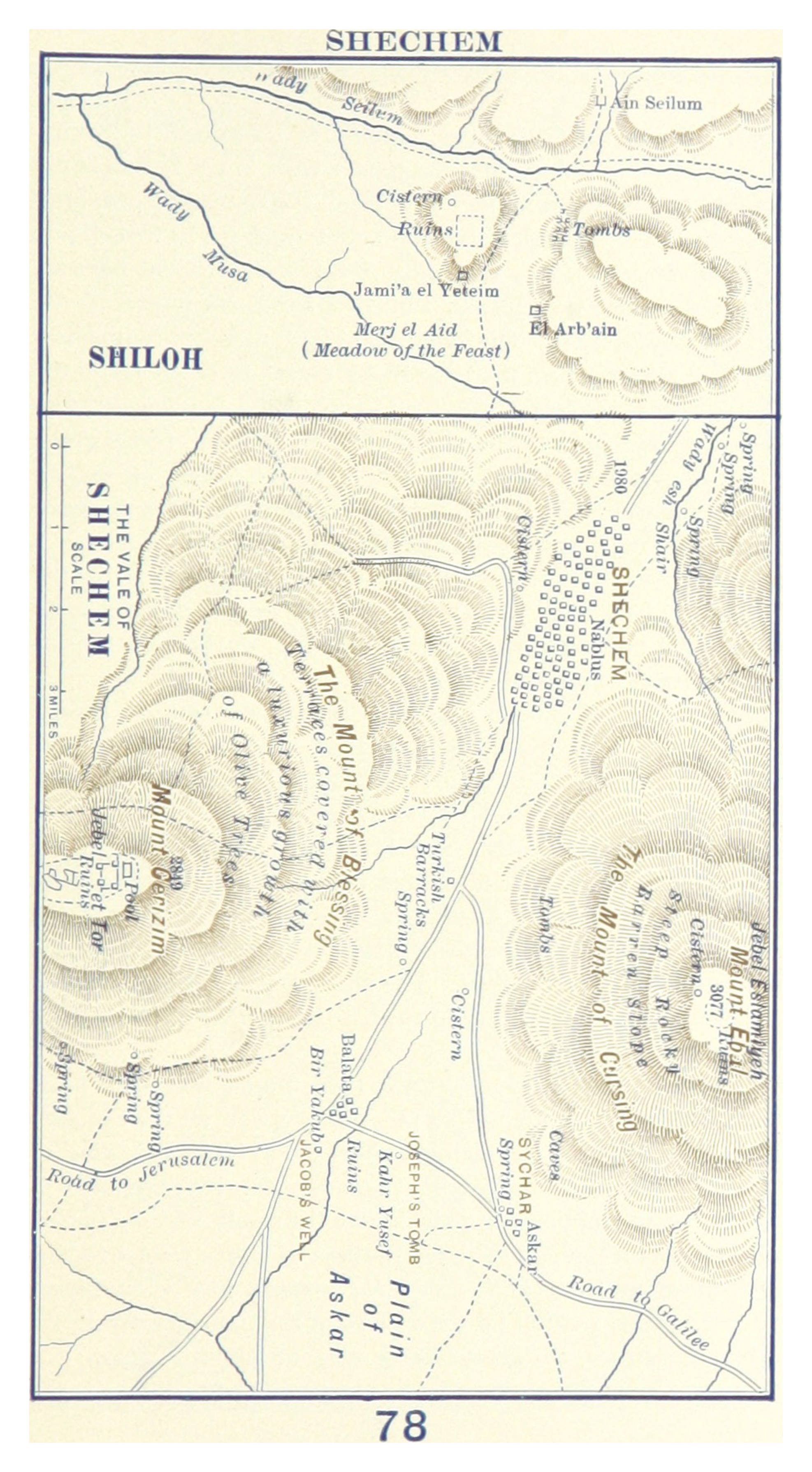
Shechem and Shiloh — from Maccoun's The Holy Land in Geography and in History (1899). The Vale of Shechem, framed by Mount Gerizim (Blessing) and Mount Ebal (Cursing), was the site of Israel's covenant renewal. Shiloh appears in the upper panel. Public domain.
What You Are Looking At
This Maccoun 1899 map presents two connected panels, both showing territory in the central highlands of Canaan — the covenantal heart of Israel's conquest. The upper panel shows the area around Shiloh, identified by the ruins label, located in the tribal territory of Ephraim. Shiloh would become the permanent home of the Tabernacle after the conquest and the site where Joshua administered the second tribal allotment (Joshua 18). The lower panel is a detailed topographic survey of the Vale of Shechem. Look for Mount Gerizim on the left, labeled “The Mount of Blessing,” and Mount Ebal on the right, labeled “The Mount of Cursing.” The ancient city of Shechem (modern Nablus) sits between them. Jacob's Well and Joseph's Tomb are marked at the southern end of the valley. This map documents the geographic setting of two critical covenant ceremonies: Joshua's covenant renewal at Mount Ebal following the battle of Ai (Joshua 8:30–35), and the final covenant at Shechem at the end of Joshua's life (Joshua 24). The northern military campaign at the Waters of Merom was the military action; Shechem was the theological anchor that gave that action its enduring meaning.
“And it came to pass, when Jabin king of Hazor heard these things... he sent to Jobab king of Madon, to the king of Shimron, to the king of Achshaph, and to the kings who were from the north, in the mountains... They came out, they and all their armies with them, as many people as the sand that is on the seashore in multitude, with very many horses and chariots... So Joshua came, and all the people of war with him, against them by the waters of Merom suddenly, and they attacked them. And the Lord delivered them into the hand of Israel.”
— Joshua 11:1, 4, 7–8 (NKJV)
The Northern Coalition
News of Joshua's devastating southern campaign spread rapidly through the remaining kingdoms of northern Canaan. Jabin, the king of Hazor — the most powerful city in the north — took action. He sent diplomatic messengers to every neighboring king, assembling the largest combined military force Israel would face in the entire conquest. The biblical text describes their numbers as “the sand that is on the seashore in multitude, with very many horses and chariots” (Joshua 11:4). This was a chariot army. Israel had no chariots. The coalition assembled at the Waters of Merom, in the upper Galilee region near Hazor, to launch their assault.
Before the battle, God gave Joshua a direct instruction that addressed the most obvious source of fear: “Do not be afraid because of them, for tomorrow about this time I will deliver all of them slain before Israel. You shall hamstring their horses and burn their chariots with fire” (Joshua 11:6). The instruction was not just tactical. It was a theological declaration: Israel was not to trust in military technology. Victory would come from the Lord.
The Battle and the Burning of Hazor
Joshua moved with his characteristic speed, attacking the coalition at the Waters of Merom suddenly, catching them completely off guard. The rout was total — the coalition was chased to Greater Sidon in the northwest, to the Brook Misrephoth in the northeast, and to the Valley of Mizpah in the east. Joshua then hamstrung the horses and burned all the chariots. He returned and attacked Hazor itself, killing Jabin with the sword and burning the city to the ground. Joshua 11:10 records why: “For Hazor previously was the head of all those kingdoms.” Archaeological excavations at the site confirm a massive destruction layer consistent with this period.
The Covenant at Shechem — The Foundation of the Campaign
The map on this page focuses not on the battlefield at Merom but on Shechem — because Shechem was the covenantal framework within which the entire conquest was conducted. After the battle of Ai, Joshua gathered all Israel at Mount Ebal near Shechem and renewed the Mosaic covenant, reading the blessings and curses of Deuteronomy aloud to the entire assembled nation (Joshua 8:30–35). This was what Moses had commanded in Deuteronomy 27, and Joshua obeyed precisely. At the conclusion of all his campaigns, Joshua summoned Israel to Shechem one final time for the great covenant renewal of Joshua 24: “Choose this day whom you will serve... but as for me and my house, we will serve the Lord.” The conquest was not an ethnic cleansing or a land grab. It was the fulfillment of a covenant established with Abraham in Genesis 12 — and Shechem, the first place Abraham had camped in Canaan, was its spiritual center.
© 2026 Michael Knighton | Christians Standing With Israel™ | All Rights Reserved