
Joshua Crosses the Jordan — Entry into Canaan
Joshua 3:14–17
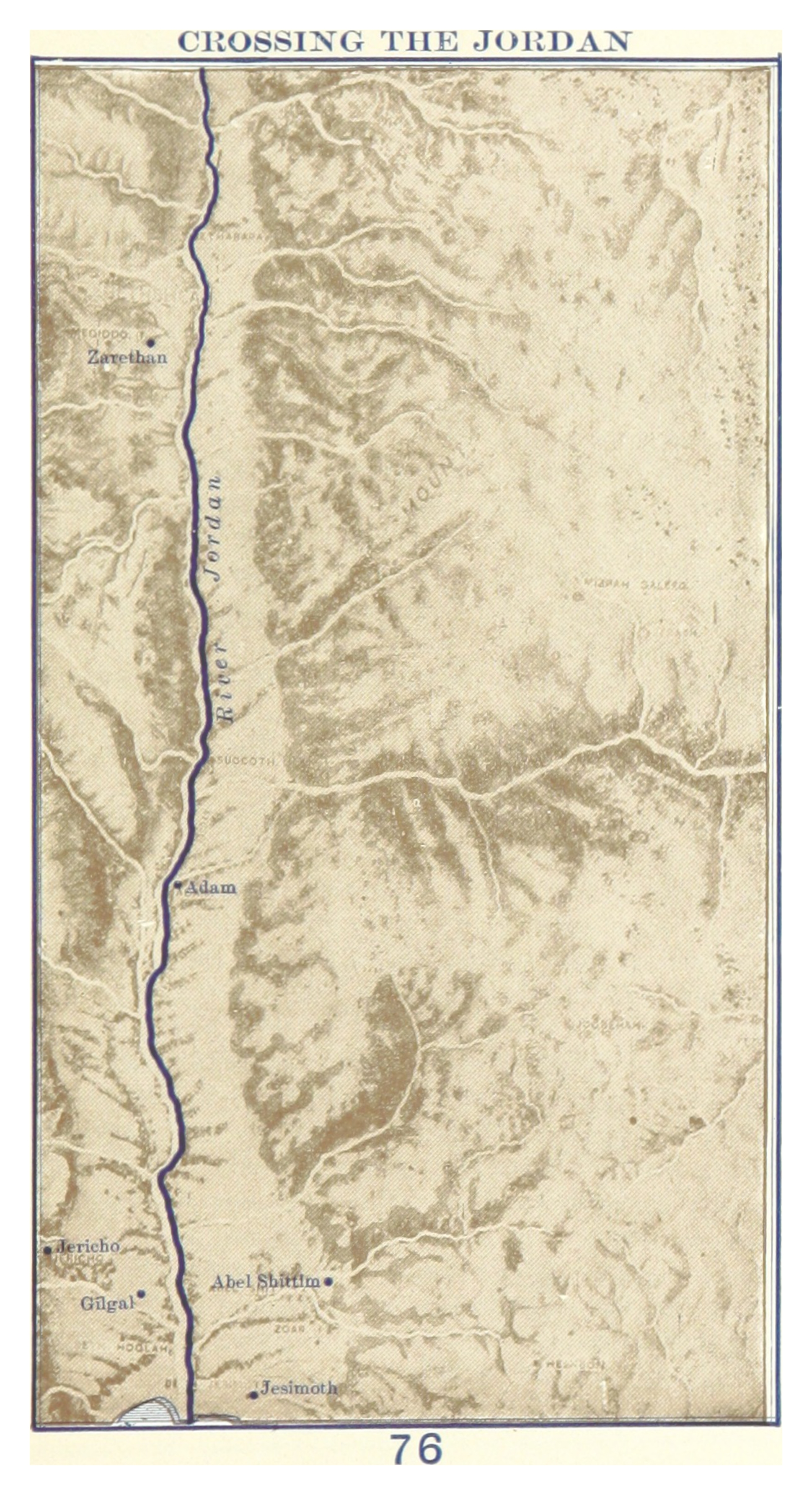
Crossing the Jordan — from Maccoun's The Holy Land in Geography and in History (1899). Public domain.
What You Are Looking At
This 1899 map by Townsend Maccoun shows the lower Jordan River valley — the precise geographic setting of Israel's miraculous entry into the Promised Land. The Jordan River is drawn as a bold blue line running vertically through the center. On the east bank, find Abel Shittim — Israel's final encampment before the crossing, where Moses had died and Joshua had taken command. On the west bank you can see Jericho clearly marked, along with Gilgal — the first campsite in Canaan where Joshua set up the twelve memorial stones. Further north on the west bank is the city of Adam, identified in Joshua 3:16 as the place where the waters “rose up in a heap” when the priests carrying the ark set foot in the river. The town of Zarethan appears higher up — the point beyond which the waters backed up. Succoth is also visible on the east bank. The overall map captures the entire corridor of the miraculous crossing in a single view.
“And the priests that bare the ark of the covenant of the Lord stood firm on dry ground in the midst of Jordan, and all the Israelites passed over on dry ground, until all the people were passed clean over Jordan.”
— Joshua 3:17 (KJV)
The Historical and Biblical Context
The crossing of the Jordan River was no ordinary military maneuver. It was a theologically charged act of divine intervention designed to confirm Joshua's leadership and announce to all the nations of Canaan that the God of Israel was present and active. The timing was deliberate: Joshua 3:15 specifically notes that the Jordan was at flood stage, overflowing all its banks. This was the harvest season, roughly April, when the river swelled with snowmelt from Mount Hermon. A natural crossing at this time was not merely difficult — it was humanly impossible. God chose this moment to demonstrate that the crossing of the Jordan would mirror the crossing of the Red Sea forty years earlier under Moses.
The order of march was precise and intentional. The ark of the covenant — the golden chest containing the tablets of the Law, Aaron's rod, and the jar of manna — was carried by the Levitical priests at the head of the procession. The people were instructed to follow at a distance of approximately 2,000 cubits, roughly 1,000 yards, so that they could see the ark clearly and know which way to go. Joshua told the people: “By this you shall know that the living God is among you” (Joshua 3:10). The crossing was not a feat of logistics. It was an act of worship.
When the feet of the priests touched the water's edge, the river stopped. The text in Joshua 3:16 is geographically precise: the waters rose in a heap at Adam, a city identified with the modern site of Tell ed-Damiyeh, located about 18 miles north of Jericho, near where the Jabbok River joins the Jordan. The entire stretch of river from Adam southward drained away, exposing dry ground across the entire width of the Jordan Valley. The priests stood with the ark in the middle of the dry riverbed while the entire nation crossed on dry ground. The text emphasizes in verse 17 that the ground was completely dry, not muddy or difficult. Israel walked across the bed of a flooding river as on solid land.
The Twelve Memorial Stones at Gilgal
Once the crossing was complete, God commanded Joshua to establish a permanent memorial. Twelve men — one from each tribe — were to take up twelve stones from the middle of the Jordan, from the very spot where the priests had stood with the ark. These stones were carried to Gilgal and set up as a monument. Joshua also set up twelve stones in the middle of the Jordan at the crossing point, stones that the text describes as being visible “to this day.”
The purpose of the memorial at Gilgal was explicitly generational: “When your children ask their fathers in time to come, saying, What are these stones? then you shall let your children know, saying, Israel crossed over this Jordan on dry land” (Joshua 4:21–22). God was establishing a permanent object lesson — a visible, tangible anchor for faith that every Israelite family would explain to their children for generations. The miraculous crossing was not to be mythologized or forgotten. It was to be taught and retold as literal historical fact.
Gilgal — Israel's First Base in the Land
The camp at Gilgal, shown on the map just west of the Jordan crossing, became Israel's primary military base for the entire conquest under Joshua. Located in the Jordan plain near Jericho, it was from Gilgal that Joshua launched every major campaign: the attack on Jericho, the battle at Ai, the defense of the Gibeonites, the southern campaign, and the northern campaign. Gilgal was also the site of the circumcision of the entire new generation born in the wilderness (Joshua 5:2–9) — an act of covenant renewal that had been neglected during the forty years of wandering. God told Joshua at Gilgal: “This day I have rolled away the reproach of Egypt from you” (Joshua 5:9). The name Gilgal comes from the Hebrew root meaning to roll away.
Theological Significance
The crossing of the Jordan is one of the most theologically rich events in the entire Old Testament. It serves simultaneously as the fulfillment of the promise made to Abraham in Genesis 12, the completion of the forty-year wilderness journey, and the inauguration of the conquest. Joshua 4:23 draws the connection to the Red Sea crossing explicitly: “For the Lord your God dried up the waters of the Jordan before you until you had crossed over, as the Lord your God did to the Red Sea, which He dried up before us until we had crossed over.” The same God who opened the sea for Moses opened the river for Joshua. The miracle was both historical and typological — pointing forward to Christ, who leads His people through the waters of death into the inheritance of eternal life.
© 2026 Michael Knighton | Christians Standing With Israel™ | All Rights Reserved