
The Fall of Jericho
Joshua 6:1–27
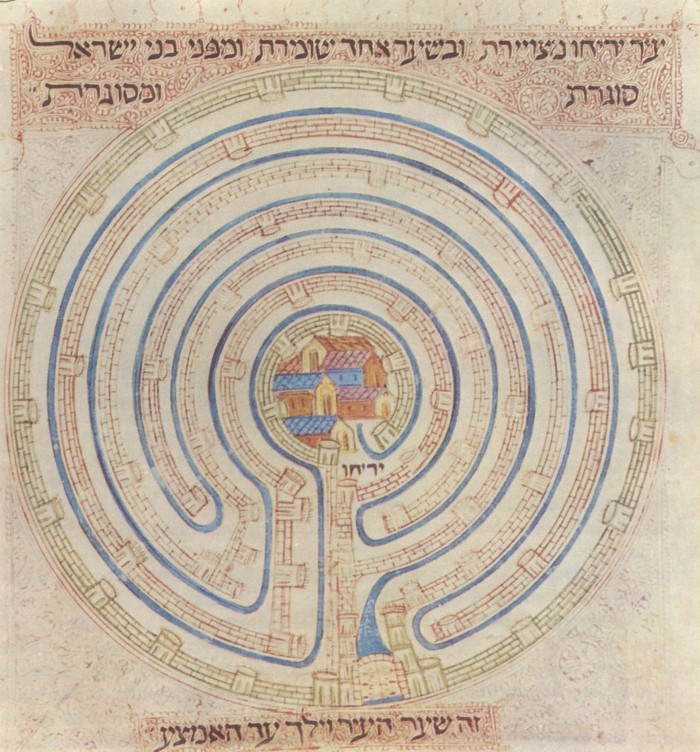
Map of Jericho from the Farhi Bible, by Elisha ben Avraham Crescas (14th century, Spain). The walls of Jericho depicted in the labyrinthine pattern of the biblical account. Public domain.
What You Are Looking At
This image comes from the Farhi Bible, an illuminated 14th century Hebrew manuscript created in Spain by the scribe and cartographer Elisha ben Avraham Crescas around 1366. It is one of the earliest known pictorial maps of Jericho and is explicitly connected to the narrative of Joshua 6. The city name Jericho (יריחו) is inscribed at the center gateway of the image. The walls of Jericho are depicted as a series of concentric circular rings arranged in a labyrinth pattern — not because the city was literally circular, but because the medieval cartographer was communicating the spiritual and strategic truth of the city: it was shut up, sealed, and humanly impenetrable. Concentric walls layered upon walls, with a single narrow gate as the only way in. The Hebrew text at the top quotes directly from Joshua 6:1: “Now Jericho was straitly shut up because of the children of Israel; none went out and none came in.” This is not a surveyor's map. It is a theological image — a 14th century Jewish artist's visual meditation on the meaning of Jericho's walls in the story of God's faithfulness to Israel.
“Now Jericho was straitly shut up because of the children of Israel: none went out, and none came in. And the Lord said unto Joshua, See, I have given into thine hand Jericho, and the king thereof, and the mighty men of valour... And it came to pass, when the people heard the sound of the trumpet, and the people shouted with a great shout, that the wall fell down flat, so that the people went up into the city, every man straight before him, and they took the city.”
— Joshua 6:1–2, 20 (KJV)
The Historical and Biblical Context
Jericho was the gateway to Canaan. It sat in the Jordan Valley controlling the passes that led up into the central highlands, and it had been a fortified city for thousands of years. Archaeological evidence at Tell es-Sultan — the site identified with ancient Jericho — reveals massive mud-brick walls that in various periods reached heights of over 30 feet, with a stone retaining wall at the base. To the Israelites, fresh from forty years in the wilderness, Jericho represented exactly the kind of obstacle that had broken the faith of the previous generation. God's plan for its capture was designed to make one thing unmistakably clear: this victory would belong entirely to the Lord.
There would be no battering rams, siege towers, or tunneling operations. The plan was this: the armed men of Israel were to march around the city in silence once a day for six days, preceded by seven priests carrying ram's horns (shofars) before the ark of the covenant. On the seventh day they would march around seven times, and when the priests gave a long blast and the people shouted, God promised the walls would fall. It was a strategy designed to eliminate all military boasting. No human tactic produced this victory.
Seven Days of Faith in Action
Consider the psychological pressure of this plan. For six days, thousands of armed warriors marched in complete silence around a heavily fortified city. The soldiers on Jericho's walls could only watch, bewildered. The Israelites heard no explanation beyond the command itself — no word of when it would end, no visible progress. It was a test of faith expressed through pure obedience. On the seventh day they rose at dawn and circled the city seven times. On the seventh circuit the priests gave the long blast, Joshua commanded the shout, and every man cried out with all his strength. The walls fell flat. Every man went straight in before him. The city was taken.
Rahab and the Scarlet Thread
In the midst of total destruction, one household was preserved. Rahab the prostitute had hidden the two Israelite spies and expressed genuine faith in Israel's God: “I know that the Lord has given you the land” (Joshua 2:9). She was promised deliverance in exchange for hanging a scarlet cord from her window. When the walls fell, Rahab's house remained standing. The two spies brought her and her entire family out safely before the city was burned.
The scarlet cord has been understood throughout Christian history as a type of the blood of Christ — the covenant sign that brings salvation in the midst of judgment. Rahab went on to marry an Israelite named Salmon, became the mother of Boaz, the great-grandmother of King David, and is listed in the genealogy of Jesus Christ in Matthew 1:5. She is also named in Hebrews 11:31 among the heroes of faith, honored not for her past but for her trust in the living God.
The Curse of Jericho
Following the conquest, Joshua pronounced a solemn curse over the ruins of Jericho: “Cursed be the man before the Lord who rises up and builds this city Jericho; he shall lay its foundation with his firstborn, and with his youngest son he shall set up its gates” (Joshua 6:26). This curse was fulfilled with precise literalness five centuries later, when Hiel the Bethelite rebuilt Jericho during the reign of King Ahab, losing his firstborn son Abiram when he laid the foundation and his youngest son Segub when he set up the gates (1 Kings 16:34). The word of the Lord does not return void.
© 2026 Michael Knighton | Christians Standing With Israel™ | All Rights Reserved