
The Battle of Ai
Joshua 8:1–29
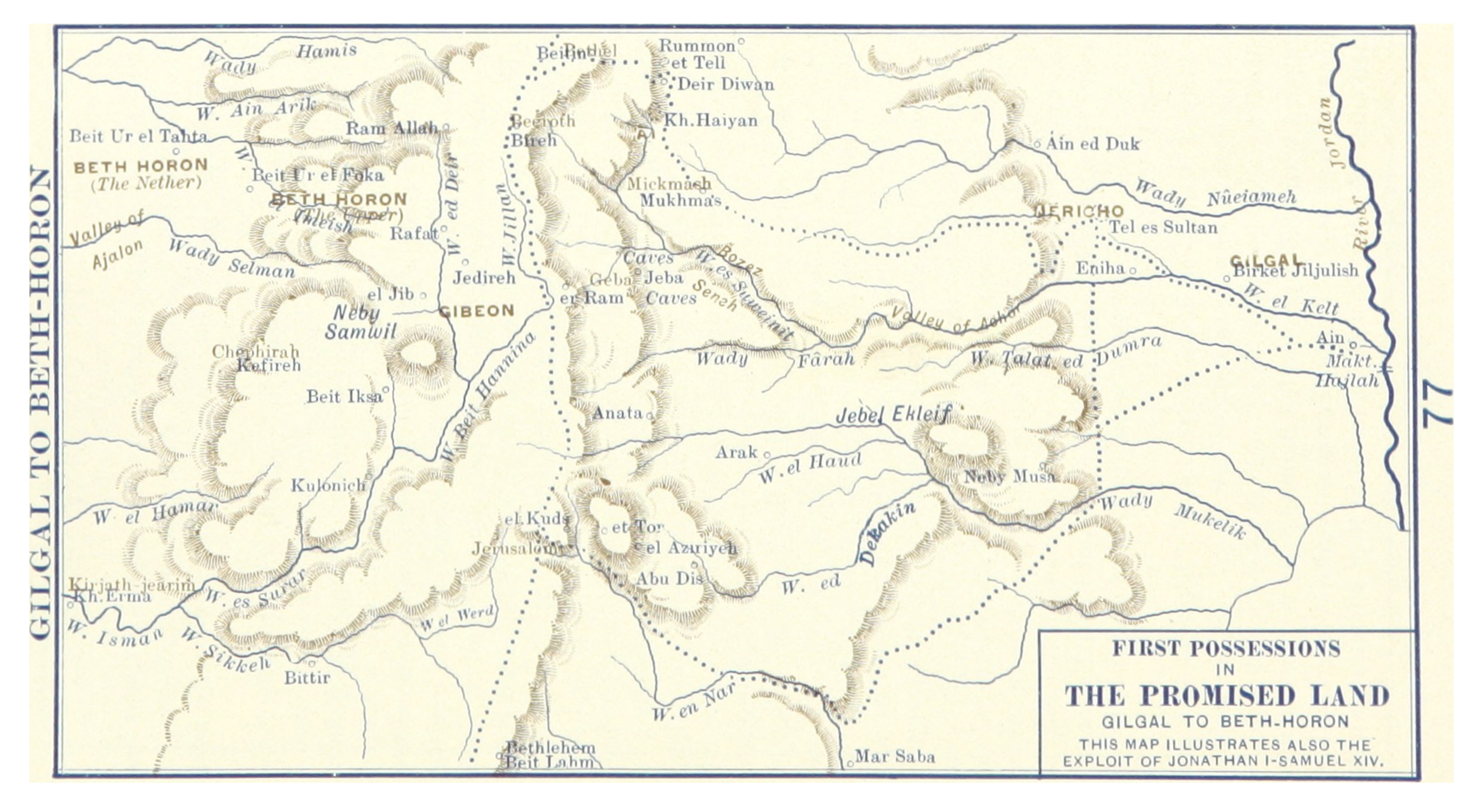
First Possessions in the Promised Land: Gilgal to Beth-Horon — from Maccoun's The Holy Land in Geography and in History (1899). The city of Ai is labeled in the central highlands. Public domain.
What You Are Looking At
This 1899 Maccoun map is subtitled “First Possessions in the Promised Land — Gilgal to Beth-Horon,” and it charts the precise geographic corridor at the heart of the Battle of Ai. Gilgal, Joshua's base camp near the Jordan River and Jericho, appears on the far right of the map. Jericho is also visible on the eastern end. From Gilgal the terrain climbs steeply westward into the central highlands, where in the upper center of the map you will find the city of Ai labeled — located in the hill country, positioned east of Bethel, which appears close by. This is the precise location described in Joshua 7:2 as “Ai, which is beside Beth Aven, on the east side of Bethel.” The dotted route line traces the path Joshua's forces traveled from their base at Gilgal up into the highlands to engage Ai. Gibeon also appears on the map, slightly south and west — the city whose treaty with Joshua would trigger the Southern Campaign that followed. Beth-Horon on the left side of the map marks the western end of this crucial corridor through which all movement between the coastal plain and the central highlands was funneled. The map note states that it also illustrates the exploit of Jonathan in 1 Samuel 14 — confirming that this same strategic corridor was militarily significant for centuries after Joshua's conquest.
“And the Lord said to Joshua: Do not be afraid, nor be dismayed; take all the people of war with you, and arise, go up to Ai. See, I have given into your hand the king of Ai, his people, his city, and his land... You shall set an ambush for the city behind it.”
— Joshua 8:1, 2 (NKJV)
The First Defeat — Achan's Sin
The story of Ai in Scripture does not begin with victory. It begins with humiliating defeat, and the cause of that defeat is one of the most sobering object lessons in the Old Testament. After the miraculous fall of Jericho, Joshua sent scouts to assess Ai — a smaller city in the central highlands about 15 miles northwest of Gilgal. The scouts returned confident: two or three thousand men would be sufficient. Three thousand went up. They fled. Thirty-six Israelites were killed in the rout as the men of Ai chased them down the slope. The hearts of the people melted and became like water.
Joshua fell on his face before the ark of the covenant and cried out to God. The divine response was direct: “Israel has sinned, and they have also transgressed My covenant which I commanded them. For they have even taken some of the accursed things” (Joshua 7:11). A systematic investigation narrowed through tribes, clans, and families until it landed on Achan of the tribe of Judah. He had hidden a beautiful Babylonian garment, 200 shekels of silver, and a wedge of gold in his tent — items taken from Jericho despite the divine command that everything in Jericho was devoted to destruction (Hebrew cherem). Achan confessed. He and his household were taken to the Valley of Achor and stoned. The name Achor means trouble, and the valley became a memorial to the truth that hidden sin cannot be hidden from God.
The Ambush Strategy
After the judgment of Achan, God instructed Joshua to take the entire army and attack Ai again — this time with a strategy of deliberate deception. Joshua divided his forces. A strike force of 30,000 men was sent out at night to position themselves in ambush to the west of Ai, between the city and Bethel, cutting off any route of escape or reinforcement. Joshua himself approached Ai from the north with the main body of the army the following morning.
When the men of Ai came out to fight, Joshua executed the critical maneuver: he and the main force turned and fled in apparent retreat, drawing the entire army of Ai away from the city in pursuit. At precisely the moment the city was emptied of its defenders, Joshua stretched out his javelin — the pre-arranged signal — and the ambush force rose from hiding, entered the undefended city, and set it on fire. When the men of Ai looked back and saw their city in flames, they were caught between two converging forces with nowhere to go. The city was utterly destroyed, 12,000 people were killed, the king of Ai was captured alive, executed, and his body hung on a tree until evening, then buried under a heap of stones at the city gate.
The Covenant Renewal at Mount Ebal
Immediately following the victory at Ai, Joshua led all Israel on a march to Mount Ebal, near Shechem, approximately 25 miles north. There he built an altar of uncut stones, offered burnt and peace offerings, wrote the Law of Moses on plastered stones, and read the entire law — blessings and curses — to the assembled nation. This was not a pause in the military campaign. It was the theological foundation of the entire campaign. The land was being taken not for political power but in obedience to the covenant of God, and that covenant was renewed in the very heart of Canaan before the conquest was half complete.
© 2026 Michael Knighton | Christians Standing With Israel™ | All Rights Reserved